Beneath today’s termination of Mike Price’s contract as head basketball coach at Rutgers University lies a very common story about the way many people in leadership positions now function and operate day-in and day-out.
 It’s interesting to see how much indignation about this.one.incident comes pouring forth, while the larger problem – and the bigger picture – is virtually ignored.
The reality is that this is a vivid example of a now very-common story line that shows how abuse of all kinds is allowed (and, often, encouraged), tolerated, and committed by people in leadership positions throughout every segment of society today. Committing abuse is present in some shape or form in every organizational construct today. It’s a reflection of a society that has come to accept the existence of abuse as being normal. As quintessential leaders, it is imperative that we are discerning and attentive so that we recognize abuse, no matter how subtly-shaded it is, and reject it as wrong and eliminate it wherever it exists.
Mike Price’s story as an abusive coach at the collegiate level is not unfamiliar. Bobby Knight at Indiana University and Woody Hayes at Ohio State come to mind almost immediately.
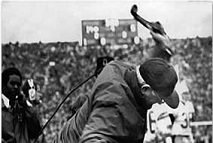 However, as I discussed last year in “Absolute Power Corrupts Absolutely,” regarding Penn State and which I discuss in detail in one of the components of Building Trust and Being Trustworthy, all of the people in leadership positions at Rutgers have shown unquintessential leadership in this matter. Because this is the second time in 16 years, that we know of, this kind of abuse has occurred with Rutgers’ athletic program – it is obvious that allowing, tolerating, and committing abuse is accepted as standard operating procedure among those in leadership positions at Rutgers. And when those in leadership positions at an organization accept abuse, abusive behavior spreads throughout the organization.
But frequency of occurrence is not the most damning evidence that those in leadership positions at Rutgers University accept abusive behavior as being normal and okay. The back story to Mike Rice’s termination today, however, is.
One of Rice’s coaching assistants, Eric Murdock, brought Rice’s abusive behavior toward players – recorded on video from practices from 2010-2012 – to the attention of Rutgers University’s athletic director, Tim Pernetti, early last summer. Rice fired Murdock in July 2012. Pernetti suspended Rice for three games and fined him $50,000 in December 2012 after the attorneys for Murdock, who sued Rutgers University for wrongful termination, produced video proof of Rice’s abusive behavior toward his players in November 2012.
If Murdock had not threatened to release the video tape to larger audiences, this would have been the only action that Rutgers University would have taken against Mike Rice. However, once the video became public, then those in leadership positions at Rutgers University – and this includes those in executive leadership positions outside the athletic department – decided the behavior of Rice was egregious enough to terminate his contract with the university.
And therein lies an unquintessential leadership philosophy: it’s okay to do the wrong thing as long as you don’t get caught and/or no one else knows or finds out about it. Everyone in a leadership position at Rutgers University clearly embraces and believes this philosophy. By extension, this philosophy is being passed on as acceptable and normal to every student who attends Rutgers University. What does this say about how these students will act and behave when they get into leadership positions in their careers?
Think about that carefully for a while. It should make all of us in leadership positions and we, who are striving to be quintessential leaders in every aspect of our lives, stop and take stock of our own actions, behaviors and beliefs. Do we allow abuse? Do we tolerate abuse? Do we encourage abuse? Do we commit abuse? If we do, then we need to change completely. If we don’t, then we need to stay vigilant to ensure that what has become normal and acceptable behavior among those in leadership positions doesn’t sneak into our behaviors, beliefs, and actions or into the behaviors, beliefs, and actions of our teams.
Inevitably, many people in leadership positions may look at Mike Rice’s behavior and think “well, I’ve never cursed at, thrown things at, or physically pushed around those I lead, so I have never been abusive to anyone I’ve led or lead.” That is very dangerous thinking, because abuse has many faces.
We, as quintessential leaders, as I’ve said many times must be brutally honest with ourselves in examining who and what we are and do to ensure that the person we’re not the most dishonest with is ourselves. This is not easy, but it is absolutely necessary. Let’s all ask and answer the following questions about ourselves in our fearless self-examination of whether we have been or are abusive.
Have I ever implicitly or explicitly threatened someone because that person pointed out something wrong or flawed or inconsistent in me or my behavior?
Have I ever publicly embarrassed or harassed someone to try to force that person to agree with me or see things from my point of view under the guise of helping that person?
Have I ever used the “I’m in charge and if you don’t like it, you can leave” statement to try to intimidate someone who had a different – but not wrong – perspective and/or opinion than I did?
Have I ever used the “silent treatment” to try to manipulate someone into agreeing with or going along with me?
Have I ever talked over someone’s head in an attempt to make that person feel inferior or ignorant?
Have I made general disparaging comments about the intelligence, the quality, the substance, and the efficacy of my teams to put them or keep them “in their place?”
If we answered “yes,” to any of these questions, we’re guilty of having been abusive. And this list of questions is not exhaustive. I urge all of us to think deeply about this subject and identify abuse so that we understand what it is we are fighting and must not allow to become part of our way of being or thinking or doing or speaking.
As human beings, we all tend toward abuse as a defense. It seems to be hard-wired into who and what we are. But, as quintessential leaders, we hold ourselves to a higher standard and part of that higher standard is treating everyone as we ourselves want to be treated. You don’t want to be abused. I don’t want to be abused. And it must be our highest priority not to be abusive in any part of our lives.
I spoke of the courage that quintessential leaders must have in my last post. This is a concrete example of what that courage looks like.

 My friend Gavin was telling me about a conversation he had with some Dutch colleagues. Gavin, and his compadre Georgina, find that the sheer volume of work they are confronted with on a weekly basis is just un-doable within the confines of a normal 8-hour work day. So they regularly put in 10-hour days at the office. And another couple of hours at home picking up emails. This causes all sorts of problems: they’re tired all the time, their spouses feel ignored, they don’t want to go out at night or over the weekend and they lose touch with friends.

 In life you would always have two options for everything. That’s why we are tagged as byproduct of the choices we make in life.



 The Quintessential Leader