Archive for the ‘Quintessential Leadership’ Category

General Motors Gets a Slap on the Wrist for Defective Ignition Switch and 124 - So Far - DeathsUpdate 9/18/15:

The number of deaths linked to the defective ignition switch – a $5 part that could have been easily fixed – that General Motors knew about for years and yet sold millions of cars with them has risen to 124 (that number will most certainly go higher).

It was announced on September 16, 2015 that “In a settlement with prosecutors, no individual employees were charged, and the Justice Department agreed to defer prosecution of the company for three years. If G.M. adheres to the agreement, which includes independent monitoring of its safety practices, the company can have its record wiped clean.”

Update 12/14/14:

42 deaths from car accidents in General Motors models have now been linked to the faulty ignition switch problem. 

Update 11/11/14:

unquintessential leadership gm delphi ignition switch deathEmails uncovered by the Wall Street Journal show that General Motors ordered a half million redesigned ignition switches from Delphi two months before the auto manufacturer issued a recall on some – but not all – vehicles with the defective ignition switch installed.

As of October 30, 2014, the number of deaths acknowledged by GM to be directly linked to the faulty ignition switch has risen from 13 to 30.

However, General Motors continues to maintain that the people in leadership positions – the executive team – in the company had no idea about the ignition switch problem, the order to Delphi for replacement ignition switches that cost GM approximately $3 million, or the need for a general recall.

yellow-dividing-line

General Motors’ 2nd quarter profits, posted on July 24, 2014, dropped 85% from their 2nd quarter 2013 profits. Frankly, it’s incredulous to me, given the financial hit the U.S. automaker has taken in massive recalls due to years of knowingly using substandard and faulty equipment, which is directly tied to 13 known fatalities, that General Motors (GM) is making any profit at all. 

To those GM customers who’ve been impacted by the lack of quintessential leadership that has been in place at the auto manufacturer for decades – and, in my opinion, still could be with the current GM CEO Mary Barra, who began her career with GM since 1980 with a degree in electrical engineering, and in leadership positions within the company since earning her MBA in 1988 – that GM has any profits at all is likely a bitter pill to swallow.

faulty ignition switch unquintessential leader general motorsI will not recount the entire unquintessential leadership history of GM here. That would be a book to write and with writing a new book already currently in the works, I don’t have time to commit to another. However, I will highlight several areas where unquintessential leadership existed/exists and will include links that provide more detailed information about them.

The paramount unquintessential leadership trait of GM is they routinely put corporate profits above the safety of their customers

Starting in 2003, GM engineers redesigned and ordered modified ignition switches – with a torque setting that was below GM’s minimum requirements – from its supplier, Delphi. The cost of an ignition switch? 57 cents.

From 2004 to 2013, thirteen fatalities occurred involving GM cars that had the modified ignition switches installed. All but one of the accidents were single-vehicle crashes where the drivers lost control and crashed head-on into something, in most cases a tree. In none of the crashes did the airbags deploy.

Additionally, beginning around the same time period as the first accident, GM car owners began reporting that their midsize and compact-size vehicles were randomly and intermittently shutting off while they were driving them. 

In the 2004 crash involving a Saturn Ion that killed Gene Erickson, GM told federal investigators, who couldn’t understand why the car suddenly swerved into a tree and the airbags didn’t deploy, that the company didn’t have any answers as to why either.

However, just a month before GM talked with federal regulators about the accident, a GM engineer had concluded that the Ion had probably lost power, which would have prevented the airbags from deploying.

Investigations into fatal car accidents where mechanical failure is the most plausible explanation involve the National Highway Traffic Safety Administration contacting the automobile manufacturer to see if (a) they have any similar reports; (b) if their engineers have determined a cause, using the car’s “black box” data; and, (3) whether it is an isolated problem or one that could require a general recall.

GM showed its unquintessential leadership trait of self-centeredness when decided to lie and obfuscate in the Erickson case because of money. Fines for an inexpensive part not meeting the company’s minimum standard, a possible lawsuit by Mr. Erickson’s family, and a large recall would have cut into GM’s profits. The shareholders wouldn’t be happy. People might lose their jobs. 

Therefore, GM’s response to federal inquiries into the subsequent 12 fatalities involving GM cars where mechanical failure was suspected was the same: silence.

Two other unquintessential leadership traits at GM are deception and dishonesty.

faulty ignition switch unquintessential leader gm general motorsIn 2009, despite years of knowledge about the faulty ignition switch and substantial evidence of conscious coverups by GM employees at every level in the company, GM engineers finally began to internally and quietly increase the torque on the faulty ignition switches.  

(And, despite what GM executives have testified to under oath, these engineers had the consent and knowledge of every person in a leadership position in every department – including the legal department, whose head denied any knowledge of the problem until this year – at GM.

To suggest otherwise is dishonest, which is why it remains to be seen if Ms. Barra will become a quintessential leader or will continue in the unquintessential leadership tradition that has, so far, defined GM’s leadership.)

However, when GM’s engineers made the change to the ignition switch, instead of creating a new part number for the ignition switch with the higher torque, which is standard operating procedure when any change is associated with a part or item to distinguish it from similar parts and items, they used the same part number assigned to the faulty ignition switch. This was clearly an act of deception and dishonesty.

(A simple example of distinguishing similar items by part number is how the part numbers of different wattage light bulbs might read: 40-watt bulb (40WBLB); 60-watt bulb (60WBLB); 100-watt bulb (100WBLB); and, 50-100-150-watt bulb (50100150WBLB).) 

The 2.6 billion recall of GM cars now underway is directly related to this deception and dishonesty. Because the two ignition switches didn’t have unique part numbers, there is no way of telling whether GM car owners have the defective switch or the corrected switch. Therefore, GM is having to replace all ignition switches in all GM cars with that part number.

Ms. Barra has a lot left to prove that she is not the latest GM CEO to be an unquintessential leader. When a CEO, who has insurmountable evidence to the contrary, states about a month ago that “I don’t really think there was a cover-up”, followed  by a lot of justifications and excuses, it is clear that Ms. Barra has absorbed a lot of the GM unquintessential leadership in the 34 years she has been employed there and, even if it’s possible, it will take a lot of time and effort to change what to her is a normal definition of leadership.

As always, it’s easy to look at a big corporation like General Motors and objectively see the unquintessential leadership within that company and shake our heads and perhaps even pat ourselves on the backs because “we’re not like that!”

But are we? Maybe not in all areas. Maybe not on the same scale in terms of causing peoples deaths and tanking corporate profits.

But here’s what we need to remember. Even one instance of unquintessential leadership that we don’t learn from and change immediately or just one unquintessential leadership trait that we are unable or unwilling to change, no matter how few people it affects, no matter the scale of the effects, puts us in the same boat as the unquintessential leadership at GM.

There are no degrees of right or wrong, good or bad, quintessential leadership or unquintessential leadership. It either is or isn’t. We either are or aren’t. 

Therefore, my fellow quintessential leaders, we should take a close and thoughful look at why the people in leadership positions at GM are unquintessential leaders and examine ourselves in the light of the unquintessential leadership traits we’ve outlined today.

How are we doing?

Quintessential leadership is not theory. It is practical application in every area of our lives, not just something we aim for at work. In other words, becoming a quintessential leader requires action. Conscious. Consistent. Continual.

One thing that makes The Quintessential Leader blog unique is the focus on what quintessential leadership looks like – and doesn’t look like.

And there is always a call to action to look at ourselves and evaluate whether we are becoming quintessential leaders or are following the general trend of unquintessential leadership that we see around us.

Reading dry suggestions or formulaic bulleted lists won’t change you or me and our paths of leadership development.

However, examining specific areas of what quintessential leadership does and doesn’t look like and then holding that mirror up to our own lives can be a strong motivator for us to change.

Why?

When we are provoked, we have strong reactions to that provocation. The reactions will either be defensive – “I don’t do that!” or “That doesn’t apply to me!” – or they will be agreeable – “I’ve seen that and I’m trying to change that” or “That’s what I want to be like (or not be like).”

I’ve had some pretty strong reactions to this blog at times, mostly in the defensive category. I’ve even had people take posts so personally that they had the hubris to believe I was talking about them specifically.

I’ve found, though, that when people get really defensive or they take posts personally that they prove themselves to be exactly what they’re upset about.

And that’s okay. Because that’s the moment when they have the opportunity to see it for themselves and change it.

And that’s always my hope with this blog. Always.

Because I am a practical person who has no patience with imaginative theory and speculation, I always want to see what things look like in practice – practical application. If I can see something in tangible terms – good or bad – then I can both evaluate myself and see where I need to make changes.

quintessential-leadership-practically-applied-front-cover-smallWith that in mind, I wrote Quintessential Leadership Practically Applied.

And I’m including free downloadable chapter from the book – “Avoiding the Snake Oil Trap” – for you as a preview of the book.

Read it. Feel free to share it (please link back to the book if you do share it). Feel free to use it.

And if you find it useful, consider buying Quintessential Leadership Practically AppliedThe price is nominal, but the information is valuable.

I don’t charge a lot for my books because I want them to be affordable and accessible to everyone. I realize people spend considerably more each day on drinks, snacks, and lunch, so I price my books at considerably less than that daily cost to encourage people to spend a little money on something irreplaceable that they can use the rest of their lives in contrast to far more money on something temporary and replaceable.

Just food for thought. Pun intended.

Quintessential leaders strive to consistently take AND stay on the high roadTaking the high road is an idiom that describes a person who is consistently making the conscious choice to travel exclusively on the highest moral and ethical ground, regardless of what anyone else and everybody else is doing.

Taking the high road also characterizes a person who unwaveringly chooses to endeavor to do the right thing all the time, no matter what the circumstances.

Taking the high road is a choice. It is a choice that every human being on this planet decides to do or not do in every single situation we face. Taking the high road is a choice that quintessential leaders are committed to making continuously in every area of their lives for their entire lives.

Although we all fall short in consistently taking the high road at times, quintessential leaders distinguish themselves from everyone else by their determination, their tenacity, and their dedication to always taking the high road.

More than that, though, quintessential leaders work – and this is, I believe, the hardest work each of us has the choice to do in our lives, because it is the work of continual monitoring of and continual application of self-control in our attitudes, our motives, our thoughts, our words, and actions – diligently and tirelessly to also stay on the high road.

Before we look at what taking AND staying on the high road looks like in quintessential leaders, let’s see what the opposite looks like (unquintessential leaders).

Stop right now and think about everything you’ve heard, seen, read, thought, said, and done today up to this point. Everything. Do all of these things, added and averaged, tend toward taking AND staying on the high road?

If we’re unflinchingly honest – and that, my friends, is part of taking AND staying on the high road and unflinching honesty is scarce to non-existent in everyone and everywhere today – the answer will be “no.”

We humans tend to to like the low road because it appeals to the basest parts of our nature and it doesn’t make any demands on us.

We can be as dishonest, greedy, vitriolic, accusatory, condemning, condescending, mean, blaming, disrespectful, profane, and all-around-nasty as we want to be because that’s, unfortunately, the easiest way for us to be.

Sadly, it makes us feel smug and victorious to lie and get away with it, steal and get away with it, accuse others, condemn others, to put everybody in their place, to say whatever is on our mind however we want to say it (“and if they don’t like, well they can just get over it, because it’s our right!”) and never apologize for anything we say or do.

It’s all around us. Everybody’s doing it. And when we take the low road and stay on it, we fit in with everyone. We are popular. We get the kudos. We get the laughs. We get the “attaboys.” We get the praise and the glory.

And these things, which have kicked our natural tendancy as humans to be narcissistic, selfish, and self-absorbed into high gear with the ubiquitous intrusion of technology into our 24/7 lives, are incredibly powerful motivators to continue to choose to take and stay on the low road.

I’m a keen observer of people and human nature. There’s very, very little that I miss.

Why?

Because instead of talking, I listen. To every word. To every context. To every nuance.

Instead of engaging in frenzied action to constantly be the center of attention, I carefully watch actions and behavior and I process and I analyze.

Just this week, I can think of three public figures who have clearly taken and decided to stay on the low road. The interesting thing that I have observed in the process is that we all, with the exception of the rare quintessential leader here and there, identify with and side with these people because we’ve decided to take and stay on the low road ourselves.

Tom Brady takes the low roadThe first public figure is Tom Brady, quarterback for the New England Patriots. The quarterback of a football team is in a leadership position (but that seldom means they are quintessential leaders).

Brady was involved in deflating footballs for the Super Bowl game in January 2015. His team won the game. 

Whether the deflation of the footballs actually had anything to do with the outcome of the game is irrelevant. The obvious cheating to put the game in the Patriots – and Brady’s – favor, however, is totally relevant.

The NFL found Brady complicit in the attempt to throw the game and suspended him for four games in the 2015-2016 season.

Now Brady is claiming to be the victim and is blaming everyone else for the deflated footballs. He’s saying he cooperated with the investigation – in spite of the fact that he destroyed the cellphone he used in that game – and the NFL is not being fair.

And a lot of the public agrees with him. Despite the cheating, the dishonesty, and the finger-pointing, most of the public believes that this is not a big deal and that it’s certainly not a punishable offense, and that Brady is getting a raw deal being suspended from playing four games.

The majority of us have chosen to take the low road and stay on it.

Donald Trump takes the low road in everything he is, says, and doesA second public example of someone taking the low road and staying on it is Donald Trump, one of the 2016 Republican presidential candidates.

Trump, who epitomizes narcissism, is intentionally and brutally offensive, using sarcasm, finger-pointing, condemning, and outright lying in both his actions and his words.

There is no filter on his mouth: everything he says is exactly what he thinks and believes and he doesn’t care who or what is on the receiving end of it.

And he doesn’t see anything wrong with his behavior, so he never backs away, never backs down, and never, ever apologizes for anything. Pride and arrogance are often an integral part of taking and staying on the low road.

And, yet, incongruously Trump has vaulted to the top of the list of most political polls, both on the national and state level.

John Heilemann, a co-managing editor for Bloomberg Politics, did a focus group meeting with Trump supporters in New Hampshire this week to find out why they supported him. I saw a short excerpt this morning, and one of the prevailing reasons is “because he’s one of us.”

That’s an incredible admission that these people probably weren’t even aware they were making. But what they said was, in essence, we’ve chosen to take and stay on the low road and we like Trump because he’s made the same choice we have.  

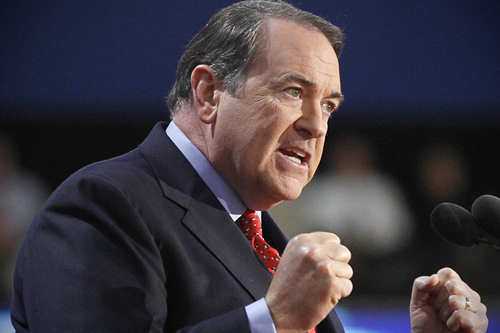
Mike Huckabee chooses to take the low road to get a spot in the Republican debateA final public example is ordained Baptist minister and former Arkansas governer Mike Huckabee, another of the 2016 Republican presidential candidates. 

It appears that Gov. Huckabee is so desperate to make the final cut of participants in the first Republican debate on August 6, 2015 that he is willing to follow Donald Trump’s example in choosing to take and stay on the low road.

Earlier this week, he declared that the pending nuclear deal between the United States and Iran is equivalent to the actions of the Germans’ genocide of the Jews in the Holocaust: ““This president’s foreign policy is the most feckless in American history. It is so naive that he would trust the Iranians. By doing so, he will take the Israelis and march them to the door of the oven.”

While there are legitimate concerns with this pending agreement that should be addressed, Gov. Huckabee’s headline-grabbing hyperbolic and incendiary language represents the low road. The high road would have been to actually talk about the real issues regarding this agreement and how he would rectify those.

What is even more damning for Gov. Huckabee, however, is that in 2008 he proposed the exact same path of this agreement according to the Des Moines Register: “Huckabee wrote in Foreign Affairs that ‘all options’ must be put on the table in dealing with Iran to avoid a military confrontation with them. He said at the time that the real winners in such a war would be the Sunni extremists who attacked America on 9-11. Iran is a Shiite Muslim nation.

Huckabee called then for the establishment of a sanctions regime against Iran coupled with direct negotiations with that country.”

Despite a strong negative backlash to his inflammatory and contradictory statement, Gov. Huckabee has continued on the low road by refusing to backtrack on the harshness of his rhetoric and to acknowledge the inconsistency with his position seven years ago.

Now that we’ve seen what choosing to take and stay on the low road looks like, what does choosing to take AND stay on the high road look like? Since we are striving to be quintessential leaders in every area of our lives, it’s not only important to know what we should not do, but also what we should do.

Quintessential leaders choose to take AND stay on the high road by:

  • Always thinking before we speak, making sure our words are not sarcastic, condemning, mean, accusatory, disrespectful, condescending, bombastic, insensitive, and hurtful. A lot of times that process means simply being quiet until we have the time and perspective to deal with our thoughts and our words properly.
  • Always considering how our words and actions will affect other people. The simple test we run everything against is “will what I want to say or do hurt, harm, or help other people?” Notice that quintessential leaders are outward-focused (they are never “it’s all about me“), which is a high-road characteristic. If it will hurt or harm other people (dishonesty, greed, stealing, crushing someone with less strength just because we can, etc.), then we don’t do or say it. If it will help others, then we ensure that we do or say it in a way that is respectful, kind, gentle, generous, and completely without strings attached.
  • Always refusing to choose to stoop to the low-road level that others may choose to take by refusing to respond at all by arguing, retaliating, attacking, badmouthing, either to their faces or behind their backs, and seeing if we can go even lower than they are going.

The high road is at times a difficult choice for all of us to make because it seems we’re naturally wired for the low road. But quintessential leaders are those rare people who choose to fight and struggle and wrestle with themselves (and this goes on almost constantly at an internal level) to take AND stay on the high road.

It is a lifelong war that we all lose battles in from time to time. But winning this war should be the goal that every quintessential leader has. And the only way we can win it is to do it.

We each need to look deep inside our own lives to see whether we have chosen to try to take AND stay on the high road everywhere, every time, all the time in our lives.

Or have we chosen to take and stay on the low road for all the wrong reasons?

How are we doing?


U.S. Bill of Rights 1st Amendment to the Constitution“But it’s my right!”

“I can say whatever I want, however I want, whenever I want, to whomever I want and nobody can stop me. I have rights!”

“I’m entitled to my opinion and if you don’t like it, then you just need to get over it!”

Sound familiar? If it doesn’t, then you must be accessing this post from a desert island where you’ve been cut off from the rest of civilization for the last 50 years.

Welcome to The Quintessential Leader blog, to the year 2015, and to present reality.

This post will discuss not only what freedom of speech looks like in quintessential leaders, but it will show how quintessential leaders decide what to say or write and what not to say or write.

This is a relevant and important topic especially because it seems where we are most able to determine whether we are quintessential leaders or not today is to look at our speech in cyberspace: emails, texts, social media, and blogs.

We can all talk a good game, but it’s often here where the truth behind all that talk is revealed. 

Quintessential leaders understand, first and foremost, that every word they speak or write is a reflection of who and what they are from the inside out.

In other words, how quintessential leaders exercise their freedom of speech reflects their character.

Therefore, quintessential leaders are very thoughtful before they commit words to speech or in writing.

While quintessential leaders may technically have the right to say or write anything, anywhere, anytime, they always ask the first right question – “Should I?” – right off the bat.

That eliminates a lot of speech and writing before any other analysis needs to be done.

If, however, further analysis needs to be done, quintessential leaders use the overarching principles of building trust and being trustworthy – forged through experience and wisdom – to identify the criteria that their words must be filtered through and determined against before they are said or written.

Quintessential leaders discern the intent of the words they are considering speaking or writingOne of those criteria that quintessential leaders use to determine whether to say or write something is intent.

Is it demeaning or denigrating to other people? Does it contain words like idiotmoronstupidretard?

Those are the most common demeaning and denigrating words used, but there are many others.

If it contains any of these kinds of words, quintessential leaders will reject them from what they speak or what they write or share or endorse.

Is it argumentative? For those of us who have used the internet since it became available to the masses, we remember the term flame wars to describe speech that was intended to be argumentative.

Flame wars were – and still are – started by someone who wants a speech melee and often consists of speech that is so outrageous and offensive that an all-out war ensues. And, once the war starts, nothing is out of bounds, and all the speech goes downhill from there.

Quintessential leaders reject argumentative speech. They will not initiate it, nor will they engage in it. 

Is it inciting? There are many things that divide humanity today and because we, as a species, are all up in arms about “our rights,” there’s an ample supply of inciting topics to speak or write about.

Inciting is the same thing as baiting. It’s a come-hither designed to provoke a strong emotional reaction that will lead to a response in terms of action (usually negative).

The Charlie Hebdo attack in Paris in January 2015 was the result of inciting cartoons the publication repeatedly and intentionally created (and I am in no way defending or sanctioning retribution of this sort or any other: quintessential leaders don’t pay back or get even because that would be inconsistent with their character; instead, they forgive and move away from and move beyond the offenders), knowing what the impact would be.

But look anywhere in the world of technology – emails, texts, social media, and blogs – all over the globe and it abounds everywhere. Look at your newsfeed on Facebook today – July 22, 2015 – and look at all the posts about “rights” that are intentionally inciting that fill your page.

Quintessential leaders reject all speech, written or spoken, that is inciting. It has no place in what they write or say or share or endorse.

Quintessential leaders determine the appropriateness of the words they speak and writeAnother criteria that quintessential leaders use to evaluate the words they speak and write is appropriateness.

There are several aspects of appropriateness that get overlooked in the speech that we write and we speak.

Is it vulgarsuggestive, or profanity-laden? If it is, then quintessential leaders will reject it outright from the words they write and the words they speak.

But here’s a nuance of this that a lot of people simply don’t filter and this really makes quintessential leaders stand out as exceptions. 

While the content itself is not vulgar, suggestive, or profanity-laden, in the case of sharing or endorsing on social media, the site it’s being shared from is. It never ceases to amaze me how much of this happens on a regular basis.

Quintessential leaders look at everything and if there is anything anywhere that is inappropriate, they reject it completely as acceptable speech.

Quintessential leaders analyze the impact of the words they speak and writeA final criteria that quintessential leaders use regarding speech is its impact.

Is it disrespectful? Disrespect is commonplace in our society. Although at times its impact is supposed to be diminished by characterizing disrespect as a joke, in the end it is still disrespect.

There are many ways to disrespect others, but speech that impugns motives not in evidence, that points out personal and private flaws and issues, that condemns obliquely (the person/people being condemned is/are unnamed), and that viciously attacks people who are unable to defend themselves (this is bullying, by the way, and adults do it just as much, if not more than, as kids do) are the most common forms of disrespect.

While quintessential leaders may address big-picture issues and things they find legitimate fault with and/or disagree with in the speech they use in writing and speaking, they are always careful to show respect in these areas. When we stop being decent human beings to each other, then we cannot claim to be quintessential leaders.

Is it libelous? Speech that directly attacks another human being by name – quintessential leaders don’t do this because the reality is that none of us can really be inside the head, the heart, the soul of another person and it’s always wise to give the benefit of doubt – is never a good idea.

For a lot of reasons.

First, even if there’s no legal action taken, we’re all on shaky ground with things we cannot definitively prove through firsthand knowledge or by factual evidence.

Second, many reputations have been ruined by these kinds of attacks which were based on innuendo and rumor. When the facts later negated the attack, it was too late for the person attacked to recover.

Third, put yourself in the person’s shoes that you want to attack and smear by name. Would you want someone to do that to you? I don’t think any of us would, but this is one of the many things that quintessential leaders consider in the speech they choose to write and speak.

Does it give a negative and/or false impression about us? I don’t think many of us really consider what our speech says about us. I think if we did – and quintessential leaders always do – we would be much more circumspect about what we say and write or share and endorse (social media).

Now is the point where each of us, striving to be quintessential leaders, need, not to look at everyone else, but to look at ourselves in how we use the freedom of speech in what we say and what we write.

What is the intent of the words we speak and write and share and endorese (social media)?

Is the speech that we use to say and write and share and endorse (social media) things appropriate?

What impact does the speech that we speak with, write with, and share and endorse (social media) have?

How are we doing?


Authenticity is Who and What Quintessential Leaders AreA discernible trait of quintessential leaders is that we are continually striving for authenticity in every part of who, what, and how we are. It is an easily-identifiable part of our character which is borne out by our behavior.

One of the easiest aspects of behavior that shows us what both unquintessential leadership and quintessential leadership looks like is in our verbal and written communication with others.

Whether we are authentic or unauthentic is plain to see by what words we say and write and how we say and write them. 

The words we choose and the method we use to convey those words provide vital insights into whether we are striving for authenticity or whether we are, at the heart, core, and soul of who we are, either struggling with inauthenticity or we are truly committed to being inauthentic as a matter of course.

I make the distinction between struggling with inauthenticity and being committed to it because it’s important for all of us to understand that quintessential leaders will struggle at times with inauthenticity, while unquintessential leaders don’t struggle at all with it because being inauthentic is a committed way of being for them.

So what makes the difference between struggling with inauthenticity and being committed to it?

Awareness is the difference.

Quintessential leaders who are being inauthentic are not aware of being inauthentic, but as soon as they become aware of the inauthenticity, they commit to changing it immediately.

Unquintessential leaders, on the other hand, are fully aware of being inauthentic and are determined to remain inauthentic.

How do I know this? Because I’ve struggled with inauthenticity at times and not even realized it. However, once it hit me between the eyes, opening my eyes to an area of inauthenticity, I immediately made and fulfilled the commitment to change it.

Not being aware of inauthenticity is a part of the growth cycle for humans and the mature development of quintessential leaders (if all of us were already perfect, we’d have absolutely nothing to do and no place to go and life would be interminably boring and meaningless). 

However, it is often the case – to our shame and discredit – that as we who are striving to be quintessential leaders are unaware of our own areas of inauthenticity, we are eager to and constantly pointing, in public venues and in condemning language, out the areas of inauthenticity in other growing-into-quintessential-leaders who are unaware of their own areas of inauthenticity. 

This is unquintessential leadership behavior. Quintessential leaders examine themselves and they focus on changing what they need to change. They do not constantly exalt themselves as paragons of virtue and continually look around at everyone else and proclaim, for the whole world to see, their faults and shortcomings.

Instead, they work diligently to be an example, in every area of their lives, of what quintessential leadership looks like. They know that action – their own work on themselves – can be a powerful motivator and teacher for everyone with whom their lives intersect.

They also know that constant and public criticism and condemnation is not only a powerful demotivator, but a lousy example for anyone to follow and emulate (unfortunately, human nature tends toward this kind of behavior, so there are always plenty of admirers and supporters in criticism and condemnation of other people).

So before we look at what authenticity in communication looks like, let’s first look at what it doesn’t look like.

Vladimar Nabokov wrote, “Words without experience are meaningless.” I would clarify this to say that any words spoken or written without experience or empathy (literally the ability and choice to walk in the shoes of someone else’s experience and understand that experience from their perspective) and compassion are meaningless.

Inauthenticity in communication says and writes words that are empty and hollow because the person communicating them either has never experienced what they are communicating about or they lack empathy and compassion, choosing to assume they know something they don’t or choosing to pass judgment without facts, without understanding, and without knowledge.

This is unquintessential leadership because pride and arrogance are behind the communication as well as a total lack of kindness and gentleness. In other words, the communicator believes, even though they don’t have clue nor do they care what they’re talking about, that they are entitled to say or write the words as well as being harsh and condemning in the process.

Inauthenticity in communication is also evident in the common behavior of simply parroting cliches, “conventional wisdom,” and idioms because it seems like the right thing to say or write.

There is no thought or depth that goes into these utterances. In fact, this is the cheap and easy way out: we throw a well-worn phrase that sounds good and we’ve heard all our lives at someone else, check it off our list (while patting ourselves on the back for our generosity and benevolence toward the poor souls we communicated with), erase it permanently, and go blissfully on with our unimpacted lives without missing a beat.

Parroting as a method of communication is unquintessential leadership for a couple of reasons.

The first is motivation. We’re communicating something we’ve always heard – but most of the time have not had to put to the test of veracity through experience – because it makes us feel better, not because it will make the person we’re communicating with feel better.

The second reason parroting is unquintessential leadership is because we are not taking the person we’re communicating with into account at all. We don’t seek insight and understanding by taking the time to really listen to them – we may hear them, but there’s a world of difference between just hearing and really listening – nor do we take the time to think about the kind of communication we would want from someone if we were in the same or similar circumstances. 

By simply parroting something we’ve heard but have no evidence or proof of its value and/or truth, we effectively complete dismiss the person we’re communicating with and we tell them we don’t care about them and they are not important enough to us for us to waste our time with them.

So now that we know what it doesn’t look like, let’s discuss what authenticity in communication – quintessential leadership – does look like.

Unfortunately, as Nabokov stated, experience is often how we gain the ability to be authentic in our communication with other people. However, whether we have authenticity in our communication with others still comes down to us making the choice to be authentic.

Choosing authenticity in our communication with other people requires an investment from us. In them. In time. In effort. In carefulness.

In a society where unquintessential leadership abounds, as well as entitlement and “it’s all about me,” the selflessness required for this kind of investment has all but disappeared.

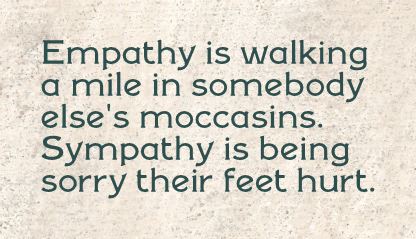
The difference between empathy and sympathyBut quintessential leaders know that they don’t have to have experienced something to be authentic in their communication with other people. And because of their commitment to developing unimpeachable character, two of the highly-developed traits they have are empathy and compassion for other people.

Empathy, like most of the other traits that make quintessential leaders trustworthy, is very rare and getting rarer. Most people believe that sympathy and empathy are the same thing and they are not.

Sympathy takes no long-term investment in another person: it tends to be a hands-off, “one-and-done” event.

Empathy, on the other hand, is a hands-on, long-term, hand-in-hand walk through the journey of – and with – another person. It is seeing through their eyes, understanding through their thoughts and emotions, and listening with interaction to know what is really behind their communication (often the words that are said or written have something else entirely behind them).

Compassion is always a by-product of and a companion of empathy. It is understanding, encouraging, invested, gentle, kind, and patient. It can be – and should be – the result of our own struggles, setbacks, and hard times in life. 

But because compassion and empathy are so interrelated, many people choose a lack of compassion because they offer only sympathy as a one-time-shot to other people.

These same people also, ironically, do everything in their power to evoke compassion toward themselves, including constant manipulation, self-exaltation, and telling everyone how they are not like all those other poor slobs in the world who don’t deserve anyone’s compassion.

This is the Scarlett O’Hara (Gone With the Wind) syndrome, because like Margaret Mitchell’s infamous anti-heroine, in the end, everything is all about them and they refuse to share the stage of life with anyone else.

Another area that demonstrates the authenticity of quintessential leaders in communication with other people is that quintessential leaders do not parrot cliches, “conventional wisdom,” or idioms. Instead, quintessential leaders consider carefully the impact of their words and how they use them.

Because quintessential leaders are invested in other people, they understand and are sensitive to the needs that exist.

Words have power and weightThey are also profoundly aware of the power of words, the impact of words, and the effect of words. 

They are not cavalier with words, simply letting whatever comes immediately to mind come out in their speech and writing. They always spend a considerable amount of time looking for ways to deeply and encouragingly communicate and avoiding hurt and offense. 

They know and understand that even words that may advocate a course correction should build up and not tear down. That can’t be done with parroting something someone else has said or something they’ve heard all their lives. It can only be done with original thought combined with empathy and compassion.

This is just one aspect of behavior that makes quintessential leaders rare in society today.

But each of us is striving to become a quintessential leader, so this must be a behavior we develop, grow, and exhibit everywhere in our lives and model for all the teams we lead in our lives. 

I say this often, but it cannot be repeated too much. If you breathe for a living, you lead at least one team in your life. Quintessential leadership is not confined to organizations, and can, therefore, be dismissed by everyone else. 

Somebody in your life is looking to you and depending on you to model leadership for them. It might be your children. It might be your students. It might be your family members. It might be your spouse. It might be your coworkers. It might be your friends. It might be the sports team you coach. It might be the volunteer groups you are involved with. It might be anybody.

So, as always, we must look in our own mirrors and conduct a thorough, extensive, comprehensive, and fearlessly honest evaluation of what our communication with other people looks like.

Are we inauthentic anywhere or everywhere in our communication with other people? 

If we are, is it because we lack awareness of our inauthenticity in our communication with other people?

Or is it because we’ve deliberately committed to a path of inauthenticity in our communication with other people?

If we find authenticity in our communication with other people, are we committed to preserving that and developing it to the point where it is literally a part of who and what we are all the time?

I can only answer these questions for myself. Each of you can answer them only for yourselves. Do we have the character and the courage to look, to see, to answer, and to change where and if we need to?

How are we doing?

What Transparency Looks LikeOne of the new organizational buzzwords is transparency. Today’s post will talk about what transparency looks like with quintessential leaders and what transparency looks like with everyone else.

You may be surprised to find that transparency among most people in leadership positions is illusionary, conditional, selective, and, in fact, is a lie because it doesn’t exist.

The word transparent at its simplest means to see through. Nothing is obscured, blurry, fuzzy, or out of view. Transparency, then, is the state or condition of being transparent. So anyone or any organization claiming transparency is describing their or its continual state or condition.

But is that true?

In most cases, the answer is “no.” While there is usually a lot of activity and A Smokescreen is Not Transparencycommunication to give the impression of transparency to the teams, what is done and what is said for everyone to see is essentially a smokescreen to keep teams feeling informed and included, while the real heart of the activity and communication – the business core – is conducted in secret behind closed doors among a small inner circle that has been sworn to secrecy.

So how do we know if a person or an organization is truly in a state or condition of transparency or not?

It’s quite simple.

Listen to them.

Anyone who or any organization that is constantly saying they are transparent is not.

People and organizations that are really see-through don’t ever have to say they are because it’s visible and obvious.

Only people and organizations with something to hide will make a conscious effort to regularly reiterate that they are committed to transparency. Just as liars will keep repeating their lies to try to convince others they are telling the truth, so will people and organizations that are not transparent who say over and over that they are.

So what are some key pieces of evidence that we can look for to see what transparency does not look like?

  1. A superficial and protective outer layer of smoke and mirrors that looks clear until it is placed on top of all the hidden layers and then nothing is clear. This looks like a plexiglass cover that is placed on top of wood-stained coffee table to protect it from damage and scratches.
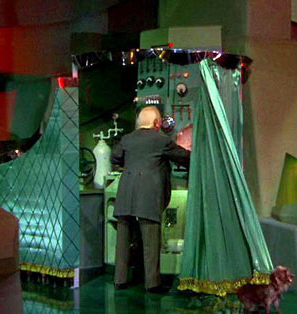
  2. The Wizard of Oz behind the curtainA continuous barrage of stimulating, but meaningless, information designed to deflect attention and shift focus away from the nuts and bolts of what’s really happening and what’s substantive. This looks like the Wizard of Oz behind the curtain projecting an illusionary image of reality.
  3. Saying one thing, but being the opposite. Actions always speak louder than words. There are far too many, since this reflects the majority of people who are currently in leadership positions, for me to name the most obvious examples I can see and think of. Look around your venue on the world. You won’t have to look far to find this behavior.

So then, now that we have seen what transparency doesn’t look like, since we are all striving to be quintessential leaders and transparency is a quality of quintessential leadership, then we must know what transparency does look like in action.

Real transparency lays all the cards on the tableReal transparency lays all the cards on the table up front. It takes a proactive approach to full disclosure of the facts and relevant circumstances, providing a big-picture framework to fully and completely encompass and describe the genesis and the outcome of decision-making.

Real transparency doesn’t sidestep controversy or issues, actions, words, etc. that are either perceived as a liability or were part of poor or ill-informed decision-making. We all have these in our realm of experience. 

Quintessential leaders, however, don’t try to sweep them under the rug and pretend they never happened, nor do they try to excuse, clarify, or blame them away. Instead, quintessential leaders own their missteps and mistakes and use them as teaching opportunities for the quintessential leaders they are developing on their teams.

The lessons of our failures and how we addressed and overcame them are the most valuable we can pass on to the next generation of quintessential leaders for several reasons.

First, future quintessential leaders understand that nobody is perfect and screwing up is sometimes part of the learning process.

Second, by our showing them step-by-step how we recovered, we are modeling a tangible and realistic example – showing them what it looks like in practice – of how to overcome, grow, and move forward.

Third, we are helping them, by sharing our experiences, hopefully not to repeat our missteps and mistakes. (When people portray themselves as perfect, there is no knowledge or experience to pass on to the next generation, who will find themselves in missteps and mistakes, but will model the unquintessential leadership example of no transparency that was modeled to them, ensuring that and perpetuating the same mistakes down the line to successive generations.)

Real transparency is WYSIWYGReal transparency doesn’t deceive, lie, or cover up anything. Everything’s an open book of reality, honesty, and what-you-see-is-what-you-get.

What unquintessential leaders don’t realize is that by not being transparent, they often spend most of their time dealing with the past (you will always hear more references to the past and especially to a mythical past of “glory days” than you will ever hear about detailed and actionable plans for how to navigate successfully through right here, right now and for navigating successfully through the future) and they, therefore, have little to no time to deal with the present and the future.

So, as always, we take the subject of transparency and we look critically, honestly and objectively into the mirrors of our own lives.

Do we faithfully practice total transparency in every aspect of our lives?

Do we practice transparency in some areas of our lives, but not others?

Do we not practice transparency anywhere in our lives?

Each of us can only answer these questions for ourselves. But we have to be willing to be honest and candid and to change, if we find anything less than total transparency in every aspect of our lives.

How are we doing?