The Kindle version of Building Trust and Being Trustworthy is now available on Amazon. You can purchase it here.
Archive for the ‘Myths and Misconceptions About Management’ Category
Kindle Version of Building Trust and Being Trustworthy Now Available
Posted: February 11, 2013 in About The Quintessential Leader Blog, Examples and Analyses of Lack of Leadership and Unquintessential Leadership, Examples and Analyses of Quintessential Leadership, General Things about Quintessential Leadership, Myths and Misconceptions About Management, Qualities of a Quintessential Leader, Quintessential Leadership, Quintessential Leadership is an Art, Team Building & DevelopmentTags: Amazon.com, authenticity, being trustworthy, building trust, character, consistency, eBook, honesty, integrity, Kindle, quintessential leadership traits, righting wrongs, setting a higher standard, setting boundaries, truthfulness
0
Building Trust and Being Trustworthy eBook Available
Posted: February 11, 2013 in About The Quintessential Leader Blog, Examples and Analyses of Lack of Leadership and Unquintessential Leadership, Examples and Analyses of Quintessential Leadership, General Things about Quintessential Leadership, Myths and Misconceptions About Management, Qualities of a Quintessential Leader, Quintessential Leadership, Quintessential Leadership is an Art, Team Building & DevelopmentTags: act today, authentic leadership, being trustworthy, building trust, don't follow the crowd, excuses, genuine leadership, lack of honesty, lack of trust, leadership pretenders, leadership traits, No one is guaranteed tomorrow, personal responsibility as a leader, personal responsibility in life, quintessential leadership, unquintessential leadership
Want to know the heart, the core, the soul of what being a quintessential leader is? It is building trust and being trustworthy. Without this, you cannot be a quintessential leader. Without this, you cannot be a leader. Period.
Let’s get real. It doesn’t matter how many platitudes you give. It doesn’t matter how many buzz words you use. It doesn’t matter how many leadership seminars you conduct, how many leadership articles you write, how many leadership lectures you give. If you are not living and being these traits of building trust and being trustworthy, then you are not a quintessential leader and your example, your seminars, your writing, your lectures are perpetuating a fraud on your teams, your students, your readers, and your audiences.
As quintessential leaders, our responsibility is to build trust and be trustworthy. We say that is who we are, but do we really know how far that commitment takes us? It’s definitely the narrow path, but to be genuine, authentic, and quintessential leaders and not wannabe’s, which is what we see around us in most of the people in leadership positions, we must commit and adhere to that. Otherwise, there will be no real leadership.
Let’s make sure we’re not pretenders. Let’s make sure we’re not following the crowd. Let’s make sure we know what we need to do – from our families, because this is where quintessential leadership starts, for our neighbors, for our teams, for our business units, for our organizations, for our towns, for our states, for our countries, for our brothers and sisters in the human race.
You and I have a personal responsibility to do this. It doesn’t matter whether anyone else is doing it or not. You and I answer for ourselves alone, not for anyone else. Anything less than ensuring that you and I are fulfilling our responsibility to build trust and be trustworthy is an excuse.
Quintessential leadership doesn’t have excuses. It is action. Let’s take action today. None of us is guaranteed tomorrow.
New Series Coming: Quintessential Leadership Analyses of Historical Leaders
Posted: February 11, 2013 in Examples and Analyses of Lack of Leadership and Unquintessential Leadership, Examples and Analyses of Quintessential Leadership, General Things about Quintessential Leadership, Myths and Misconceptions About Management, Qualities of a Quintessential Leader, Quintessential Leadership, Quintessential Leadership is an Art, Team Building & DevelopmentTags: angling, dishonesty, historical leaders, history, lies, quintessential leadership, spin, unquintessential leadership
Beginning this week, I will be starting a new series of posts that will evaluate how quintessential – or not – the leadership of well-known people in history that held leadership positions was.
This idea came as an outgrowth of a request from a very good friend of mine to consider writing a “real” history book – an idea that I’m researching and considering seriously – to counter all the mostly skewed, angled, and sometimes outright untrue information that passes for history these days – in education, in non-fiction writing, and on the internet.
It seems that we, as humans, have become lazy enough to believe just about anything without proving or disproving it and we like “smooth words” more than the truth.
The history of humanity is ugly. If we, as quintessential leaders, look honestly and closely at ourselves, we’ll admit that some of our personal history is ugly too. It seems, though, that a lot of people would rather just lie about it or doctor it up, instead of facing it and doing something about it to clean it up and make our future histories not ugly.
Once lies and deception become part of our histories and established histories, then we’ve lost the battle for change, for betterment, and, in fact, to become quintessential leaders. Let’s be sure that we’re not afraid to be honest, with ourselves, with our histories, with the world’s history. Only when we face the truth about all of these are we ever in a position it to change it and do something better and different.
January 2013 Unquintessential Leadership in the News
Posted: January 18, 2013 in Examples and Analyses of Lack of Leadership and Unquintessential Leadership, General Things about Quintessential Leadership, Myths and Misconceptions About Management, Qualities of a Quintessential Leader, Quintessential Leadership, Quintessential Leadership is an ArtTags: angling, cheating, competition, cycling, deadspin sports news, dishonesty, doping, fear-mongering, football, heisman trophy, hoax, it's all about the money, Jack Swarbrick, lack of integrity, lack of quintessential leadership, lack of remorse, lack of trust, lack of trustworthiness, Lance Armstrong, Lance Armstrong quote from Oprah Winfrey interview 2013, Lennay Kekua, Livestrong, Manti Te'o, Notre Dame, sociopath, spin, straw arguments, the big con, the end justifies the means, Tour de France, twisting, United States Anti-Doping Agency, USADA, win at all costs
This month, in U.S. news, two prominent people in leadership positions in the sports world who have shown themselves to be thoroughly unquintessential leaders have emerged. One of the ties between these two people – Lance Armstrong (7-time Tour de France winner) and Manti Te’o (the highly-touted former Notre Dame linebacker and Heisman Trophy runner-up) – is that of broken trust as a result of blatant dishonesty, spin, angling, the blame game, and outright deception.
As quintessential leaders, it is absolutely imperative that we understand how trust is built and how we become and stay trustworthy, because as is the case with Lance Armstrong and Manti Te’o, once trust is destroyed and trustworthiness is gone, it is difficult, if not impossible, to ever get back.
My eBook, “Trust & Trustworthiness” provides a compellingly insightful and comprehensive compilation of the quintessential leadership components of building and keeping trust and becoming and being trustworthy and what they look like in practice.
Although I enjoy sports, professional cycling and college football are two sports I don’t have any interest in nor do I really understand exactly what the mass appeal of them is.
However, I would have had to have lived under a rock for the past twenty years or so not to have a fairly good knowledge about Lance Armstrong and his career. The interesting thing about Armstrong, though, is that years ago, when he really hit his stride and became a household name, I observed a certain disconnectedness and ruthless coldness about him that made me uncomfortable. His eyes, I think, betrayed him. When the then-rumors about his doping began to swirl, I believed they were more than just rumors and were probably credible.
Armstrong vehemently insisted for years that he had never used drugs to enhance his physical performance and continued that steadfast denial even in the face of the irrefutable proof of his usage of banned substances and his distribution of those substances to others in the cycling world in the 1000+-page report from the United States Anti-Doping Agency (USADA) released in June 2012.
One of the most disturbing things I observed about Lance Armstrong during this period of accusations and denials was his viciousness and his determination to destroy as many lives as possible along the way. His behavior seemed more like that of a sociopath than of a man defending himself against unfounded and baseless claims. He spent a lot of time and energy ridding himself of accusers and, in his mind, enemies, fingering them as being cheaters and liars and claiming to be a victim of vindictiveness spurred by jealousy over his accomplishments.
After seeing portions of Lance Armstrong’s interview with Oprah Winfrey and reading the full transcript, it turns out that Armstrong was the cheater and the liar all along. Watching his body language and his eyes and observing the calculated and emotionless responses to Winfrey’s questions, it’s clear that Armstrong has strong sociopathic tendencies and that is the epitome of unquintessential leadership.
The first thing that I noticed about Lance Armstrong in the actual interview clips was that he still doesn’t believe he did anything wrong – and he never will. There is no contrition. There is no regret. There is no remorse. There is no guilt.
There is nothing behind the very feeble gestures that he’d like us to believe are admissions of dishonesty, wrong-doing, and cheating. No one who knows this man should ever expect a genuine apology from him. Whenever someone starts this statement: “I guess I’ll have to apologize…,” that person is not convicted within him or herself of his or her guilt, culpability, or the need to right a wrong.
In Lance Armstrong’s mind and heart, he’s innocent of any wrong-doing. One of his claims to defend his doping is that “everyone else was doing it.” That’s the oldest excuse in the world, but only unquintessential leaders use it. All the other wrongs in the world don’t make a quintessential leader’s wrong right. Wrong is wrong and right is right.
People in leadership positions set the example for those they are responsible for leading. So when Lance Armstrong dopes, lies, cheats, and blames and crushes other people, what example is he setting? It’s unquintessential leadership on steroids, pun intended.
The most telling quote for me of Lance Armstrong’s interview with Oprah Winfrey was this one about cheating: “At the time, no. I kept hearing I’m a drug cheat, I’m a cheat, I’m a cheater. I went in and just looked up the definition of cheat and the definition of cheat is to gain an advantage on a rival or foe that they don’t have. I didn’t view it that way. I viewed it as a level playing field.”
This is the heart, core, soul of Lance Armstrong. He has no integrity and he epitomizes the very worst – the opposite of quintessential leadership – of unquintessential leadership.
Manti Te’o, the former Notre Dame linebacker and Heisman Trophy contender, has a shorter, but equally unquintessential leadership track as that of Lance Armstrong. Another appalling aspect to this story is the same kind of unquintessential leadership being shown by Notre Dame’s executive staff, most notably athletic director, Jack Swarbrick, who has countered Deadspin’s revelation of the fraud and dishonesty perpetrated by Te’o by continuing to assert that Te’o was the victim of a hoax.
Te’o’s story of the death of his grandmother and girlfriend within a 12-hour period of each other fueled sympathy and admiration both by the media and the public for the young football player in September of 2012.
However, as Deadspin revealed this week, the story was a lie. Te’o’s grandmother did die in September 2012, but there was no girlfriend and no subsequent death from leukemia. It turns out that this was a publicity move of dishonesty and fraud – probably to up the chances of Te’o winning the Heisman Trophy and being drafted higher in the NFL – that, no matter what the assertions of Te’o and Notre Dame officials are, Te’o was intimately involved in and continually purported to be true.
The fact that Te’o actively participated in the fraud is what highlights his own and Notre Dame’s lack of quintessential leadership. How Notre Dame’s athletic director can keep telling people that Te’o is an innocent victim of a hoax when Te’o’s own words convict him and show him to be thoroughly involved in the web of deceit is beyond comprehension. It seems that once people go down the road of dishonesty, eventually they begin to believe their own lies to the point that truth is never and can never be within their grasps again.
Te’o’s dishonesty, with Notre Dame’s apparent approval and backing, has destroyed any credibility – and that includes trust and trustworthiness – he had. Even if he is drafted by the NFL (personally, I think they’d be crazy to draft him), no one will ever trust him again. He has proven himself to be an unquintessential leader: unreliable, undependable, dishonest, untrustworthy, and selfish, self-centered, and self-absorbed.
Te’o, in the end, like Lance Armstrong, and like every other unquintessential leader, is all about himself. They don’t care about the team or the truth. They have no integrity. They lack any authenticity. They are pretenders, wannabe’s, and examples of the opposite of what we as quintessential leaders want to be, should be, and, indeed, must be.
How Anakin Skywalker Became Darth Vader – A Quintessential Leadership Analysis
Posted: December 17, 2012 in Examples and Analyses of Lack of Leadership and Unquintessential Leadership, General Things about Quintessential Leadership, Myths and Misconceptions About Management, Qualities of a Quintessential Leader, Quintessential Leadership, Quintessential Leadership is an ArtTags: Anakin Skywalker, anger, Attack of the Clones, blind ambition, consistency, Darth Vader, deceit, emotional control, fear, hate, impatience, inconsistency, lack of integrity, lack of vision, moral failure, pride, unquintessential leadership
 Recently, I sat down and watched, for the second time, back-to-back, the last two movies of the Star Wars prequel trilogy – Episode II: Attack of the Clones and Episode III: Revenge of the Sith. I had not seen either movie in several years, but wanted to review them after a recent Star Wars marathon on Spike TV during the Thanksgiving weekend when I saw most of all the three Star Wars movies in the original trilogy.
As I watched these two movies, I was amazed to see a lot of quintessential leadership – the presence or lack of presence – issues emerge. I decided to do an analysis of how Anakin Skywalker became Darth Vader, because in looking at the transformation, we can learn some important lessons about quintessential leadership – what it is and what it isn’t and how the presence or absence of the components of trust and trustworthiness, which I’ve discussed in detail in this blog, determine whether even the most competent, gifted, and capable people are also quintessential leaders.
 One of the first things I noticed this time is how much Anakin and Luke Skywalker were alike in temperament and thinking. Both men were extremely gifted, but both also overestimated their gifts and their abilities and it created a recklessness and pride in them that clouded their ability to think clearly, to be humble, and to exercise self-control.
Both Anakin and Luke Skywalker were inconsistent in performance. At times, they both did the right thing, and at other times, they both did the wrong thing. Emotionally, they were both out of control, and they both lived their lives based on their feelings, which is why they both had an inconsistent level of performance. In short, they were unreliable and unpredictable, which are traits of unquintessential leaders.
Additionally, both Anakin and Luke Skywalker shared the trait of impatience. This came in part from pride and their overestimation of themselves, but it also came from a lack of contentment with where they were and what they were doing and the ability to see each step as part of a big-picture process. They both wanted, for example, to be Jedi knights – and both pretended to be before they were – before they had met all the qualifications through training and experience to actually be a Jedi knight.
This is a common character flaw that we find in unquintessential leaders. They want to positions, the titles, but they are either unwilling or unable to patiently do the work and take the time to be qualified to have those positions and titles. When they find a way – as Anakin did – to take a shortcut to where they believe they should be and want to be, the results are always disastrous.
Luke, in spite of sharing many of the unquintessential character traits of his father, turned out to, when push came to shove, avoid the same path his father had chosen. But it occurred to me that even though he did the right thing in the end, he still had the character flaw that he shared with Anakin of questioning the fairness of things as it related to him and he never completely learned to control his emotions, so Luke, as a force for good, long-term, remains questionable in my mind. Doing one right thing one time doesn’t make a person’s character. Right character is developed through a lifetime of making the right choices every time, all the time.
Granted, none of us does this perfectly, but a quintessential leader has this at the front of his or her intent and purpose at all times. That’s the quality of integrity.
So let’s look briefly at the unquintessential leader traits that Anakin Skywalker had that led him to choose to become Darth Vader. Notice that I purposefully used the word choose, because that is a crucial element in this discussion: the totality of all the choices in life that each of us makes is an integral component of whether we are quintessential leaders or unquintessential leaders at our core. Granted, there are gifts, abilities, talents that contribute to this equation, but even there, we have the choice to develop them or ignore them, use them or not use them, and to decide how we’re going to use them, so choice is always involved at the fundamental level.
In Episode II: Attack of the Clones, we see Anakin Skywalker as a young adult and in an apprenticeship with Obi-Wan Kenobi to become a Jedi knight. One of the things that stands out about Anakin’s character, even here, is how forcefully he is led by his emotions. He’s a no-holds-barred kind of person when it comes to how he feels. His pursuit of love is untamed and relentless. His fears rule his days and nights. His anger is fierce and hot. His resentments about the things he believes aren’t fair seethe steadily just under the surface, occasionally spewing out in volcanic outbursts.
 Interestingly, both Yoda and Obi-Wan Kenobi – as they would years later with his son – are constantly warning Anakin about self-control in all areas of his life (choices), but especially with regard to his emotions. Anakin doesn’t realize that being led by his emotions is the destabilizing force in his life.
Emotional thinking crowds out objective thinking and the ability to observe things are they are instead of things from – as Obi-Wan ironically tells Luke to explain not revealing Darth Vader as Luke’s father – from a “certain point of view.” Emotional thinking leads to inconsistency, which is an unquintessential leader trait.
The roots of Anakin’s discontent, which is fueled by his rampant and conflicting, at times, emotions are evident in this episode.
He doesn’t see, for example, Lord Palpatine clearly, and believes he is one of the good guys, while Lord Palpatine is slowly and deliberately using Anakin’s emotional thinking and lack of objectivity to surreptitously manipulate Anakin.
Anakin believes that things the Jedi are or aren’t doing for him, with him, and to him are not fair and are holding him back. This belief is fully cemented in Episode III: Revenge of the Sith, and it becomes the underpinning of all the choices he makes from there on out.
As a result of Anakin’s lack of self-control, not only with his emotions, but in the rest of his life, where we see the same vacillation between extremes that his emotions have start appearing, we see three other unquintessential traits appear: a lack of integrity, a lack of honesty, and a lack of authenticity.
Anakin becomes dishonest with everyone, including himself, in these two episodes. Anakin isn’t even truthful with his wife, even though his fear – uncontrolled emotion – of her dying in childbirth leads him to choose to become Darth Vadar, because Lord Palpatine offers Anakin the power to prevent her death. This dishonesty also points to Anakin’s self-absorption, self-centeredness, and selfishness.
No longer is he focused on the big picture of why he is there and what the mission of the Jedi is. It no longer is important to Anakin by the end, only what he wants and what he feels and what he needs. In a sense, even his wife and twin children go off Anakin’s radar because his choices will dramatically and negatively affect them.
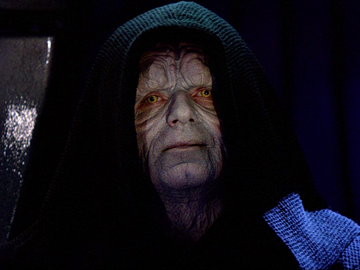 Near the end of Anakin’s road to choosing to become Darth Vadar, he straddles the line between being a Jedi apprentice and being Lord Palpatine’s apprentice. He is thoroughly inauthentic, double-minded, and we watch as he walks the tightrope of trying to be someone that he has already abandoned being in his mind and in his emotions. The Jedi sense that something’s wrong, as does Anakin’s wife, but Anakin has gotten so good at pretending to be something he’s not that no one realizes what is really wrong until it’s too late.
Anakin’s issue with integrity was always there, but he made choices in both episodes which eroded and destroyed his integrity completely. A simple – and yet not simple when we examine it – example is his marriage to Padmé Amidala. The Jedi code forbade close attachments because of the emotions those attachments engendered and which the Jedi realized could dilute a Jedi’s obligation to his primary duty and could make him a vulnerable target for the dark side of the force.
But Anakin made a choice to deliberately break the Jedi code and marry Padmé in secret, and then further chose to hide their marriage and lie about their marriage, and encouraged Padmé to do the same. I think this is the defining event that destroyed any integrity that Anakin had left.
So, by the end of the third episode, we have seen all the choices along the way that Anakin Skywalker made that led him to choose to become Darth Vader. He had tremendous gifts, great abilities, and a lot of potential. But he lacked the traits of a quintessential leader, so, in the end, all that Anakin possessed naturally didn’t matter. We see the the same lack of quintessential leadership traits in the machine-driven-Darth Vader in the first Star Wars trilogy: his outside has changed, he’s got more power, but the inside – what he lacked or destroyed by choice to begin with – remained remarkably the same.
The question I leave with you is what are all the choices that are we making today? Are they choices that will enhance our quintessential leadership potential and realization, or are they choices that are eroding our quintessential leadership potential and are cumulatively making us unquintessential leaders?
Every choice matters. Let’s make every choice count toward quintessential leadership.
 The Quintessential Leader