Building Trust and Being Trustworthy is available on Amazon in both paperback and Kindle versions.
The mission statement and motto of The Quintessential Leader is simple, but it encompasses the totality of quintessential leadership: “Lead people. Manage things.”
While we’d all like to be quintessential leaders and work with quintessential leaders, the reality is that a lot of people in leadership positions are not quintessential leaders.
There are key differences that highlight whether someone in a leadership position is a quintessential leader or not. Today’s post will summarize those differences.
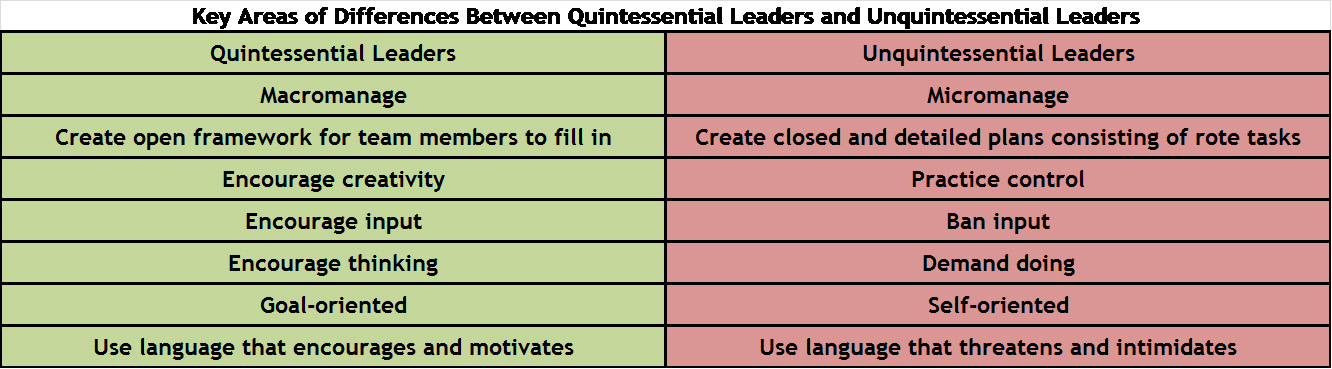
The first difference is that quintessential leaders lead (macromanage) their teams and unquintessential leaders manage (micromanage) teams.
Let’s talk about micromanagement and why people are micromanagers. The first issue is that micromanagers don’t trust their teams; in fact, it turns out the only people they trust are themselves.
However, what’s ironic about this is that they apparently only trust even themselves up to a point, because if a person really had confidence in their abilities as leaders, they would have confidence that they built and developed a team they could trust.
The second issue with micromanagers is that they are in people’s faces constantly about every little detail and, by doing that, they smother the flow of productivity and they extinguish any initiative or desire to maximize effort on the part of their teams.
The third issue with micromanagers is their constant need to remind their teams that they are “in charge.” This is what dictators and despots do as well.
This, as you can imagine, doesn’t always set well with grown people who are constantly being treated like young children (before all you parents jump on me, I know this has to be done with tiny kids because they’ll run you over in a heartbeat if they don’t know you’re in charge, but you don’t say it all the time and eventually, you don’t have to say it at all).
So how are macromanagers (quintessential leaders) different?
Macromanagers trust their teams. They also respect their teams. Quintessential leaders build teams carefully and well, and they have confidence in the people they’ve chosen: that they will do the right thing and the best thing in all circumstances.
Macromanagers also look at the big picture and that’s where they keep their focus and invest their energy. They know that staying on top of the big stuff will ensure that their teams can progress and be successful. Instead of hindering productivity and squelching initiative, macromanagers fuel the development of their team members by allowing them to own the process.
Macromanagers never say have to say they are in charge. Their teams know macromanagers lead, guide, and direct them – and, if need be, will jump in and work right beside them or save them if they’re in over their heads – but their teams also know that, first and foremost, macromanagers are part of the team.
There’s no “us” and “them” or “you all” and “me.” Instead, there is only “we.”
Another key difference between people who are quintessential leaders and those who are not is in how they approach projects and goals.
Unquintessential leaders always present goals and projects as closed, detailed plans that are set in stone with nothing left for the team members to do except execute rote tasks. This is that mind-numbing work that all of us hate – it’s necessary at times, but no one enjoys it – and it kills enthusiasm and initiative.
It also prevents growth, change, and innovation, ensuring that things continue to be done the same way because that’s the way it’s always been done. This is a death knell to any organization. It may take a while, but the organization will eventually die because it stagnates and becomes obsolete.
 Quintessential leaders, on the other hand, always present goals and projects as a framework (much like builders do when they frame a house). This frame has established parameters, major milestones, and what the end result should look like completed, but everything else is in the hands of the team to conceptualize and complete.
Why? Although there are many reasons, I’ll give a couple here.
One reason is to develop the talents and abilities of the team, giving them a safe environment in which to try new ideas – and there will be failures, but each time there is a failure, there is also a learning opportunity – and bring some originality to the table.
The other reason is that quintessential leaders intentionally build their teams with people who are smarter than they are and who know more than they know. They know these people can find better, faster, more efficient, more effective, and more profitable ways to complete goals and projects. And, seriously, what’s the point of having all that intelligence, knowledge, and talent if you’re not going to use it?
A third key difference between quintessential leaders and unquintessential leaders is how they approach their teams.
Unquintessential leaders alway practice control of their teams. They dictate everything to their teams and they don’t allow any deviation from what they dictate. Team members who dare to deviate are resoundingly condemned and usually punished and humiliated publicly as a warning to the rest of the team that unless they stay in line, they will suffer the same fate.
 Quintessential leaders, on the other hand, encourage creativity. They recognize that each person on the team is unique and brings something unique – that’s why they are on the team! – to the team and to processes. Quintessential leaders also realize that creativity leads to innovation and innovation can lead to positive changes.
Another key difference between quintessential leaders and unquintessential leaders is how they view input from their teams.
Unquintessential leaders, as we’ve seen, know everything already, are in charge, and dictate everything, so it’s no surprise they don’t want any input from their teams. But they go a step further by banning their teams from giving them any input.
The message this sends is that unquintessential leaders don’t even need their teams, but they got stuck with them anyway, so they’re making the best of it by keeping them invisible and quiet.
Quintessential leaders, on the other hand, constantly encourage input from their teams. They know that they don’t have all the answers and they know they’re surrounded by a group of trustworthy and smart and creative people who can work together with them to come up with the right and best answers.
A fifth key difference between people in leadership positions who are quintessential leaders and those who are not has to do with how they view the minds of their teams.
Unquintessential leaders don’t care what their teams think. They see thinking as dangerous. The way this is manifested is by demanding that their teams do whatever the unquintessential leaders say to do without questioning or thinking about it. And, just so we’re clear, this is what people like Adolph Hitler, Joseph Stalin, Idi Amin, and Robert Mugabe did and do too.
The problem with not knowing what others are thinking is that you really don’t know them at all, so the relationship is, at best, superficial, and, at worst, hostile.
And unspoken hostility is awful to deal with, because although it doesn’t come out in words, there are all these uncomfortable things that you sense and you don’t know why or what they mean and that you touch the edges of without knowing what it is that’s beyond those edges.
Quintessential leaders, in contrast, strongly encourage thinking among their teams. They understand the value of eschewing blind acceptance of anything without proof and conviction.
 And quintessential leaders also understand that thinking people can help in the process of eliminating bad ideas, wrong ideas, untenable ideas, and unworkable ideas.
Quintessential leaders recognize that none of us exists in a vacuum and, because we’re all prone to making mistakes and missing the obvious, having a thinking team on board can rectify those things before we get so far down the road, investment-wise, with them that it’s very costly and very hard to tear everything down and start over.
The next key difference between quintessential leaders and unquintessential leaders is in what they emphasize and focus on.
Unquintessential leaders always have themselves – how things affect them, how they are treated, how they are perceived, how important they are, and how respected they are – as their primary emphasis and focus. “It’s all about me” is the message they send out over and over again.
Quintessential leaders rarely even think about themselves except within the framework of the team, and their emphasis and focus is always on goals. That means an almost-parallel emphasis and focus is on their teams. Because the team as a unit accomplishes goals. So the welfare of quintessential leaders’ teams is always directly tied to the accomplishment of the teams’ goals.
The last key difference between people who are quintessential leaders and those who are not is in how they communicate.
Unquintessential leaders overarchingly communicate using language that threatens and intimidates. Most of the time, it’s obvious and in your face, But there’s an interesting phenomenon that occurs sometimes: the threats and intimidation are couched as a sincere desire to help, but when seen as a whole, it becomes obvious what they actually are.
Communication is an area where quintessential leaders tend to be very good. They say what they mean and they mean what they say. However, quintessential leaders always use language that encourages and motivates, even when they’re correcting a problem or coaching a team member whose performance needs to improve.
The thought I’ll leave you with today requires looking in the mirror at ourselves instead of through the window at everybody else.
Let’s take these key areas and see which side of the equation we fall on. We may be quintessential leaders in all but one of them. Or we may be quintessential leaders in half of them. Or we may be quintessential leaders in less than half of them.
Recognizing and acknowledging honestly where we are is the first step to change. None of us are perfect. None of us are not guilty, somewhere in the course of our lives, of being unquintessential leaders. That includes me.
But just because we were – or maybe still are in some areas – doesn’t mean that we have to stay there. There’s no time like today to start the process of change.
And it is a process. We didn’t get here overnight and we won’t change from where we are overnight.
But we commit to change and we start taking steps forward to put that into action.
There will be falls. There will be setbacks. There may even be a few disasters along the way.
But the key to successful change is to get back up each time and start moving forward again.
If we fall and don’t get up, or if we decide it’s just too hard and too much work and we quit, then we have failed in reaching our potential and our goal of being quintessential leaders. Let’s not fail!
I’ve often said that quintessential leadership is an art. It can be learned by anyone, but some of us are more naturally inclined by personality, temperament, perspective, and experience to being quintessential leaders. For us, it’s an extension of who and what we are.
For those to whom this doesn’t come naturally, it’s hard work a lot of the time. But, no matter how we’re naturally constructed, this is not impossible work for anyone.
Whether we become quintessential leaders depends on whether we want to be and whether we’re committed to it no matter what and we diligently apply and grow in that commitment, with the evidence of that clearly visible in who and what we’re becoming.
So let’s talk about a few tangible ways that quintessential leaders think and do differently from others. I will be identifying and discussing these from time to time and today’s post is the first discussion.
All of these should be things that each of us looks at in our own leadership mirrors to see how much we’re reflecting them. If the reflection is clear, then we need to continue to keep that clear. If it’s dim or absent, then we’ve still got a lot of work to do.
Spoiler alert: we all still have a lot of work to do. None of us are perfect at any of these all the time.
However, these are a few of the baseline benchmarks against which we should routinely measure, in-depth, how our journey to quintessential leadership is going: where we’ve been, where we are, and where we need to go. (more…)
All quintessential leaders need a strong inner circle that they choose, because as Rockwell points out failure in leadership occurs in both isolation and control. The right inner circle – and this only comes through time, experience, interaction, and observation – enhances us as quintessential leaders and as people.
Quintessential leaders understand that they have areas of weakness, gaps in knowledge, and lack certain skills. Their inner circles will supplement and fill the voids.
Everyone we include in our inner circles should bring a lot to the table. This generally includes strong personalities and opinions (there is a HUGE difference between strong and argumentative – quintessential leaders will not add those who debate or argue for the sake of debating or arguing to their inner circles because this is a recipe for disaster and destruction). People with strong personalities and opinions will be successful when their focus is on goals, not themselves, and not winning at all costs.
Too many organizations mistake strong personalities and opinions that are self-centered, as well as isolation (I’m the “one and only”) and control (“my way or the highway”) as leadership. In reality this is the antithesis of leadership. It’s just self-absorption, self-aggrandizement, and self-centeredness.
Our inner circles should have passion, but they should be able to back that passion up with substance: truth, facts, logic, and focus. Passion for the sake of passion is never enough.
Rockwell lists three types of people who should be in our quintessential leadership circles. “You need a:
Visionary who is never satisfied.
Tender-heart who nurtures people.
Doer who is fanatical about execution.Note: Include at least one old (visionary or nurturer) and one young (doer).”
Think today about the three people who fill these roles in your inner circles. If you don’t have all three, then think about who you would choose to fill these roles.
The enemy of success is isolation. The higher you go the easier isolation becomes, but, it’s a devastating problem at all levels of leadership.

Isolated leaders fear conspiracies and feel misunderstood. Worse yet, ivory-tower leaders resort to control through authority.
Us/them thinking destroys influence.
Defeat isolation and enhance success by developing a high-power inner circle.
Choose:
Don’t take volunteers. Choose your inner circle.
Three people are enough. Six is too many and two is too few. You need a:
Note: Include at least one old and one young.
Strengths:
View original post 139 more words
People change. Sometimes they change for the better. Sometimes they change for the worse. But, nonetheless, they change.
The physiological way that humans develop indicates that. Each of us starts out basically the same way at birth, then we grow and mature, with similarities to our families as well as things that are unique to us. Different hair colors, eye colors, heights, weights, shapes, interests, personalities, temperaments, and strengths and weaknesses.
While physical growth stops at some point, it is the only way in which we stop changing. Everything else should be directed at changing (growing and maturing) for the better, but, at times, we all get sidetracked and derailed for a little while, and while that is change too, it’s definitely not change for the better.
However, most of us eventually come back from that sidetracking and those derailments and start moving forward again in the right direction.
 Quintessential leaders get sidetracked and derailed sometimes during their lifetimes, so they understand this is part of being human. They also understand that it’s a temporary snapshot in time, like a picture, that does not represent the whole time before and after that time. They understand that people are movies.

 The Quintessential Leader