U.S. Bill of Rights 1st Amendment to the Constitution“But it’s my right!”

“I can say whatever I want, however I want, whenever I want, to whomever I want and nobody can stop me. I have rights!”

“I’m entitled to my opinion and if you don’t like it, then you just need to get over it!”

Sound familiar? If it doesn’t, then you must be accessing this post from a desert island where you’ve been cut off from the rest of civilization for the last 50 years.

Welcome to The Quintessential Leader blog, to the year 2015, and to present reality.

This post will discuss not only what freedom of speech looks like in quintessential leaders, but it will show how quintessential leaders decide what to say or write and what not to say or write.

This is a relevant and important topic especially because it seems where we are most able to determine whether we are quintessential leaders or not today is to look at our speech in cyberspace: emails, texts, social media, and blogs.

We can all talk a good game, but it’s often here where the truth behind all that talk is revealed. 

Quintessential leaders understand, first and foremost, that every word they speak or write is a reflection of who and what they are from the inside out.

In other words, how quintessential leaders exercise their freedom of speech reflects their character.

Therefore, quintessential leaders are very thoughtful before they commit words to speech or in writing.

While quintessential leaders may technically have the right to say or write anything, anywhere, anytime, they always ask the first right question – “Should I?” – right off the bat.

That eliminates a lot of speech and writing before any other analysis needs to be done.

If, however, further analysis needs to be done, quintessential leaders use the overarching principles of building trust and being trustworthy – forged through experience and wisdom – to identify the criteria that their words must be filtered through and determined against before they are said or written.

Quintessential leaders discern the intent of the words they are considering speaking or writingOne of those criteria that quintessential leaders use to determine whether to say or write something is intent.

Is it demeaning or denigrating to other people? Does it contain words like idiotmoronstupidretard?

Those are the most common demeaning and denigrating words used, but there are many others.

If it contains any of these kinds of words, quintessential leaders will reject them from what they speak or what they write or share or endorse.

Is it argumentative? For those of us who have used the internet since it became available to the masses, we remember the term flame wars to describe speech that was intended to be argumentative.

Flame wars were – and still are – started by someone who wants a speech melee and often consists of speech that is so outrageous and offensive that an all-out war ensues. And, once the war starts, nothing is out of bounds, and all the speech goes downhill from there.

Quintessential leaders reject argumentative speech. They will not initiate it, nor will they engage in it. 

Is it inciting? There are many things that divide humanity today and because we, as a species, are all up in arms about “our rights,” there’s an ample supply of inciting topics to speak or write about.

Inciting is the same thing as baiting. It’s a come-hither designed to provoke a strong emotional reaction that will lead to a response in terms of action (usually negative).

The Charlie Hebdo attack in Paris in January 2015 was the result of inciting cartoons the publication repeatedly and intentionally created (and I am in no way defending or sanctioning retribution of this sort or any other: quintessential leaders don’t pay back or get even because that would be inconsistent with their character; instead, they forgive and move away from and move beyond the offenders), knowing what the impact would be.

But look anywhere in the world of technology – emails, texts, social media, and blogs – all over the globe and it abounds everywhere. Look at your newsfeed on Facebook today – July 22, 2015 – and look at all the posts about “rights” that are intentionally inciting that fill your page.

Quintessential leaders reject all speech, written or spoken, that is inciting. It has no place in what they write or say or share or endorse.

Quintessential leaders determine the appropriateness of the words they speak and writeAnother criteria that quintessential leaders use to evaluate the words they speak and write is appropriateness.

There are several aspects of appropriateness that get overlooked in the speech that we write and we speak.

Is it vulgarsuggestive, or profanity-laden? If it is, then quintessential leaders will reject it outright from the words they write and the words they speak.

But here’s a nuance of this that a lot of people simply don’t filter and this really makes quintessential leaders stand out as exceptions. 

While the content itself is not vulgar, suggestive, or profanity-laden, in the case of sharing or endorsing on social media, the site it’s being shared from is. It never ceases to amaze me how much of this happens on a regular basis.

Quintessential leaders look at everything and if there is anything anywhere that is inappropriate, they reject it completely as acceptable speech.

Quintessential leaders analyze the impact of the words they speak and writeA final criteria that quintessential leaders use regarding speech is its impact.

Is it disrespectful? Disrespect is commonplace in our society. Although at times its impact is supposed to be diminished by characterizing disrespect as a joke, in the end it is still disrespect.

There are many ways to disrespect others, but speech that impugns motives not in evidence, that points out personal and private flaws and issues, that condemns obliquely (the person/people being condemned is/are unnamed), and that viciously attacks people who are unable to defend themselves (this is bullying, by the way, and adults do it just as much, if not more than, as kids do) are the most common forms of disrespect.

While quintessential leaders may address big-picture issues and things they find legitimate fault with and/or disagree with in the speech they use in writing and speaking, they are always careful to show respect in these areas. When we stop being decent human beings to each other, then we cannot claim to be quintessential leaders.

Is it libelous? Speech that directly attacks another human being by name – quintessential leaders don’t do this because the reality is that none of us can really be inside the head, the heart, the soul of another person and it’s always wise to give the benefit of doubt – is never a good idea.

For a lot of reasons.

First, even if there’s no legal action taken, we’re all on shaky ground with things we cannot definitively prove through firsthand knowledge or by factual evidence.

Second, many reputations have been ruined by these kinds of attacks which were based on innuendo and rumor. When the facts later negated the attack, it was too late for the person attacked to recover.

Third, put yourself in the person’s shoes that you want to attack and smear by name. Would you want someone to do that to you? I don’t think any of us would, but this is one of the many things that quintessential leaders consider in the speech they choose to write and speak.

Does it give a negative and/or false impression about us? I don’t think many of us really consider what our speech says about us. I think if we did – and quintessential leaders always do – we would be much more circumspect about what we say and write or share and endorse (social media).

Now is the point where each of us, striving to be quintessential leaders, need, not to look at everyone else, but to look at ourselves in how we use the freedom of speech in what we say and what we write.

What is the intent of the words we speak and write and share and endorese (social media)?

Is the speech that we use to say and write and share and endorse (social media) things appropriate?

What impact does the speech that we speak with, write with, and share and endorse (social media) have?

How are we doing?


Authenticity is Who and What Quintessential Leaders AreA discernible trait of quintessential leaders is that we are continually striving for authenticity in every part of who, what, and how we are. It is an easily-identifiable part of our character which is borne out by our behavior.

One of the easiest aspects of behavior that shows us what both unquintessential leadership and quintessential leadership looks like is in our verbal and written communication with others.

Whether we are authentic or unauthentic is plain to see by what words we say and write and how we say and write them. 

The words we choose and the method we use to convey those words provide vital insights into whether we are striving for authenticity or whether we are, at the heart, core, and soul of who we are, either struggling with inauthenticity or we are truly committed to being inauthentic as a matter of course.

I make the distinction between struggling with inauthenticity and being committed to it because it’s important for all of us to understand that quintessential leaders will struggle at times with inauthenticity, while unquintessential leaders don’t struggle at all with it because being inauthentic is a committed way of being for them.

So what makes the difference between struggling with inauthenticity and being committed to it?

Awareness is the difference.

Quintessential leaders who are being inauthentic are not aware of being inauthentic, but as soon as they become aware of the inauthenticity, they commit to changing it immediately.

Unquintessential leaders, on the other hand, are fully aware of being inauthentic and are determined to remain inauthentic.

How do I know this? Because I’ve struggled with inauthenticity at times and not even realized it. However, once it hit me between the eyes, opening my eyes to an area of inauthenticity, I immediately made and fulfilled the commitment to change it.

Not being aware of inauthenticity is a part of the growth cycle for humans and the mature development of quintessential leaders (if all of us were already perfect, we’d have absolutely nothing to do and no place to go and life would be interminably boring and meaningless). 

However, it is often the case – to our shame and discredit – that as we who are striving to be quintessential leaders are unaware of our own areas of inauthenticity, we are eager to and constantly pointing, in public venues and in condemning language, out the areas of inauthenticity in other growing-into-quintessential-leaders who are unaware of their own areas of inauthenticity. 

This is unquintessential leadership behavior. Quintessential leaders examine themselves and they focus on changing what they need to change. They do not constantly exalt themselves as paragons of virtue and continually look around at everyone else and proclaim, for the whole world to see, their faults and shortcomings.

Instead, they work diligently to be an example, in every area of their lives, of what quintessential leadership looks like. They know that action – their own work on themselves – can be a powerful motivator and teacher for everyone with whom their lives intersect.

They also know that constant and public criticism and condemnation is not only a powerful demotivator, but a lousy example for anyone to follow and emulate (unfortunately, human nature tends toward this kind of behavior, so there are always plenty of admirers and supporters in criticism and condemnation of other people).

So before we look at what authenticity in communication looks like, let’s first look at what it doesn’t look like.

Vladimar Nabokov wrote, “Words without experience are meaningless.” I would clarify this to say that any words spoken or written without experience or empathy (literally the ability and choice to walk in the shoes of someone else’s experience and understand that experience from their perspective) and compassion are meaningless.

Inauthenticity in communication says and writes words that are empty and hollow because the person communicating them either has never experienced what they are communicating about or they lack empathy and compassion, choosing to assume they know something they don’t or choosing to pass judgment without facts, without understanding, and without knowledge.

This is unquintessential leadership because pride and arrogance are behind the communication as well as a total lack of kindness and gentleness. In other words, the communicator believes, even though they don’t have clue nor do they care what they’re talking about, that they are entitled to say or write the words as well as being harsh and condemning in the process.

Inauthenticity in communication is also evident in the common behavior of simply parroting cliches, “conventional wisdom,” and idioms because it seems like the right thing to say or write.

There is no thought or depth that goes into these utterances. In fact, this is the cheap and easy way out: we throw a well-worn phrase that sounds good and we’ve heard all our lives at someone else, check it off our list (while patting ourselves on the back for our generosity and benevolence toward the poor souls we communicated with), erase it permanently, and go blissfully on with our unimpacted lives without missing a beat.

Parroting as a method of communication is unquintessential leadership for a couple of reasons.

The first is motivation. We’re communicating something we’ve always heard – but most of the time have not had to put to the test of veracity through experience – because it makes us feel better, not because it will make the person we’re communicating with feel better.

The second reason parroting is unquintessential leadership is because we are not taking the person we’re communicating with into account at all. We don’t seek insight and understanding by taking the time to really listen to them – we may hear them, but there’s a world of difference between just hearing and really listening – nor do we take the time to think about the kind of communication we would want from someone if we were in the same or similar circumstances. 

By simply parroting something we’ve heard but have no evidence or proof of its value and/or truth, we effectively complete dismiss the person we’re communicating with and we tell them we don’t care about them and they are not important enough to us for us to waste our time with them.

So now that we know what it doesn’t look like, let’s discuss what authenticity in communication – quintessential leadership – does look like.

Unfortunately, as Nabokov stated, experience is often how we gain the ability to be authentic in our communication with other people. However, whether we have authenticity in our communication with others still comes down to us making the choice to be authentic.

Choosing authenticity in our communication with other people requires an investment from us. In them. In time. In effort. In carefulness.

In a society where unquintessential leadership abounds, as well as entitlement and “it’s all about me,” the selflessness required for this kind of investment has all but disappeared.

The difference between empathy and sympathyBut quintessential leaders know that they don’t have to have experienced something to be authentic in their communication with other people. And because of their commitment to developing unimpeachable character, two of the highly-developed traits they have are empathy and compassion for other people.

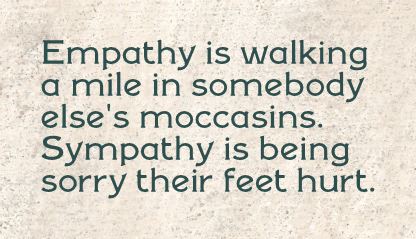
Empathy, like most of the other traits that make quintessential leaders trustworthy, is very rare and getting rarer. Most people believe that sympathy and empathy are the same thing and they are not.

Sympathy takes no long-term investment in another person: it tends to be a hands-off, “one-and-done” event.

Empathy, on the other hand, is a hands-on, long-term, hand-in-hand walk through the journey of – and with – another person. It is seeing through their eyes, understanding through their thoughts and emotions, and listening with interaction to know what is really behind their communication (often the words that are said or written have something else entirely behind them).

Compassion is always a by-product of and a companion of empathy. It is understanding, encouraging, invested, gentle, kind, and patient. It can be – and should be – the result of our own struggles, setbacks, and hard times in life. 

But because compassion and empathy are so interrelated, many people choose a lack of compassion because they offer only sympathy as a one-time-shot to other people.

These same people also, ironically, do everything in their power to evoke compassion toward themselves, including constant manipulation, self-exaltation, and telling everyone how they are not like all those other poor slobs in the world who don’t deserve anyone’s compassion.

This is the Scarlett O’Hara (Gone With the Wind) syndrome, because like Margaret Mitchell’s infamous anti-heroine, in the end, everything is all about them and they refuse to share the stage of life with anyone else.

Another area that demonstrates the authenticity of quintessential leaders in communication with other people is that quintessential leaders do not parrot cliches, “conventional wisdom,” or idioms. Instead, quintessential leaders consider carefully the impact of their words and how they use them.

Because quintessential leaders are invested in other people, they understand and are sensitive to the needs that exist.

Words have power and weightThey are also profoundly aware of the power of words, the impact of words, and the effect of words. 

They are not cavalier with words, simply letting whatever comes immediately to mind come out in their speech and writing. They always spend a considerable amount of time looking for ways to deeply and encouragingly communicate and avoiding hurt and offense. 

They know and understand that even words that may advocate a course correction should build up and not tear down. That can’t be done with parroting something someone else has said or something they’ve heard all their lives. It can only be done with original thought combined with empathy and compassion.

This is just one aspect of behavior that makes quintessential leaders rare in society today.

But each of us is striving to become a quintessential leader, so this must be a behavior we develop, grow, and exhibit everywhere in our lives and model for all the teams we lead in our lives. 

I say this often, but it cannot be repeated too much. If you breathe for a living, you lead at least one team in your life. Quintessential leadership is not confined to organizations, and can, therefore, be dismissed by everyone else. 

Somebody in your life is looking to you and depending on you to model leadership for them. It might be your children. It might be your students. It might be your family members. It might be your spouse. It might be your coworkers. It might be your friends. It might be the sports team you coach. It might be the volunteer groups you are involved with. It might be anybody.

So, as always, we must look in our own mirrors and conduct a thorough, extensive, comprehensive, and fearlessly honest evaluation of what our communication with other people looks like.

Are we inauthentic anywhere or everywhere in our communication with other people? 

If we are, is it because we lack awareness of our inauthenticity in our communication with other people?

Or is it because we’ve deliberately committed to a path of inauthenticity in our communication with other people?

If we find authenticity in our communication with other people, are we committed to preserving that and developing it to the point where it is literally a part of who and what we are all the time?

I can only answer these questions for myself. Each of you can answer them only for yourselves. Do we have the character and the courage to look, to see, to answer, and to change where and if we need to?

How are we doing?

What Transparency Looks LikeOne of the new organizational buzzwords is transparency. Today’s post will talk about what transparency looks like with quintessential leaders and what transparency looks like with everyone else.

You may be surprised to find that transparency among most people in leadership positions is illusionary, conditional, selective, and, in fact, is a lie because it doesn’t exist.

The word transparent at its simplest means to see through. Nothing is obscured, blurry, fuzzy, or out of view. Transparency, then, is the state or condition of being transparent. So anyone or any organization claiming transparency is describing their or its continual state or condition.

But is that true?

In most cases, the answer is “no.” While there is usually a lot of activity and A Smokescreen is Not Transparencycommunication to give the impression of transparency to the teams, what is done and what is said for everyone to see is essentially a smokescreen to keep teams feeling informed and included, while the real heart of the activity and communication – the business core – is conducted in secret behind closed doors among a small inner circle that has been sworn to secrecy.

So how do we know if a person or an organization is truly in a state or condition of transparency or not?

It’s quite simple.

Listen to them.

Anyone who or any organization that is constantly saying they are transparent is not.

People and organizations that are really see-through don’t ever have to say they are because it’s visible and obvious.

Only people and organizations with something to hide will make a conscious effort to regularly reiterate that they are committed to transparency. Just as liars will keep repeating their lies to try to convince others they are telling the truth, so will people and organizations that are not transparent who say over and over that they are.

So what are some key pieces of evidence that we can look for to see what transparency does not look like?

  1. A superficial and protective outer layer of smoke and mirrors that looks clear until it is placed on top of all the hidden layers and then nothing is clear. This looks like a plexiglass cover that is placed on top of wood-stained coffee table to protect it from damage and scratches.
  2. The Wizard of Oz behind the curtainA continuous barrage of stimulating, but meaningless, information designed to deflect attention and shift focus away from the nuts and bolts of what’s really happening and what’s substantive. This looks like the Wizard of Oz behind the curtain projecting an illusionary image of reality.
  3. Saying one thing, but being the opposite. Actions always speak louder than words. There are far too many, since this reflects the majority of people who are currently in leadership positions, for me to name the most obvious examples I can see and think of. Look around your venue on the world. You won’t have to look far to find this behavior.

So then, now that we have seen what transparency doesn’t look like, since we are all striving to be quintessential leaders and transparency is a quality of quintessential leadership, then we must know what transparency does look like in action.

Real transparency lays all the cards on the tableReal transparency lays all the cards on the table up front. It takes a proactive approach to full disclosure of the facts and relevant circumstances, providing a big-picture framework to fully and completely encompass and describe the genesis and the outcome of decision-making.

Real transparency doesn’t sidestep controversy or issues, actions, words, etc. that are either perceived as a liability or were part of poor or ill-informed decision-making. We all have these in our realm of experience. 

Quintessential leaders, however, don’t try to sweep them under the rug and pretend they never happened, nor do they try to excuse, clarify, or blame them away. Instead, quintessential leaders own their missteps and mistakes and use them as teaching opportunities for the quintessential leaders they are developing on their teams.

The lessons of our failures and how we addressed and overcame them are the most valuable we can pass on to the next generation of quintessential leaders for several reasons.

First, future quintessential leaders understand that nobody is perfect and screwing up is sometimes part of the learning process.

Second, by our showing them step-by-step how we recovered, we are modeling a tangible and realistic example – showing them what it looks like in practice – of how to overcome, grow, and move forward.

Third, we are helping them, by sharing our experiences, hopefully not to repeat our missteps and mistakes. (When people portray themselves as perfect, there is no knowledge or experience to pass on to the next generation, who will find themselves in missteps and mistakes, but will model the unquintessential leadership example of no transparency that was modeled to them, ensuring that and perpetuating the same mistakes down the line to successive generations.)

Real transparency is WYSIWYGReal transparency doesn’t deceive, lie, or cover up anything. Everything’s an open book of reality, honesty, and what-you-see-is-what-you-get.

What unquintessential leaders don’t realize is that by not being transparent, they often spend most of their time dealing with the past (you will always hear more references to the past and especially to a mythical past of “glory days” than you will ever hear about detailed and actionable plans for how to navigate successfully through right here, right now and for navigating successfully through the future) and they, therefore, have little to no time to deal with the present and the future.

So, as always, we take the subject of transparency and we look critically, honestly and objectively into the mirrors of our own lives.

Do we faithfully practice total transparency in every aspect of our lives?

Do we practice transparency in some areas of our lives, but not others?

Do we not practice transparency anywhere in our lives?

Each of us can only answer these questions for ourselves. But we have to be willing to be honest and candid and to change, if we find anything less than total transparency in every aspect of our lives.

How are we doing? 


The Unquintessential Leadership Trait of Character AssassinationWe humans have a lot of things, good and bad, in common despite all the things that make us different and unique individually from each other. Today we’re going to discuss one of the prevailing bad things we have in common, which is a hallmark trait of unquintessential leadership.

That unquintessential leadership trait is character assassination. But this unquintessential leadership trait is not isolated just to those who routinely assassinate the character of other people. It extends to those people who listen to the character assassination, who believe the character assassination without verification or proof, who perpetuate the character assassination, and who applaud the person who is assassinating another person’s character.

In other words, character assassination can be both active and passive. The active forms are initiating and perpetuating the assassination of someone else’s character. The passive forms are listening to, believing without verifying or proving, and applauding the assassination of someone else’s character.

Although any assassination of another person’s character is unquintessential leadership in action, the most hurtful types of character assassination are those that are perpetrated by, listened to, believed by, perpetuated by, and applauded by people who are supposedly friends of the people whose character is being assassinated.

Character Assassination is an Unquintessential Leadership TraitWith friends like these, who needs enemies?

We humans innately have a tendency to talk too much. In that eagerness to speak, we also tend to talk without thinking and say things in the heat of emotional upheaval. In these cases, we usually don’t mean the things we say and, if we’re quintessential leaders, as soon as we realize we’ve hurt or offended someone, we apologize and make amends.

Character assassination, on the other hand, is a calculated and deliberate campaign of words composed of outright lies, half-truths, manipulation, insinuation, and instigation that has the sole intent of destroying not only the reputation and integrity of another person, but the person themselves. Anyone who participates in this actively or passively is showing themselves to be unquintessential leaders.

With the advent of social media, character assassination has become prolific, public, egregious, and normal.

It’s as though we humans check our brains, turn off all the filters of common decency, forget the Golden Rule entirely, and embrace the darkest parts of our human nature at the door of social media.

Although the methodologies differ – and are sometimes so subtle, they are difficult to recognize  – the intent and the result is the same.

And, more often than not, the people whose character is being assassinated don’t even know that it’s happened or is happening. Others just suddenly disappear out of their lives or consciously avoid them altogether and the people who’ve been the victims of character assassination have no idea why. 

So what does the perpetration of character assassination look like in practice? 

  1. Keeping the wording vague, but malicious, and keeping the victim anonymous, the perpetrator makes sure everybody knows how “awful” the maligned person is with cutting words and harsh condemnations that indicate that the perpetrator can perfectly read thoughts, attitudes, intents, motives, actions, and hearts (if we really believe that we can do this with other people, then we are unquintessential leaders, because we can’t).
  2. Baiting people by providing tantalizing and derogatory information about someone else.
  3. Twisting words to make it look like someone said or intended something they did not.
  4. Taking innocent actions – with no knowledge of what is actually going on – and making them seem sinister, salacious, or wrong.
  5. Gossiping and spreading rumors about someone.
  6. Tearing someone down to others.

The roots of why unquintessential leaders initiate and participate in character assassation are two-fold and speak to the character of the initiators and participators. 

The first root is jealousy. Generally, people who are victims of character assassination are persistent, genuine, proactive and original, and doing everything in their power to make positive movement forward. Usually, they’re doing it steadily and quietly, but the impact is readily apparent. 

Narcissism is a Root of Character AssassinationUnquintessential leaders are generally imitators and copiers. They make a lot of noise and constantly scream “Hey, look at me!” but the noise is unoriginal, often hackneyed, and always copied from someone else. Therefore, they are jealous of people who don’t imitate and don’t copy other people, but actually do the hard work of research, innovation, and original creation.

For unquintessential leaders, the only way to quiet their jealousy and to hope to minimize or eliminate the impact of a person’s honesty, authenticity, originality and forward motion is to assassinate that person’s character.

The second root of character assassination is a darker  aspect of human nature that unquintessential leaders give in to routinely and that is finding a perverse joy and fulfillment in either watching somebody destroyed or destroying that person themselves. 

There seems to be an ugly pride and smugness among unquintessential leaders when they’ve assassinated someone’s character. Ironically, unquintessential leaders use these opportunities to talk about how awesome, how great, and how wonderful they are, sometimes in comparison to the person whose character they have assassinated, but, more often than not, because for unquintessential leaders it’s all about me, they simply sing their own praises and invite everybody else to join in their song.

And now, my friends, it’s that time when we all honestly look into our own mirrors and examine ourselves to see if we have the unquintessential leadership trait of character assassination in our lives.

Do we routinely assassinate the character of other people:

  1. Via social media or other means of communication, by stating or insinuating that those people are deficient and defective in character, attitude, motive, action, mindset, etc.? (It’s important to remember that those people aren’t there to defend themselves – and likely don’t even know what’s being said about them – nor are they able set the record straight so what we’re saying is one-sided and never the whole story.)
  2. By spreading rumors and gossip about them?
  3. By listening to a perpetrator’s character assassination of them?
  4. By believing without verification or proof a perpetrator’s character assassination of them?
  5. By perpetuating a perpetrator’s character assassination of them?
  6. By applauding a perpetrator’s character assassination of them?

I can only answer these questions for myself by honestly looking in the mirror of my own life. You can only answer them for yourself by doing the same.

How are we doing?


Changing Choice to ForceIn a previous post, I asked whether choice or force was the methodology of quintessential leadership. Now I want to discuss the effects of force when choice is the default. 

In other words, what are the effects when people are forced to do something that is, by default, a choice that they can opt to do or not to do? 

Does forcing people to do something that is presented as a choice for them bring them around to whatever the intended effects are that the people who are exerting force are trying to get or does it make those people even more resistant to opting ever for the choice?

I always go for practical, this-is-what-it-looks-like examples of the topic we’re discussing, so we’ll look at a couple of real-world scenarios.

Let’s say that your organization does a weekly blog on random topics that are interesting, perhaps, but not mission-critical (whether team members read it or not will not have any effect on productivity, project completion, or successful outcomes).

Let’s say, as well, that your organization has a weekly video presentation that, again, is not mission-critical. Instead it is, in essence, a promotional video for the organization that continually pats the organization on the back and talks about how great the organization is. The video is posted on the same website as the blog and team members can opt to watch it or not.

What I’ve presented in these two scenarios is choice. Just like the choice you are exercising right now by reading this post (anyone who doesn’t read it is also exercising choice). 

Now, let’s say that the organization’s web analysts have been told to monitor how many hits the blog and the video get each week and their report shows that almost nobody’s reading the blog or watching the video. Remember, this is a choice that team members have to read, to watch or to not read and not watch.

Commandeering Team Meets to Make Choice ForceThe people in leadership positions decide the response among team members is unacceptable, so they commandeer each department’s weekly status meetings and have the blog read to each team and the video played before the actual meeting about what everybody’s actually there for begins.

There are a myriad of reasons why each of us, as unique and highly-individualized creations from the very hand of God, choose to opt in or opt out of the millions of choices we are presented with daily. 

In the scenario with the blog, some people don’t like to read.

Others want to stay focused on the things that are linked to productivity, to project completion, and to successful outcomes without a lot of extraneous – and, in many cases, distracting or unhelpful – information in the mix.

And still others find themselves in frequent disagreement with some of the subjective and erroneous information (we’re all guilty of it at times, my friends, and to pretend or deny that we aren’t is the height of pride and arrogance) included in the blog, so they don’t read it because it would end up being detrimental to them in the big scheme of things.

In the scenario of the video, some people simply will not watch videos. I’m one of those (the same is true with listening to audio).

Because of my learning style, which requires me to see words on a page, I need to read to process, to comprehend, and to think about whatever I’m choosing to invest into and make the focus of my time and attention.

Others don’t watch the videos because they are simply self-promotion of the organization and they’re not interested in “cheerleading” videos.

And still others don’t watch simply because they’re not interested at all.

However, because the blog posts and the videos are now part of weekly status meetings, the choice for each team member and their reasons for opting out has been taken away.

So what are the effects now that choice for each team member has been replaced with force?

The first effect will be a combination of anger and resistance.

And this is what unquintessential leaders who use this tactic – and it happens a lot – don’t understand or comprehend. The reason – the motive – behind force is to compel people to buy in to whatever is being presented. The belief is that force will lead to choice because team members just “aren’t aware of what they’re missing” or “team members just don’t know what the value of the information in the blog posts or videos is.”

In other words, team members are perceived as ignorant children who don’t know what’s good for them, so by forcing them to read (or listen) and watch, they will see the light and become devoted readers and watchers.

Wrong. Force will only drive those team members who have opted out of choice further away from a buy in. 

These team members will be angry because they are viewed by people in leadership as being ignorant and childlike (in other words, they can’t make good and/or right decisions for themselves). These team members will also be angry because they will see the force for what it is: an attempt to manipulate unconditional loyalty and support for the organization.

The team members who chose to opt out and now are facing force will also be resistant because their choice was taken away. These team members may sit there, but they’re not listening and they’re not watching. Instead, they are committed to the authenticity in their reasons for why they opted out to begin with. In other words, these team members will “check out” for the duration.

Another effect of choice being replaced with force is an outgrowth of resistance: attrition.

The reality is that once an organization replaces choice with force, it has embarked on the slippery slope of attempts to control everything and everybody in the organization. Choice is no longer available. Everything becomes force.

Resistance to that force, which is actually oppression, eventually leads to attrition. When continual and increasing attrition rates affect an organization, the organization has dealt itself a fatal death blow. 

Anger and Resistance Against Force Instead of Choice Leads to AttritionIt may take months or years to shudder into its eventual demise, but the outcome is, nevertheless, certain. Potential team members always look at an organization’s viability before committing to become a member of the team.

Viability is evident in the relationship among what kind of leadership is in place, organizational policies, and the rate of attrition. The higher the attrition rate, the more evident that unquintessential leadership is at the helm and an organizational policy of force is in place. 

If the existing team members are bailing, then potential team members are going to look elsewhere as well. It’s just the inevitable and logical outcome of the effects of force replacing choice.

So, my fellow quintessential leaders, now is the time for us to look in the mirror. We can always point at other people in any scenario we use, but that does us no good. We must instead look at ourselves, because we’re committed to the highest standard, to a different standard, to doing the right thing all the time, no matter what we personally may have to sacrifice in the process or what it may personally cost us, with every team we lead in life. It’s a matter of our character and our integrity.

Are we guilty of replacing choice with force? Are we in organizations that dictate that we replace choice with force? Do we go along because we don’t want to rock the boat or do we have the courage to say “No, that’s wrong. If it’s a choice, then we’re not going to force it on anyone?” 

Are we willing to lose everything – our position within the organization, our income from the organization, and our teams in the organization – to be authentic, genuine, and to stand up for and do what’s true and right, or will we compromise, becoming unquintessential leaders, because it will negatively impact us personally if we don’t?

I can only answer these questions for myself. You can only answer them for yourselves.

How are we doing?


Leaders Must Have Ethics and Morals - Strength Alone is Not EnoughIt seems to me that the term “leader” has now begun to ring hollow because it’s applied to anybody and everybody in the world who emerges in the top tier of the heap of any social, religious, academic, governmental, or organizational structure, regardless of how they got there.

The reality is that how they got to the top of the heap matters. A lot. Just because people end up in the top tier of any of these venues does not automatically mean they are leaders. Anymore, it often means just the opposite.

Why?

Because how people get to the top of the heap shows the kind of ethical-moral foundation they have. Or don’t have.

While we seem to routinely disconnect how people behave from their intellect, knowledge, and skills, we do ourselves a huge disservice when we don’t consider the whole person, especially when they’re begging us to unconditionally (which, by the way, is unquintessential leadership) follow them.

The presence or absence of an ethical-moral foundation in a person is directly proportional to whether they build trust and are trustworthy or they destroy trust and are not trustworthy.

The reality is that there is very little trust and trustworthiness in the world today. Time and again, most of us prove, often in what we believe are “little things,” that we cannot be trusted and we are not trustworthy. 

Little things,” it turns out, are symptomatic of big things and those big things show whether we have an ethical-moral foundation or not. How is this translated practically? In a word, character. Character embodies these elements: who we are, what we are, our motives, our attitudes, our thoughts, our words, and our actions.

If one or more of those elements doesn’t sync up with the rest, or what we claim to be, then we have a problem with our ethical-moral foundation and we are deficient in character.

There are certain external behaviors that reveal more than others whether we have an ethical-moral foundation. They are:

  1. A pattern of questionable and surreptitious actions that have built-in plausible deniability;
  2. A history of deflecting responsibility and/or changing the subject (avoiding the subject altogether) when confronted with substantiated actions and words;
  3. A prevailing sense of anger and outrage each time these kinds of actions and words occur and we are called on it;
  4. A history of twisting, spinning, angling, deception, and dishonesty that threads through our entire lives;
  5. An overarching pride and arrogance that literally oozes from our pores continually;
  6. An inability to ever admit we are wrong, we’ve done something wrong, and we need to make amends and change those wrongs in a demonstrable way.

I am very rarely completely on the same page as New York Times columnist David Brooks (I find him to be myopic, elitist, and without an objective view of the big picture most of the time, and that leads him to conclusions that are generally lopsided and not entirely accurate), but in his April 28, 2015 op-ed piece, “Goodness and Power,” Brooks nails the integrated relationship between quintessential leadership and an ethical-moral foundation.

Hillary Clinton Dishonest and UntrustworthyBrooks began the piece with the results of a Quinnipiac Poll that showed that 60% of independent voters rated Hillary Clinton as a strong leader. But 61% of those same voters said that Hillary Clinton is not honest and is not trustworthy (here’s the disconnect I referred to before between behavior and intellect, knowledge, and skills).

Then Brooks moves out to the long view that the real ability to lead is directly tied to honesty and trustworthiness by asking the right question: “Can you be a bad person but a strong leader?”

As those of us who are striving to be quintessential leaders know already, the answer is “no.” To paraphrase Brooks, putting “…someone with bad private morals [in a leadership position] is like setting off on a battleship with awesome guns and a rotting hull. There’s a good chance you’re going to sink before the voyage is over.”

Why?

As Brooks notes, people who have no ethical-moral foundation are Machiavellian in their behavior and the end always justifies the means, and in the end what we get is not leadership, but tyranny and despotism.

The lust for power and control is the driving force behind these unquintessential leaders. The dishonesty is that they obscure their real motives with platitudes that sound like they are selfless, sacrificing, giving, and doing this for the good of the people that they actually want power over and want to control.

And here’s the proof. They’ll talk a good talk until they get what they want, but there are always shadows of impropriety, of shadiness, of manipulation, and of deception hanging around them. Nobody trusts them, even if they manage to get a leadership position.

Once they do get a leadership position, these unquintessential leaders reveal their total lack of an ethical-moral foundation in everything they are, they say, and they do.

What does that look like in practice? As we strive to become quintessential leaders, we must be able to not only know what quintessential leadership looks like, but also what it doesn’t look like and we need to make sure we’re always monitoring ourselves to make sure we’re on the right path and haven’t veered off onto the wrong one.

When people without an ethical-moral foundation get into leadership positions, these are the tell-tale signs:

  • Tightened control over everything and everyone (it will be loose during their campaign to be in charge and promises of egalitarianism will abound)
  • A closed inner circle that is an existing network and that is severely limited with very specific criteria so that only those who are already in it can meet them
  • All-or-nothing demands for loyalty and allegiance
  • Big Brother Lack of Ethical-Moral FoundationConstrictive and restrictive rules and regulations
  • Continual threats of retribution and adverse actions if rules and regulations are believed to be broken
  • Constant assertion of authority and superiority to everyone else
  • Constant devaluing of others in attempts to promote and enhance their own value
  • Mistrust and suspicion of everyone else

Look around in your life and see if this looks familiar. It does in my life, because, unfortunately, this is the general tenor of the kind of people in leadership positions in every area of our lives.

It’s become acceptable to not have an ethical-moral foundation and be in a leadership position. Not only is it acceptable, but it is, indeed, preferred.

But as we strive to become quintessential leaders, we can’t just follow the crowd. We can’t use the excuse that everybody else is doing it. We can’t allow ourselves, even if it means we end up being the only person on the planet doing the right thing because we have and we hold on to the right foundation, to ever lose sight of what makes us quintessential leaders.

We are rare for a reason. But there are people, those whom we serve on every team in our lives, who count on the rarity of us having, continuing to fortify, and adhering to an unshakeable ethical-moral foundation.

How are we doing?