Posts Tagged ‘unquintessential leadership’

This is not the post I had planned for this blog today. However, it is clear to me that everyone – from the media all the way to Paula Deen – is missing the bigger picture of the core issue at the heart of this story.

As a side note, I shake my head continually at the situational ethics and twisted logic that a lot of people are approaching this story with. The heart of this story is not about a lack of forgiveness, about “casting stones,” about defaming Paula Deen (she did that all by herself by her lack of quintessential leadership without any help from anyone else).

It is, instead, a cautionary tale that all of us, and especially those of us who are quintessential leaders, need to look into the mirror of and see where and if we see our own reflections. If we miss that in all of this, then we’ve missed the whole point. 

The core issue of this situation with Paula Deen is that she lacks the unimpeachable character, the irrefutable integrity, the unwavering values, the non-negotiable adherence to and upholding of the highest of standards personally and professionally, and the evident humility of a quintessential leader. 

Paula Deen Today Show 6-26-13Increasingly, the story has zeroed in on a single aspect of Paula Deen’s deposition in response to a lawsuit filed by a former employee (who, for the record, is not African-American and who had quite a bit of responsibility at several of Paula Deen’s restaurants) raising the specter that Deen is prejudiced against African-Americans.

Paula Deen herself has waffled all over the place about this one part of a much bigger problem, so it’s really unclear exactly where she stands. And that’s consistent with a lack of unimpeachable character. When you don’t have a solid foundation of anything that is absolute in life, the floor constantly shifts on you from moment to moment.

But the charges of racism are only one part of a larger picture of who Paula Deen is and how she has failed as a quintessential leader both personally and professionally throughout her career. If you want the whole picture, you can read the former employee’s lawsuit here and Paula Deen’s deposition here.

Paula Deen fails the quintessential leader test in several areas. The first is setting and adhering to the highest set of standards of conduct (behavior, which includes speech and action) and requiring that everyone on the team adhere to them too. When people on the team fail to adhere to them, the remedial process to change or go is begun and if there’s no change, those people go. No matter who they are.

A telling quote from Paula Deen’s interview on the Today show this morning reveals her lack of understanding of leadership and her lack of ability to lead: “It’s very distressing for me to go into my kitchens and hear what these young people are calling each other. … I think for this problem to be worked on, these young people are gonna have to take control and start showing respect for each other.”

Paula Deen is in the leadership position and it is her job to set the standard of what is acceptable and what isn’t in her kitchens. She, as she has done since the beginning of all this, once again puts the responsibility somewhere else, instead of taking it herself. If she didn’t allow this kind of behavior in her restaurants – which clearly she does – she wouldn’t be hearing it at all there.

This is Paula Deen’s fundamental blind spot. She seems to have absolutely no comprehension of what her role as a leader is. This seems to be another case of someone who’s really good at a skill, but who should have never been in a leadership position because she’s not equipped to do it.

Once a person in a leadership position, as Paula Deen has time and again, allows, tolerates, and accepts compromise and exceptions to what is generally considered appropriate and right behavior, first in themselves and then with others, they have failed as quintessential leaders.

Once compromise and exceptions enter the picture, character is negatively impacted, and this is the second area where Paula Deen fails the quintessential leader test.

Paula Deen doesn’t see anything intrinsically wrong with any of the behavior in either the former employee’s lawsuit or in her own deposition. The casualness with which she accepts unacceptable behavior in speech and in action – and even does it herself – shows defective character.

Character is a big deal. Every choice, every decision, every thought impacts our character. That impact can either be positive or negative.

The more we negatively impact our character, the less we will care about right and wrong and good and bad and the looser our standards of what’s “okay,” “normal,” and “acceptable” will be.

This is unquintessential leadership. Quintessential leaders know character matters and we know that everything we do and our teams do reflect on our character.

We know you can do one hundred things right and one thing wrong, and the one wrong thing, unless we tackle it head on by admitting it, fixing it, and changing it so that it doesn’t happen again, can be what defines us the rest of our lives.

This is what Paula Deen is not doing and why she is not a quintessential leader.

The reality is that Paula Deen has hit a watershed moment in her life. This could be a time of real change for her.

This, believe it or not, is not unfixable. The fixing will be painful and embarrassing and will cost Paula Deen a lot in effort, money, and reputation. But the result would be worth it in the end.

But if you don’t understand that anything’s wrong, which Paula Deen doesn’t seem to, and you cannot accept the responsibility for your failures as a leader, which Paula Deen has never addressed, and your way of dealing with it is to cast a wide net of blame and responsibility on others by playing the victim and indulging in self-pity, then change will not happen. At least not now.

Paula Deen confirmed that this morning with her statement that “I is who I is and I’m not changing.”

Paula Deen, in the way she has conducted herself at every step of the way in her current situation, has shown herself to be an unquintessential leader.

First, Paula Deen showed – in case you think this is “no big deal” – herself to be a bully (this falls under the unquintessential leadership trait of bullying) and to have a prevailing lack of personal integrity and self-discipline.

Part of personal integrity is having and demonstrating respect for everyone. Personal integrity also has high standards of conduct and will not engage in – or allow – behavior or speech that denigrates and disrepects another human being. Self-discipline enforces personal integrity.

Second, after Paula Deen had failed on this part of quintessential leadership, although she had opportunities to redeem herself and prove that she was a quintessential leader who made a mistake, but was eager to rectify it and make it right immediately, she continues to show unquintessential leadership.

The first thing a quintessential leader does when he or she realizes they’ve screwed up – and we all do it as long as we breathe for a living – is to correct it and make amends. Matthew 5:25 gives quintessential leadership advice on how to handle someone suing you.

Had Paula Deen been a quintessential leader, she would have initiated a one-on-one meeting with her former employee as soon as she learned of the lawsuit and Paula Deenapologized and asked her former employee how she could make amends to her. Granted that takes a lot of humility, which quintessential leaders also have, but it would have resolved the issue between them and the general public would have probably never heard about it.

Instead, Paula Deen responded to the lawsuit in a deposition that made it even more clear how little personal integrity and self-discipline she possesses. It’s enough to make all of us who are striving to be quintessential leaders cringe most of the way through it.

Her inability to see the seriousness and hurtfulness of her mindset – because how we think is how we talk and act – in her speech and behavior and to accept it as “okay” or “normal” is more proof that Paula Deen is an unquintesssential leader.

Inset statement here: All of us who are Southerners should be cringing as well and putting a lot of distance between ourselves and Paula Deen. Paula Deen does not and will never represent me as a Southerner. We are not all like that. I apologize on behalf of Paula Deen and tell you that her speech and her behavior is wrong, unacceptable, and should not and will not, by me anyway, be tolerated in any way, shape, or form.

After Paula Deen’s deposition became public, she once again had an opportunity to own up and make it right all the way around, as quintessential leaders will eventually do. She failed again.

Instead of taking responsibility and correcting everything on the spot, Paula Deen showed the unquintessential leadership trait of pointing the finger everywhere but at herself. She blamed the South and the time she grew up in as the reason she is a bigot and disrepectful in her treatment of and behavior and speech toward African-Americans.

When that statement became public, Paula Deen yet again had an opportunity to humble herself and be a quintessential leader and take full responsibility and commit to changing herself and making amends.

And, once again, she failed. Her three anemic attempts to “apologize” were not apologies. They did not include a sincere and heartfelt apology where she acknowledged that she was wrong, she needs to and will change, and she will make amends to everybody affected (not just her former employee who is suing).

Paula Deen made it obvious that, in her mind, she stills believes what she demonstrated in her speech and behavior toward this employee and her deposition, but she felt forced to do something to try to save her gig with the Food Network and keep her $17 million dollar brand from imploding.

But there was nothing real, sincere, humbled, or changed behind any of her words. As with all unquintessential leaders, it was talking the talk with no intention of walking the walk.

food-networkAfter seeing these three videos, the Food Network did indeed say they would not renew her contract when it expires at the end of the month.

That was the right thing for the Food Network to do.

And, you know what, I really hope at some point that Paula Deen comes around and understands, acknowledges, really apologizes, makes amends, and makes the changes she needs to make. That’s my prayer for her. She’s got a lot of talent, but a lot of talent doesn’t make you a good person, nor does it make you right, nor does it make you a quintessential leader. 

Now, as quintessential leaders, we need to take some time  to review our own mindsets and how that comes out in our speech and behavior. Do we have personal integrity and self-discipline? Do we care? Or do we just go along with whatever the people around us are doing?

Quintessential leaders set the highest standards for ourselves. And we adhere to them, not when it’s convenient, not when we feel like it, but all the time. Even if it means we’re standing all by ourselves. It’s an act of courage, as indeed our lives are lived by many acts of courage that often swim constantly against the prevailing tide of unquintessential leadership that exists just about everywhere today.

So, let’s be courageous and be the quintessential leaders we say we are striving to be. It’s not the easy path and it’s not a whole lot of fun sometimes, especially when we screw up, but it’s the only way that we’ve committed ourselves to be.

My sister bought a pet storm door from Lowe’s in Matthews, NC about a year ago. Over time, several parts on the door proved defective. She had a one-year warranty on the door, so about two months ago, she contacted Lowe’s and they sent a contract installer out to fix the door.

He had all the parts he needed except one and told her he would order the part and have it shipped to her house for installation that week. The part never arrived and the many subsequent calls to Lowe’s about the part were a lot of empty promises, but no results.

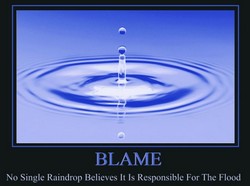
It's Not My FaultYesterday, I called and asked to speak to the store manager. When he answered the phone, I began to explain the problem and the first thing he said as he interrupted me before I finished was that the store doesn’t do the installations, so it wasn’t his fault, but instead the installer’s fault.

I politely told him that Lowe’s sold the door, so ultimately the responsibility was theirs, so he needed to get it taken care of. He said “I’ll call you right back.”

Thirty minutes later, I called back. When he answered, I reminded him that he’d told me he’d call right back. He was clearly annoyed and said he had just hung up with me ten minutes before. I told him it had been thirty minutes, and the reason I was calling back was this was the same thing that my sister had been listening to in repeated phone calls for about six weeks and there were never any calls back.

I made it clear that the problem had been unresolved long enough and I wanted a solution. I could hear by the tone of his voice that he was irritated, but he told me – which I doubt – that he was on the phone with the installation company, throwing in one more time that the problem was not Lowe’s’ fault. I told him I expected a resolution within the hour.

The installation company’s manager called me about five minutes later. I explained, without interruption, the problem and he told me that he’d get an installer out today if Lowe’s had the part needed in stock. I told him that this was poor leadership and poor customer service and that my sister shopped often at Lowe’s for home improvement items, but there were other home improvement choices within sight of Lowe’s and the odds were good she was going to be taking her future business there. He listened and he got it.

Just a few minutes later he called back and said an installer would be at my sister’s house between 9 am and 10 am this morning to do the installation. I thanked him.

The time frame came and went this morning (my sister had a dentist appointment at 11 am this morning) with noUnquintessential Leadership

‘I counted internally to ten to get my temper under control and then told him politely but firmly that the internal problems of communication, follow-up, and completion of jobs between Lowe’s and the installation company were not my concern as a customer. The door was purchased at Lowe’s and all subsequent work was coordinated by Lowe’s, so the responsibility was his as the store manager. I told him to get it resolved or I would have no choice but to escalate it to the Lowe’s corporate office.

He said he’d call me back once he got it resolved. Not only did he not call back, but he did not bother to call the installation company either. At 10:55 am, while my sister and I were at the dentist’s office waiting for her to go back, the installer called and said he was at the house and asked if anyone was home.

I explained that no one was there and that was why the appointment was scheduled between 9 am and 10 am – he then started making excuses about why he was late (I asked why he didn’t call this morning if he knew he was running late and we could have rescheduled, and he gave me another set of excuses) – so he’d have to come back. Supposedly, he will be here tomorrow morning between 8 am and 8:30 am.

The store manager at the Matthews, NC Lowe’s exhibited pure unquintessential leadership. It is clear that he doesn’t have a big-picture understanding that losing customers affects the company’s profits and when corporate profits fall, stores close and this one could well be one of those that closes and he will be out of work.

Had he been a quintessential leader, he would have done the following:

  • Listened without interrupting
  • Taken ownership of the problem and the solution
  • Followed up with me each step of the way in the process
  • Offered a good-will gesture, such as a store credit or a gift certificate, for all the things that went wrong to retain a customer

As quintessential leaders, we can never afford to have an experience like this one take place under our watches. Everything matters.

Please take some some time to read the Quintessential Leadership article recommendations for the week of May 10, 2013 that are listed below.

In Josh Bersin’s article, he asks the valid and relevant question of whether the traditional – and unproductive and archaic – annual performance appraisal system that most organizations still use should be replaced with a different system. The traditional performance appraisal system is tied to monetary raises and is a once-a-year-event where team members hear – or read – what their supervisor liked and didn’t like about their past year’s job performances. Usually, the only outcome of this system is frustration because this is the first time team members are hearing about things they did that didn’t work, needed to change, or needed to improve. 

Lack of communication, which I believe is an intrinsic problem in all organizations, is inherent in this “hammer-over-the-head” method of evaluating team members. It does not produce positive results and often leads to attrition among the most gifted and talented team members an organization has. In my eBook, Building Teams for Performance, I give a detailed “what-it-looks-like-in-practice” guide to using performance evaluation systems the way that Josh Bersin correctly concludes they should be used.

Quintessential Leader Articles Review 5-10-13Todd Smith gives a quintessential leadership trait in “Making Your Weaknesses Relevant,” by challenging all of us, as quintessential leaders, not to make excuses for our weaknesses – which we all have – but to face them and change them.

Does it ever seem like you’re in over your head? As quintessential leaders, we will have times that we are in over our heads, but Mike Myatt gives some very practical advice about how to be in over our heads without drowning.

In my post, “Quintessential Leadership News for Week Ending 3-15-13,” I challenged each of us, as quintessential leaders, to look into mirrors, not through windows as we examine ourselves and our path as quintessential leaders to make sure there’s a total match-up between what we say and what we do and are. John Baldoni offers an excellent followup to that post with this article.

In Michael McKinney’s article, Better Decision Making, he discusses the quintessential leadership balance between facts and feelings as being a key determinant in the quality of our decision-making. Feelings and emotions have their place, but they should never be the engine that drives us because they are transient and unreliable. Decisions made using feelings and emotions as the primary driving force often leave us in a worse position than if we had done nothing at all.

The Quintessential Leader blog routinely looks at why unquintessential leadership makes organizations dysfunctional. John Bossong rejoins this discussion with his article that looks at how we can identify unquintessential leadership through the signs of an unhealthy organizational culture.

The last article recommendation this week, written by Kristina Lacida, highlights, as “The Mysteries of Quintessential Leadership Revealed” discusses in detail, the differences between being a “boss” and being a “leader.” 

I hope all of us have had productive, forward-looking and forward-moving quintessential leadership weeks. I’m sure we’ve had our challenges, our missteps, and our failures. But each of those give us an opportunity to learn and to grow.

And, when it’s all said and done, we get back up and we recommit to our goal, our purpose, one step, one choice, one decision at a time. This, my friends, is a marathon, not a sprint.

May the distance we cover between now and the next time we get together be better in every way than the distance we’ve covered already.

A quick review of the week of March 15, 2013 finds further examples of unquintessential leadership already noted with two principles here previously.

The first is Carnival Cruise Lines. After the debacle the week of February 15, 2013 with the Triumph, this week brings stories about three of the cruise line company’s other ships having similar troubles. The Dream, Elation, and Legend cruise ships all experienced technical difficulties this week, and all have had to be either towed, stopped early, or are limping slowly back to port.

Once again, Carnival’s response is to offer insignificant refunds or discounts, instead of taking their whole fleet off the water for whatever time it takes to update the equipment and make the vessels seaworthy and trustworthy. This is unquintessential leadership because these are serious and potentially dangerous, if not fatal, problems andCarnival Cruise Legend Cruise Ship those in leadership positions are unwilling to acknowledge and fix them immediately, no matter what the cost in money or time is. Those in executive positions at Carnival Cruise Lines are unquintessential leaders because they don’t care about the safety of the passengers nor the reliability and trustworthiness of the company. Instead, all they care about is how much money they can make. This is greed and selfishness in action.

The second principle is freshman Senator Ted Cruz. Senator Cruz is a Harvard Law School graduate who should be totally knowledgeable about the difference between an opinion about the U.S. Constitution and what the U.S. Constitution actually says. If he’s not, then Harvard needs take a serious look at its law school curriculum and professors.

On Thursday, March 14, 2013, Senator Cruz, in what has become his customary rude and disrespectful manner toward more-seasoned legislators, argued during a Senate Judiciary committee meeting than a ban on assault weapons is unconstitutional. In a condescending “schooling” session directed at Senator Dianne Feinstein that, in essence, implied that she had no understanding of the 2nd Amendment, so she needed it explained to her, Senator Cruz said that banning assault weapons is to the 2nd Amendment what censoring books is to the 1st Amendment.

It is not, although that’s what the Tea Party and the NRA would like everyone to believe. The 2nd Amendment says: “A well regulated militia, being necessary to the security of a free state, the right of the people to keep and bear arms, shall not be infringed.”

The Supreme Court ruled definitively on the scope of what the 2nd Amendment covers in 2008’s District of Columbia V. Heller, with Justice Anthony Scalia’s majority opinion, which clearly says that 2nd amendment does not preclude banning assault weapons.

The reality is that at the time the amendment was added to the U.S. Constitution, no assault weapons existed, and the intent was to give all U.S. citizens the right to protect their homes, property, and families, and to feed themselves through hunting. It goes without saying that one doesn’t need assault weapons to do either of these things.

So Senator Cruz shows his unquintessential leadership again in several ways. First, he doesn’t even know the body of constitutional law involving the 2nd Amendment, which is unacceptable for a person in a leadership position who is a member of a committee that deals with matters involving constitutional law. Second, he is contradicting, without legitimate basis, the highest legal authority in the United States. And third, Senator Cruz consistently shows contempt and disrespect in his dealings and conversations with his colleagues, many of whom have served much longer – admittedly, probably too long in many cases – in the United States Senate than he has.

These are two news items that caught my attention regarding quintessential leadership – or the lack of it – this week. I urge all of us as quintessential leaders to observe the world around us – and that includes the news – and find mirrors that we can look into and see if we’re being the quintessential leaders we’re striving to be and say we are or there are areas where we are being unquintessential leaders and we need to change.

I’ve certainly seen some unquintessential leadership things in my mirrors this week and I have committed myself to changing them into quintessential leadership. We all have our weak spots and our blind spots and our unquintessential leadership thoughts, attitudes, and actions.

The difference between an unquintessential leader and a quintessential leader is that unquintessential leaders always look through windows, so they never see what they need to see about themselves, only what others need to do or change or be.

Quintessential leaders, on the other hand, look into mirrors and when they see the reflections of themselves, they see what needs to done, changed, or who they need to be, and they immediately commit to and start taking action to make that happen.

So my question to you, fellow quintessential leaders, is are you looking through a window or are you looking into a mirror?

In a follow-up to last week’s post on CPR and quintessential leadership regarding the action of a Brookdale Senior Living nurse refusing to do CPR on 87-year-old Lorraine Bayless, I saw this news article today where Brookdale Senior Living, which initially backed up the nurse’s refusal to do CPR as being consistent with company policy, has now reversed their position.

The statement says that the incident “resulted from a complete misunderstanding of our practice with regards to emergency medical care for our residents” and that the nurse had “misinterpreted the company’s guidelines.”

This further shows the unquintessential leadership in place at Brookdale Senior Living. First is the “reversal” of a policy that the company defended and stood by several days. Second is the subtle shifting of the blame to the nurse for the lack of medical attention. And the third is the minimalizing language Brookdale Senior Living uses in their reversal statement. To characterize this incident as “misunderstanding” or “misinterpretation” is to basically say it’s not a big deal, even though that misunderstanding and misinterpretation led to somebody’s death.

All of these show just how entrenched the unquintessential leadership is at Brookdale Senior Living. As I said before, it would be naive to believe this is the only senior living company where practices and policies like these are in place and unquintessential leadership is extant through the ranks within the corporation.

But it should serve as a warning and a caution to those of us entrusted with being quintessential leaders in helping our parents as they age to ensure that we’re providing the best and most care for them, as they did for us when we were babies, helpless, and completely dependent on them. These companies, despite their claims, really don’t have “our residents” as their priority. It is about money (greed) and the law (minimum legal liability).

These are driving forces that the unquintessential leadership in these companies come from, along with the lack of character, integrity, ethics, and moral responsibility that many of the individuals that are employed by these companies possess.