Posts Tagged ‘truth’

the quintessential leader building trust and being trust worthy book

In the first post of this series, the excerpt from chapter 1 included a list of all the components we must develop and have to build trust and be trustworthy.

In the subsequent chapter excerpts detailing the components we need to have and develop to build trust and be trustworthy, chapter 2 discusses honesty, chapter 3 discusses integrity, and chapter 4 discusses fairness, and chapter 5 discusses righting wrongs.

This post, which includes an excerpt from chapter 6, discusses the component of accountability that builds trust and makes us trustworthy.

Accountability is a two-pronged component that includes both a sense of duty and a willingness to take responsibility for our conduct, whether that is our words or our actions, or both.

Accountability also entails taking responsibility for the things and the people entrusted to us. Literally, when we are accountable we stand as a shield between everything and everyone we are responsible for.

If attacks come from from outside, we take the hit. We provide a safe and protected environment where growth, learning, and progress can thrive because we encourage it and the environment is threat-free.

Accountability, therefore, encompasses a large amount of territory. It also requires that we put our egos permanently on the shelf and conduct ourselves selflessly in all areas of our lives.

But, like all the other components of building trust and being trustworthy, accountability is rarely seen among people who are leadership positions today.

Building trust and being trustworthy is an integrated trait of quintessential leaders.

It is also an integrated trait that all of us – because each and every one of us leads at least one team, small or large, of people in our lives – need to develop and have as part of the core of who we are and what we are. In essence, this trait is at the center of exemplary character and conduct, and none of us should settle for anything less than this in ourselves and others.

Unfortunately, most of us settle for less. A lot less. In ourselves. In others. 

The majority of people in leadership positions today are not trust builders and they are not trustworthy. Many of us, frankly, are also not trust builders and trustworthy.

We live in a world that with no moral code as its foundation that expects trust to be non-existent or broken. Look around. It’s everywhere, including, in many cases, very close to you.

And society has become so accustomed to this that it glorifies it instead of condemning it.

Politicians who lie routinely, who line their pockets with money and perks while making decisions that hurt and destroy the people they are supposed to represent, who cheat on their wives because they can.

Arts and sports celebrities who have no regard for faithfulness to their spouses, who live hedonistic lifestyles that destroy their families, the people around them, and, eventually their lives.

Religious leaders who cheat on their wives, who cheat on their taxes, and who scam their congregations both in how they deceitfully handle the word of God and in coercive and corrupt financial matters, acquiring wealth and power in the process.

Business leaders who destroy millions of lives by deceit, fraud, and illegal actions that result in their employees and customers losing everything while they escape any kind of punitive action and instead reap obscene profits and end their tenures – only to go to another financially lucrative position – with golden parachutes that are equally obscene.

And we, as individual leaders for our teams, who cheat on our taxes, who are routinely dishonest with the children (our own and others) and other people entrusted to us, who routinely steal things from our workplaces (you most likely didn’t pay for that pen you’re using at work, so it doesn’t belong to you), who routinely break traffic laws, who will walk out of stores with something we were not charged for and never think twice about it, who will take extra money that we’re not owed in financial transactions without blinking an eye, who cheat on our spouses, who marry until “divorce do us part,” and who, as a course of habit, break confidences of family and friends, gossip about family and friends behind their backs, and destroy reputations in the process.

Maybe we haven’t thought about building trust and being trustworthy at this kind of nitty gritty level.

But until we do – and we develop and have this trait as the core of who and what we are – we will not build trust and we will not be trustworthy. And we will not be quintessential leaders.

Trust and trustworthiness is probably the single most important trait we can possess. And it is also the most fragile.

It can take a long time to build and be, but it can be broken irreparably in a single second.

Therefore, this is a lifetime work on and in ourselves that we must commit to making an integral part of our character by continually developing it, maintaining it, and growing it. 

This goal should be our goal.

But it requires courage. It requires diligence. It requires vigilance. It requires continual self-examination. It requires continual change. It requires the ability to, much of the time, stand alone to maintain.

It is not for the faint-hearted. It is not for the vacillators. It is not for the crowd-pleasers. It is not for the pretenders. It is not for the wannabes. It is not for the weak.

But if you’re reading this, I know that you’re not any of those kinds of people. Those kinds of people won’t even read this because it requires time, effort, change, and commitment, and too many of us are, sadly, either just too lazy or we just don’t care. 

Building Trust and Being Trustworthy takes an in-depth look at the “this is what it looks like in practice” aspect of each of the components we need to develop and have to build trust and be trustworthy. The second chapter discusses the component of honesty in building trust and being trustworthy.

olive-horizontal-line

Excerpt from”Chapter 6: The Accountability Component of Trust and Trustworthiness”

In this chapter we’ll show the aspects that encompass accountability and I believe it will become apparent when we review those that there is a serious lack of quintessential leadership in all walks of life today. But as we strive to be quintessential leaders, we will see that the component of accountability is one that must be part of who and what we are in order to build trust and be trustworthy.

What does accountability entail and how does accountability get measured in terms of quintessential leadership? Merriam-Webster defines accountability as “an obligation or willingness to accept responsibility” or “to account for one’s actions.” Being obligated and being willing are both attributes of character and mindset, which are crucial areas of distinction that make quintessential leaders stand out from everyone else. 

Obligation is rarely found in organizational thinking today and in many ways it reflects the larger lack of a sense of obligation reflected in society.

Instead of recognition and actions that reflect that recognition of what we owe others, society, in general, has adopted an entitlement mindset that says “I owe nothing, but everyone else owes me.”

This is reflected in the “I deserve” and “my rights” attitudes that are prevalent in every part of life – home, family, school, extracurricular activities, religion, and work – today. 

Obligation, by definition, is not negotiable. It is an integral and driving force in who we are, what we do, what we say, and how we think. Quintessential leaders know and understand their obligations and strive to fulfill them in every part of their lives and that includes the area of accountability.

Willingness is another character and mindset attribute of a quintessential leader.

Even if people know they should (obligation) do something, but they don’t do it, then they lack the quality of willingness. There is a proverb that says the road to hell is paved with good intentions. This speaks directly to knowing we should do something, but being unwilling, whether by procrastination, slothfulness, or lack of desire, to do what we know we should do. 

So, as quintessential leaders, we know we should and are willing to be accountable for everything within our control. What does that exactly mean? What does it look like in practice?

Mike Myatt, in his article, “Leadership is Not Dodgeball,” gives a big-picture summary in his title.

We all remember playing dodge ball in elementary school. The object of the game was to avoid being hit by the ball if you were in the middle of the circle and it required running, jumping out of the way, ducking, and occasionally pushing other people in the path of the ball.

And for the most part, we see people in leadership positions doing these same maneuvers in terms of accountability in negative situations (these are also the first people to take full credit and accountability in positive situations).

One of the most common responses of most people in leadership positions today, across the human spectrum of organizational units and constructs when problems, issues, and mistakes happen is to simply run away – to distance themselves personally as far from the negative events as possible. This is out and out cowardice and not a quintessential leader trait.”


the quintessential leader building trust and being trust worthy book

In the first post of this series, the excerpt from chapter 1 included a list of all the components we must develop and have to build trust and be trustworthy.

In the subsequent chapter excerpts detailing the components we need to have and develop to build trust and be trustworthy, chapter 2 discusses honesty, chapter 3 discusses integrity, and chapter 4 discusses fairness.

This post, which includes an excerpt from chapter 5, discusses the component of righting wrongs that builds trust and makes us trustworthy.

It seems for us humans that admitting we were wrong, made a mistake, or totally screwed up is the hardest thing for us to do.

However, if we are not able to do this, then we can’t fix what we’ve broken and we can’t right what and/or we’ve wronged.

The ability to immediately own and immediately make right being wrong, the mistakes we make, and those colossal screw-ups that we all have in our lives is a part of character that is sadly lacking in most people in leadership positions today. 

That is one of the reasons why things spiral further out of control in a negative direction, why things get even more broken to the point of being beyond repair, and why there is so little trust in people in leadership positions. 

It doesn’t do any good to say “trust me” when all we’ve shown is an inability to be trustworthy at all, because we continue to leave ever-growing trails of unadmitted and unfixed breaks, wrongs, and disasters behind us.

Actions will always speak louder than words.

Building trust and being trustworthy is an integrated trait of quintessential leaders.

It is also an integrated trait that all of us – because each and every one of us leads at least one team, small or large, of people in our lives – need to develop and have as part of the core of who we are and what we are. In essence, this trait is at the center of exemplary character and conduct, and none of us should settle for anything less than this in ourselves and others.

Unfortunately, most of us settle for less. A lot less. In ourselves. In others. 

The majority of people in leadership positions today are not trust builders and they are not trustworthy. Many of us, frankly, are also not trust builders and trustworthy.

We live in a world that with no moral code as its foundation that expects trust to be non-existent or broken. Look around. It’s everywhere, including, in many cases, very close to you.

And society has become so accustomed to this that it glorifies it instead of condemning it.

Politicians who lie routinely, who line their pockets with money and perks while making decisions that hurt and destroy the people they are supposed to represent, who cheat on their wives because they can.

Arts and sports celebrities who have no regard for faithfulness to their spouses, who live hedonistic lifestyles that destroy their families, the people around them, and, eventually their lives.

Religious leaders who cheat on their wives, who cheat on their taxes, and who scam their congregations both in how they deceitfully handle the word of God and in coercive and corrupt financial matters, acquiring wealth and power in the process.

Business leaders who destroy millions of lives by deceit, fraud, and illegal actions that result in their employees and customers losing everything while they escape any kind of punitive action and instead reap obscene profits and end their tenures – only to go to another financially lucrative position – with golden parachutes that are equally obscene.

And we, as individual leaders for our teams, who cheat on our taxes, who are routinely dishonest with the children (our own and others) and other people entrusted to us, who routinely steal things from our workplaces (you most likely didn’t pay for that pen you’re using at work, so it doesn’t belong to you), who routinely break traffic laws, who will walk out of stores with something we were not charged for and never think twice about it, who will take extra money that we’re not owed in financial transactions without blinking an eye, who cheat on our spouses, who marry until “divorce do us part,” and who, as a course of habit, break confidences of family and friends, gossip about family and friends behind their backs, and destroy reputations in the process.

Maybe we haven’t thought about building trust and being trustworthy at this kind of nitty gritty level.

But until we do – and we develop and have this trait as the core of who and what we are – we will not build trust and we will not be trustworthy. And we will not be quintessential leaders.

Trust and trustworthiness is probably the single most important trait we can possess. And it is also the most fragile.

It can take a long time to build and be, but it can be broken irreparably in a single second.

Therefore, this is a lifetime work on and in ourselves that we must commit to making an integral part of our character by continually developing it, maintaining it, and growing it. 

This goal should be our goal.

But it requires courage. It requires diligence. It requires vigilance. It requires continual self-examination. It requires continual change. It requires the ability to, much of the time, stand alone to maintain.

It is not for the faint-hearted. It is not for the vacillators. It is not for the crowd-pleasers. It is not for the pretenders. It is not for the wannabes. It is not for the weak.

But if you’re reading this, I know that you’re not any of those kinds of people. Those kinds of people won’t even read this because it requires time, effort, change, and commitment, and too many of us are, sadly, either just too lazy or we just don’t care. 

Building Trust and Being Trustworthy takes an in-depth look at the “this is what it looks like in practice” aspect of each of the components we need to develop and have to build trust and be trustworthy. The second chapter discusses the component of honesty in building trust and being trustworthy.

olive-horizontal-line

Excerpt from”Chapter 5: The Righting Wrongs Component of Trust and Trustworthiness”

This chapter is one in which we’ll tackle a subject that addresses the heart of a quintessential leader. It is true that no one really knows our hearts completely except for God. However, behavior (actions and words) indicates the state of our character (good or bad) and character indicates the state of our inner selves – the heart.

I believe one of the most difficult things for all of us to do is to admit we made a mistake, we were wrong, or we screwed up. There is something intrinsic in us that wants to avoid that, deny that, excuse that, justify that, or even blame it on someone else.

This reticence to own up, to take responsibility for all of our words and actions will be addressed fully in an upcoming chapter on another of the components of trust and trustworthiness, which is accountability.

But the fact that we all wrestle with the admission of wrong-doing, in whatever form those words and/or actions took – and until we admit wrong-doing, we cannot right wrong-doing – shows that this is a quintessential leader trait we must be consciously working to both acquire and practice consistently. Without it, we will not be quintessential leaders. 

There are many examples of the fallout from being unwilling to admit and then to right wrongs that we can look at to see, as quintessential leaders, what not to do.

I will briefly summarize a few here, but I strongly encourage you to research on your own the many more examples from history, religion, society, and public life where wrongs were not admitted to and corrected to see how devastating the results were and to understand the things that each of us must be on guard to not repeat in our own lives and leadership of others.

I also strongly encourage each of us to look at our own lives for examples where we have not exhibited this quintessential leader trait.

Unfortunately, we all have them. We may not be in a position to go back and fix them all – if we are, we should – but we have the opportunity to learn the lessons and change so that we are consistently admitting, without excuses and blame, and righting our wrongs immediately.

There are two examples of people in leadership positions who lacked this quintessential leader trait in the Bible that stand out in my mind every time I read about them and I literally shake my head that they were unwilling to do anything about it, even though the consequences were dire and long-term.

the quintessential leader building trust and being trust worthy book

In the first post of this series, the excerpt from chapter 1 included a list of all the components we must develop and have to build trust and be trustworthy.

The second post in this series, which included an excerpt from chapter 2 of Building Trust and Being Trustworthy, looked at the component of honesty in building trust and being trustworthy.

This post will include an excerpt from chapter 3 of Building Trust and Being Trustworthy

Another component of building trust and being trustworthy that we must have is integrity.

Most people don’t realize that integrity and honesty are two distinct but complementary components of building trust and being trustworthy. This chapter defines and shows what integrity does and doesn’t look like.

Building trust and being trustworthy is an integrated trait of quintessential leaders.

It is also an integrated trait that all of us – because each and every one of us leads at least one team, small or large, of people in our lives – need to develop and have as part of the core of who we are and what we are. In essence, this trait is at the center of exemplary character and conduct, and none of us should settle for anything less than this in ourselves and others.

Unfortunately, most of us settle for less. A lot less. In ourselves. In others. 

The majority of people in leadership positions today are not trust builders and they are not trustworthy. Many of us, frankly, are also not trust builders and trustworthy.

We live in a world that with no moral code as its foundation that expects trust to be non-existent or broken. Look around. It’s everywhere, including, in many cases, very close to you.

And society has become so accustomed to this that it glorifies it instead of condemning it.

Politicians who lie routinely, who line their pockets with money and perks while making decisions that hurt and destroy the people they are supposed to represent, who cheat on their wives because they can.

Arts and sports celebrities who have no regard for faithfulness to their spouses, who live hedonistic lifestyles that destroy their families, the people around them, and, eventually their lives.

Religious leaders who cheat on their wives, who cheat on their taxes, and who scam their congregations both in how they deceitfully handle the word of God and in coercive and corrupt financial matters, acquiring wealth and power in the process.

Business leaders who destroy millions of lives by deceit, fraud, and illegal actions that result in their employees and customers losing everything while they escape any kind of punitive action and instead reap obscene profits and end their tenures – only to go to another financially lucrative position – with golden parachutes that are equally obscene.

And we, as individual leaders for our teams, who cheat on our taxes, who are routinely dishonest with the children (our own and others) and other people entrusted to us, who routinely steal things from our workplaces (you most likely didn’t pay for that pen you’re using at work, so it doesn’t belong to you), who routinely break traffic laws, who will walk out of stores with something we were not charged for and never think twice about it, who will take extra money that we’re not owed in financial transactions without blinking an eye, who cheat on our spouses, who marry until “divorce do us part,” and who, as a course of habit, break confidences of family and friends, gossip about family and friends behind their backs, and destroy reputations in the process.

Maybe we haven’t thought about building trust and being trustworthy at this kind of nitty gritty level.

But until we do – and we develop and have this trait as the core of who and what we are – we will not build trust and we will not be trustworthy. And we will not be quintessential leaders.

Trust and trustworthiness is probably the single most important trait we can possess. And it is also the most fragile.

It can take a long time to build and be, but it can be broken irreparably in a single second.

Therefore, this is a lifetime work on and in ourselves that we must commit to making an integral part of our character by continually developing it, maintaining it, and growing it. 

This goal should be our goal.

But it requires courage. It requires diligence. It requires vigilance. It requires continual self-examination. It requires continual change. It requires the ability to, much of the time, stand alone to maintain.

It is not for the faint-hearted. It is not for the vacillators. It is not for the crowd-pleasers. It is not for the pretenders. It is not for the wannabes. It is not for the weak.

But if you’re reading this, I know that you’re not any of those kinds of people. Those kinds of people won’t even read this because it requires time, effort, change, and commitment, and too many of us are, sadly, either just too lazy or we just don’t care. 

Building Trust and Being Trustworthy takes an in-depth look at the “this is what it looks like in practice” aspect of each of the components we need to develop and have to build trust and be trustworthy. The second chapter discusses the component of honesty in building trust and being trustworthy.

olive-horizontal-line

Excerpt from”Chapter 3: The Integrity Component of Trust and Trustworthiness”

We have already looked in-depth at the honesty component of trust and trustworthiness, and now we will look a corresponding and complementary component: integrity. They are not the same, although both must be present in quintessential leaders. To separate them more logically in thinking, honesty is how a person is (conduct), while integrity is who and what a person is (values and standards).

Generally, one doesn’t exist without the other because they depend on each other. If you observe someone who’s habitually dishonest with him or herself and others in any and/or every part of his or her life, you will find upon further observation, that person also lacks integrity. On the other hand, if you see someone who’s habitually honest with him or herself in any and/or every part of his or her life, upon further observation of that person, you will learn that he or she possesses integrity.

The word integrity comes from the root word integral, which means, among other things, entirecomplete, or whole. And that is a strong part of what integrity actually is. It is undivided and unwavering with regard to moral principles, to right and wrong, to right values and standards.

There  is no deviation, regardless of circumstances or costs. It is a systemic quality that affects everything in life. If it’s not a part of a person, life is perpetually chaotic, a free-for-all, and completely unpredictable in terms of directions and outcomes. If it is part of a person, there’s an unchangeable and dependable framework that can be trusted and counted on no matter what’s going on inside the frame.

So, what does integrity look like in action? It first has an intrinsic set of immutable values and standards and adheres to those values and standards, no matter what. Second, it is a conscious and deliberate choice of service – selflessness – over self-interest.

Integrity, by default, is encapsulated by Spock’s famous statement before sacrificing his life to save the rest of the Enterprise crew in The Wrath of Khan: “The needs of the many outweigh the needs of the one.” A quintessential leader will have the integrity to do what’s best for everyone, not just what’s best for him or herself. There is never a component of self-interest as a guiding principle in decision-making.

Integrity is also demonstrated by good stewardship. A quintessential leader will use resources correctly and judiciously and will acquire and allocate them fairly and skillfully, maximizing the benefit to all, based on needs, not wants.

Additionally, a quintessential leader will guard and protect those resources, ensuring that they are not diluted or wasted (this includes people – a good team can be undone by just one person that is not contributing or is actively creating divisions and disruptions).”

the quintessential leader building trust and being trust worthy book

In the first post of this series, the excerpt from chapter 1 included a list of all the components we must develop and have to build trust and be trustworthy.

This post, which includes an excerpt from the second chapter of Building Trust and Being Trustworthy, begins to look at each of those components extensively in terms of what they are and aren’t and what they look like and don’t look like in practice. 

The first component of building trust and being trustworthy that we must have is honesty.

Building trust and being trustworthy is an integrated trait of quintessential leaders.

It is also an integrated trait that all of us – because each and every one of us leads at least one team, small or large, of people in our lives – need to develop and have as part of the core of who we are and what we are. In essence, this trait is at the center of exemplary character and conduct, and none of us should settle for anything less than this in ourselves and others.

Unfortunately, most of us settle for less. A lot less. In ourselves. In others. 

The majority of people in leadership positions today are not trust builders and they are not trustworthy. Many of us, frankly, are also not trust builders and trustworthy.

We live in a world that with no moral code as its foundation that expects trust to be non-existent or broken. Look around. It’s everywhere, including, in many cases, very close to you.

And society has become so accustomed to this that it glorifies it instead of condemning it.

Politicians who lie routinely, who line their pockets with money and perks while making decisions that hurt and destroy the people they are supposed to represent, who cheat on their wives because they can.

Arts and sports celebrities who have no regard for faithfulness to their spouses, who live hedonistic lifestyles that destroy their families, the people around them, and, eventually their lives.

Religious leaders who cheat on their wives, who cheat on their taxes, and who scam their congregations both in how they deceitfully handle the word of God and in coercive and corrupt financial matters, acquiring wealth and power in the process.

Business leaders who destroy millions of lives by deceit, fraud, and illegal actions that result in their employees and customers losing everything while they escape any kind of punitive action and instead reap obscene profits and end their tenures – only to go to another financially lucrative position – with golden parachutes that are equally obscene.

And we, as individual leaders for our teams, who cheat on our taxes, who are routinely dishonest with the children (our own and others) and other people entrusted to us, who routinely steal things from our workplaces (you most likely didn’t pay for that pen you’re using at work, so it doesn’t belong to you), who routinely break traffic laws, who will walk out of stores with something we were not charged for and never think twice about it, who will take extra money that we’re not owed in financial transactions without blinking an eye, who cheat on our spouses, who marry until “divorce do us part,” and who, as a course of habit, break confidences of family and friends, gossip about family and friends behind their backs, and destroy reputations in the process.

Maybe we haven’t thought about building trust and being trustworthy at this kind of nitty gritty level.

But until we do – and we develop and have this trait as the core of who and what we are – we will not build trust and we will not be trustworthy. And we will not be quintessential leaders.

Trust and trustworthiness is probably the single most important trait we can possess. And it is also the most fragile.

It can take a long time to build and be, but it can be broken irreparably in a single second.

Therefore, this is a lifetime work on and in ourselves that we must commit to making an integral part of our character by continually developing it, maintaining it, and growing it. 

This goal should be our goal.

But it requires courage. It requires diligence. It requires vigilance. It requires continual self-examination. It requires continual change. It requires the ability to, much of the time, stand alone to maintain.

It is not for the faint-hearted. It is not for the vacillators. It is not for the crowd-pleasers. It is not for the pretenders. It is not for the wannabes. It is not for the weak.

But if you’re reading this, I know that you’re not any of those kinds of people. Those kinds of people won’t even read this because it requires time, effort, change, and commitment, and too many of us are, sadly, either just too lazy or we just don’t care. 

Building Trust and Being Trustworthy takes an in-depth look at the “this is what it looks like in practice” aspect of each of the components we need to develop and have to build trust and be trustworthy. The second chapter discusses the component of honesty in building trust and being trustworthy.

olive-horizontal-line

Excerpt from”Chapter 2: The Honesty Component of Trust and Trustworthiness”

Let’s look at some specific examples of what the quintessential leader trait of honesty looks – and doesn’t look – like. Maybe a leader is honest with his team not hiding any truth from them. But what if his or her team routinely sees the leader exhibit dishonest behavior outside the confines of the team?

Is the leader honest with his or her superiors, or does the leader routinely fudge, obfuscate, tell “little white lies” (there is no such thing: a lie is a lie is a lie) to them about things? This routinely occurs in most organizations. Sometimes it done under the guise of protecting the team and sometimes it’s done out of habit. Either way, it’s dishonest.

Is the leader honest with his or her peers or is he or she known to exaggerate or embellish on a regular basis? This is ego-driven dishonesty and comes from a spirit of competition and one-upmanship. This is definitely not a quintessential leader we’re talking about, but it reflects a lot of the people we see in leadership positions in organizations.

Does the leader respect company property and use it honestly? For example, if the leader has a company credit card does he or she use it strictly for company/business-related expenses or does the leader do things like put personal expenditures on it from time to time or use it to take everyone out for a night on the town during a business trip? Is their computer, phone, car – and anything else the company might provide – used solely for business or are they routinely employed for the leader’s personal use? If company property is used for anything other than directly-related-to-business purposes and things, then those uses are an example of dishonesty.

And here’s the net effect of these areas of dishonesty. Even if a leader is honest with his or her team, because he or she is dishonest in every other part of his or her life, the team can’t trust him or her. The team will question even the things that are true and will never trust the leader. The evidence is too compelling that, in the balance of things, he or she is untrustworthy.”

yoda star wars leadershipUnless you’re God, Jesus Christ, or a fictional character (whose record, unlike the first two, is not perfect) in a Star Wars movie, the answer is “no.”

If you answered anything but “no,” then this post is for you.

Even if you answered “no,” this post is for you.

Because just saying “no” without understanding why doesn’t make you any more knowledgeable, any wiser, or any more of a quintessential leader than anyone who answered “yes” or “maybe.”

To discuss this topic cogently and thoroughly, we need to first look at the big picture and understand that there are different categories of questions we’re asked. These include factual questions, informational questions, moral questions, ethical questions, and life questions.

Moral questions and ethical questions should never be, for a quintessential leader, questions that we don’t have an immediate answer for and an explanation for our answers.

Consistent, unwavering, and unimpeachable moral and ethical character is a defining trait of quintessential leaders. It is literally a part of who and what we are and it is one of the traits that makes us trustworthy.

However, there are some factual questions and informational questions that we may not know the answers to, but we know we can find the answers.

When we are asked these kinds of questions, our responses are “Let me find the answers and get back to you.” Our responsibility then is to do what we say we’re going to do promptly.

life questions quintessential leaderBut the questions that will be the ones we will not know or have all the answers for are life questions. And how and if we answer those questions accurately and compassionately will determine if we’re quintessential leaders or not.

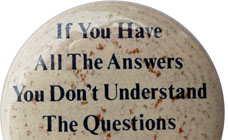
There is a leadership myth that people who are in positions of leadership are required to have all the answers and know everything or they are not leaders.

Many people in leadership positions tend to fall into the traps of this myth. And the results are devastating because more hurt and damage is done by trying to live up to the myth than simply saying “I don’t know, but…”

Because the reality is that when it comes to life questions, none of us have or know all the answers. Ever. There are many things in life that are beyond our human understanding, knowledge, and comprehension.

To pretend that we have all the answers or to believe that we can find all the answers is, at its root, dishonest.

Sometimes it’s unintentional dishonesty. We are trying to do what we think we’re supposed to be doing – the myth. There are several ways this unintentional dishonesty happens.

One way is that we simply don’t understand the nature of the question and we believe we’re answering it when in fact we’re answering another question altogether.

Another way is that we haven’t been where the person asking the question has been or is. In other words, we haven’t experienced firsthand either exactly or to the degree of what that person has or is experiencing, so we have no frame of reference from which to answer their question. But we try to answer it anyway.

And then sometimes it’s intentional dishonesty because of pride, arrogance, and the need to maintain control. We know we don’t know, but we don’t care.

So we make things up, we lie without blinking, and we fool enough of the people enough of the time to gain a lot of people who believe us until our fantasies and our lies fall apart, as all fantasies and lies do in time, and in the wake of them is a bigger swath of destruction and damage than any hurricane, earthquake, volcanic eruption, or tsunami could even begin to touch because we’ve destroyed lives from the inside out.

Destruction and damage to stuff is difficult to deal with and, while some losses are permanent and unrecoverable, a viable measure of recovery is still possible.

no one has all the answers quintessential leaderDestruction and damage to the soul and to the psyche, on the other hand is excruciating, and often times, the possibility of any kind of meaningful recovery is slim to none.

The reality of life is that some things in life simply don’t have answers – at least that are available to us peeps on the planet.

With many life questions, it’s impossible to make a nice, neat list and say, “If you do a, b, c, this will answer x life question.” Life and the unique situations that each of us experience – which generates the questions – as we go through life are not that simple.

If any of us thinks it is, then we simply don’t get it.

So when we are trying to live up to the “leader-knows-all” myth, we not only hurt ourselves and do more damage by “answering” life questions, but we hurt and do a lot of damage to those we’re “answering.”

What, then, do quintessential leaders do? 

This came up recently in a discussion about an “answered” life question that I didn’t – and wouldn’t – ask, but that I have been and am experiencing 24/7 for a long time. And I’ll share with you what I shared in the discussion.

The “answer” was well-intentioned but it had some noticeable flaws and, in the end, was the answer to another question.

I had a physical reaction – my chest tightened up and I really had to work hard for a few minutes to get a grip and calm myself down – at the very beginning of the “answer,” because I knew it wasn’t the answer to the question.

There were disconcerting statements made that literally caused anxiety in me because I knew what was being said – and I’m not even sure the person answering the question realized they said what they said – showed a lack of knowledge, experience, and intimate understanding, even though the person answering the question is very compassionate, caring, and empathetic.

On a personal note, in some ways, at least for me, that’s much, much harder to deal with than someone you know doesn’t care.

And, yet, there would be no way to explain to this person or any other person who has not walked intimately and long-term in the shoes of this – or any other, for that matter – life question that the answers, if there are any, are not always so cut and dry, “this” or “that,” and that, in the big scheme of things, there are a lot of aspects that there are no answers for. 

But as I listened to the “answer,” it became apparent that the life question being answered was not the one that had been asked. I have done and am doing all the things contained in that answer and none of them has answered my life question (which is the same life question the person was attempting to answer).

Quintessential leaders, first and foremost, recognize their limitations. And when it comes to life questions, we are all limited. We don’t have or know all the answers to life questions and we won’t as long as we breathe for a living.

And that’s okay. It doesn’t mean we’re less of a leader. It doesn’t mean we’ve failed. It doesn’t mean that we’ve let other people down. It means that we’re human.

I was asked during the discussion how I would have answered this life question. Since it’s a predominant life question for me right now, I gave the answer I’ve come to accept, but I added what someone who hasn’t walked in the shoes of this life question isn’t really able to in a meaningful way.

My answer? “I don’t know the answer, but I’m asking the same question myself because I’m going through the same thing. I completely understand exactly what you’re asking, why you’re asking it, and what a crushing, 24/7 weight it is on your mind and your life. I can’t solve it for you. I can’t fix it for you. But I can walk, step for step, with you and beside you through it. You are not completely alone.”

My fellow quintessential leaders, “I don’t know” in the matter of life questions is the next best thing to silence if we don’t know or have the answers. It is the product of wisdom. It is also the product of humility.

An abundance of words about something we haven’t experienced firsthand, know little or nothing about in a meaningful way, or simply don’t understand is the worst thing we can do.

Life questions are tough for everyone. Except for the people being intentionally dishonest in answering them, the motivation to find answers is not malicious (in fact, it’s the opposite because we really want to help), but when the answers are hollow or wrong or to a different question altogether, we do more harm than good. 

How are we doing?


Listed below are The Quintessential Leader’s recommendations for articles that all of us quintessential leaders should read and think about this week.

A note about these article recommendations. I am very careful in selecting these and their inclusion here means that I agree with the premise and gist of the article, not necessarily with every single thing that the writer says. 

That’s the purpose of reading and critically thinking. Reading should ignite our thinking and it should cause us to process, weigh, question, answer, accept and reject. I believe that the reasons why groupthink is so prevalent everywhere in society today are because:

(a) most people don’t read substantively

(b) most people have stopped – if they ever knew how – critically thinking about everything

(c) most people have been subtly conditioned to not question anything and everything for its truthfulness and accuracy

(d) most people have not developed an internal database of truth to find answers in (they depend on others to tell them what truth is)

(e) most people don’t have a clue how to accept or reject information coming at them, so everything comes in and stays (and creates confusion). 

Quintessential Leadership is About Breaking ThingsThis quote from “Leadership is About Breaking Things” by Michael Myatt sums up one of the hallmark differences between quintessential leadership and unquintessential leadership: “If you’re more interested in protecting what is than you are finding the answer to what if  you might be in a leadership role, but you’re likely not leading well. Order isn’t all it’s cracked-up to be. In fact, I’d go so far as to say routine is the great enemy of leaders. Conformity to the norm does little more than pour the foundation of obsolescence by creating an environment that shuns change rather than embraces it. Disruption is never found by maintaining the status quo, but it’s most commonly revealed in the chaos that occurs by shattering the status quo. Smart leaders don’t think ‘best’ practices – they focus their attention on discovering ‘next’ practices. The simple fact of the matter is too many leaders are concerned with fixing things, when what they should be doing is breaking things.” 

Note that it is things quintessential leaders break, not people. Unquintessential leaders desperately maintain the status quo and spend all their time and energy on breaking people into yielding and submitting to ways of doing things that often are archaic, inefficient, ineffective, inexplicable, and weren’t even good or right to begin with. 

As quintessential leaders, we must never fall into the trap of “that’s the way we’ve always done it, so that’s the way we’ll continue to do it.” Quintessential leaders know why they’re doing everything and are able to, in their own words, explain, quantify, and show the tangible results – honestly and authentically (no dog-and-pony shows and no smoke and mirrors)- to anyone and everyone.

Quintessential leaders are forward-looking and forward-moving. They never rest on their laurels and they never stop asking “why” and “how.” Quintessential leadership is never static, but instead it is always dynamically improving.

In “Why Leaders Must ‘Get Real’ – 5 Ways to Unlock Authentic Leadership,” by Margie Warrell, the link between authenticity and quintessential leadership is summed up in five key areas where we must be “real.” 

While Guari Sharma’s article, “How to Grow a Small Team: Nine Best Hiring Practices,” focuses on building small teams in a start-up environment, these nine best hiring practices should be part of the way we as quintessential leaders hire.

I am always surprised at how little effort can sometimes be expended in the hiring process as well as how little potential employers think outside of the box with regard to hiring and then the moaning and groaning that comes when the new hires are, at best, mediocre, in key areas of their responsibilities, or, at worst, abysmally poor in all areas of their responsibilities, initiating the 90-day “let’s find a way to get rid of them while we can” probational period that most jobs now have attached to them.

Quintessential leaders are high-level and performance-oriented teambuilders. We understand that investing well and at a high time (and perhaps monetary) cost up front will pay off for everyone involved. Too many people in leadership positions have no long-term and big-picture vision for themselves, their teams, and their organizations, so they hire randomly and sloppily and everyone suffers in terms of progress, success, and profits.

In Dan Rockwell’s, “The Surprising Path to the Top,” the quintessential leadership trait of growing others is discussed. Quintessential leaders are always growing other people in their lives, not just their team members. That is an intrinsic part of who quintessential leaders are. Because quintessential leaders are big-picture thinkers, we realize that helping everyone we have the opportunity to help grow in whatever forms that takes is part of our responsibilities and legacies. 

The reality is that the only thing we take out of this temporary, physical life is our character and the net results of our relationships with God and others. Quintessential leaders take this knowledge to heart and that is where the focus of every aspect of our lives is. And that is why we are always growing others where we are able. We understand it’s never all about “me.”

We understand that our lives and the gifts we’ve been given didn’t originate with us and are not ours to use selfishly. Power and pride and money are never part of the equation. We want financial security, but we will not sell our souls or throw others under the bus time and again to get and keep it. We value integrity, truth, and honesty more highly than anything else in the world. And sometimes that means we take – and they can be big – physical losses and hits. Sometimes we recover and sometimes we don’t on a physical level. But a character loss and hit, while theoretically recoverable, is something we’re not willing to take, because that destroys everything in terms of trust and trustworthiness

This quote from “The Single Greatest Secret of Leadership – Fail Up” by Daniel K. Williams illustrates how quintessential leaders approach failures (their own and those of others): “As leaders, we serve our employees best by not focusing attention on their weaknesses and mistakes. Instead we should encourage them to navigate through challenges on their journey. We can help by asking questions like ‘How do you learn best?’ ‘What could you do better?’ or ‘How can the team better support you in the future?’

The most important thing is to strive to move forward continually. Some days we make great progress in some areas; other days we seem to slide a bit. If we were to chart our progress on a board, it has ups and downs, but overall it should move upward as we live and learn from our mistakes and failures.

Peaks and Valleys of LifeQuintessential leaders understand that this thing called life, which includes our work, is never a straight line, but a series of mountains and valleys that represent our successes and our failures. However, it should be through our failures that we find the greatest opportunities to grow, to change, to move forward, or as Williams puts it “to fail up.”

Quintessential leaders seize those opportunities and do that, not just with themselves, but with everyone on all the teams they lead in life.

May we continue along the quintessential leader path, navigating the mountains and valleys with equanimity and courage, growing ourselves and growing others along the way.

We are in the middle of an incredible process that begins with who we are internally on a foundational level, proceeds with wisdom, knowledge, and application (growth), and results in not only our quintessential leadership being perfected, but also planted and cultivated in everyone with whom our lives intersects.