Posts Tagged ‘trustworthiness’

Leaders Must Have Ethics and Morals - Strength Alone is Not EnoughIt seems to me that the term “leader” has now begun to ring hollow because it’s applied to anybody and everybody in the world who emerges in the top tier of the heap of any social, religious, academic, governmental, or organizational structure, regardless of how they got there.

The reality is that how they got to the top of the heap matters. A lot. Just because people end up in the top tier of any of these venues does not automatically mean they are leaders. Anymore, it often means just the opposite.

Why?

Because how people get to the top of the heap shows the kind of ethical-moral foundation they have. Or don’t have.

While we seem to routinely disconnect how people behave from their intellect, knowledge, and skills, we do ourselves a huge disservice when we don’t consider the whole person, especially when they’re begging us to unconditionally (which, by the way, is unquintessential leadership) follow them.

The presence or absence of an ethical-moral foundation in a person is directly proportional to whether they build trust and are trustworthy or they destroy trust and are not trustworthy.

The reality is that there is very little trust and trustworthiness in the world today. Time and again, most of us prove, often in what we believe are “little things,” that we cannot be trusted and we are not trustworthy. 

Little things,” it turns out, are symptomatic of big things and those big things show whether we have an ethical-moral foundation or not. How is this translated practically? In a word, character. Character embodies these elements: who we are, what we are, our motives, our attitudes, our thoughts, our words, and our actions.

If one or more of those elements doesn’t sync up with the rest, or what we claim to be, then we have a problem with our ethical-moral foundation and we are deficient in character.

There are certain external behaviors that reveal more than others whether we have an ethical-moral foundation. They are:

  1. A pattern of questionable and surreptitious actions that have built-in plausible deniability;
  2. A history of deflecting responsibility and/or changing the subject (avoiding the subject altogether) when confronted with substantiated actions and words;
  3. A prevailing sense of anger and outrage each time these kinds of actions and words occur and we are called on it;
  4. A history of twisting, spinning, angling, deception, and dishonesty that threads through our entire lives;
  5. An overarching pride and arrogance that literally oozes from our pores continually;
  6. An inability to ever admit we are wrong, we’ve done something wrong, and we need to make amends and change those wrongs in a demonstrable way.

I am very rarely completely on the same page as New York Times columnist David Brooks (I find him to be myopic, elitist, and without an objective view of the big picture most of the time, and that leads him to conclusions that are generally lopsided and not entirely accurate), but in his April 28, 2015 op-ed piece, “Goodness and Power,” Brooks nails the integrated relationship between quintessential leadership and an ethical-moral foundation.

Hillary Clinton Dishonest and UntrustworthyBrooks began the piece with the results of a Quinnipiac Poll that showed that 60% of independent voters rated Hillary Clinton as a strong leader. But 61% of those same voters said that Hillary Clinton is not honest and is not trustworthy (here’s the disconnect I referred to before between behavior and intellect, knowledge, and skills).

Then Brooks moves out to the long view that the real ability to lead is directly tied to honesty and trustworthiness by asking the right question: “Can you be a bad person but a strong leader?”

As those of us who are striving to be quintessential leaders know already, the answer is “no.” To paraphrase Brooks, putting “…someone with bad private morals [in a leadership position] is like setting off on a battleship with awesome guns and a rotting hull. There’s a good chance you’re going to sink before the voyage is over.”

Why?

As Brooks notes, people who have no ethical-moral foundation are Machiavellian in their behavior and the end always justifies the means, and in the end what we get is not leadership, but tyranny and despotism.

The lust for power and control is the driving force behind these unquintessential leaders. The dishonesty is that they obscure their real motives with platitudes that sound like they are selfless, sacrificing, giving, and doing this for the good of the people that they actually want power over and want to control.

And here’s the proof. They’ll talk a good talk until they get what they want, but there are always shadows of impropriety, of shadiness, of manipulation, and of deception hanging around them. Nobody trusts them, even if they manage to get a leadership position.

Once they do get a leadership position, these unquintessential leaders reveal their total lack of an ethical-moral foundation in everything they are, they say, and they do.

What does that look like in practice? As we strive to become quintessential leaders, we must be able to not only know what quintessential leadership looks like, but also what it doesn’t look like and we need to make sure we’re always monitoring ourselves to make sure we’re on the right path and haven’t veered off onto the wrong one.

When people without an ethical-moral foundation get into leadership positions, these are the tell-tale signs:

  • Tightened control over everything and everyone (it will be loose during their campaign to be in charge and promises of egalitarianism will abound)
  • A closed inner circle that is an existing network and that is severely limited with very specific criteria so that only those who are already in it can meet them
  • All-or-nothing demands for loyalty and allegiance
  • Big Brother Lack of Ethical-Moral FoundationConstrictive and restrictive rules and regulations
  • Continual threats of retribution and adverse actions if rules and regulations are believed to be broken
  • Constant assertion of authority and superiority to everyone else
  • Constant devaluing of others in attempts to promote and enhance their own value
  • Mistrust and suspicion of everyone else

Look around in your life and see if this looks familiar. It does in my life, because, unfortunately, this is the general tenor of the kind of people in leadership positions in every area of our lives.

It’s become acceptable to not have an ethical-moral foundation and be in a leadership position. Not only is it acceptable, but it is, indeed, preferred.

But as we strive to become quintessential leaders, we can’t just follow the crowd. We can’t use the excuse that everybody else is doing it. We can’t allow ourselves, even if it means we end up being the only person on the planet doing the right thing because we have and we hold on to the right foundation, to ever lose sight of what makes us quintessential leaders.

We are rare for a reason. But there are people, those whom we serve on every team in our lives, who count on the rarity of us having, continuing to fortify, and adhering to an unshakeable ethical-moral foundation.

How are we doing?
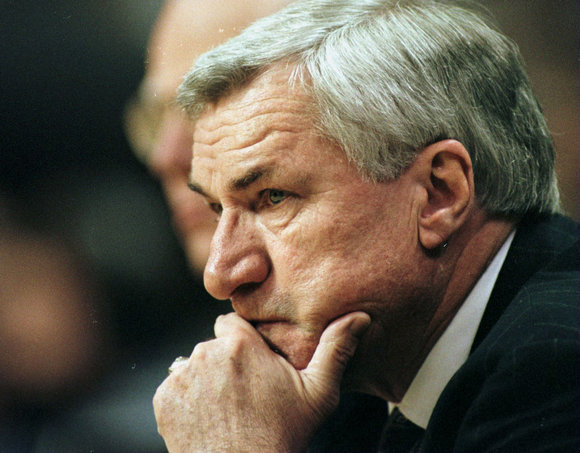


Coach Dean Smith UNC quintessential leaderCoach Dean Smith, who led the University of North Carolina basketball program for 36 years, died on February 7, 2015 after a long battle with dementia. Throughout his coaching career and his life after coaching, Coach Smith embodied many of the characteristics of quintessential leadership.

He was not a perfect man, but none of us can claim perfection either. There were times when he wasn’t a quintessential leader, just as there are times we are not quintessential leaders.

But when Coach Smith’s life as a whole, both on the basketball court and off, is considered (and that’s the only way to consider anyone’s life, including our own, because no one – including each of us – gets it right every single time), it’s clear that his goal was to be a quintessential leader. And the results of his commitment to that goal are evident to this day.

I grew up in North Carolina. But me being an UNC basketball fan was not a given. My dad got his undergraduate degree from Wake Forest and he taught physical therapy at Duke University and did a year of pre-veterinary schools studies at North Carolina State University. My mom studied medical technology at Duke University, which is where she and my dad met and made their lifelong commitment to each other. (more…)

the quintessential leader building trust and being trust worthy book

In the first post of this series, the excerpt from chapter 1 included a list of all the components we must develop and have to build trust and be trustworthy.

In the subsequent chapter excerpts detailing the components we need to have and develop to build trust and be trustworthy, chapter 2 discusses honesty, chapter 3 discusses integrity, andchapter 4 discusses fairness, chapter 5 discussesrighting wrongs, chapter 6 discusses accountability, and chapter 7 discusses consistencychapter 8 discusses sincerity, and chapter 9 discusses setting boundaries.

This post, which includes an excerpt from chapter 10, discusses the component of setting a higher standard that builds trust and makes us trustworthy.

Setting a higher standard should be the first thing people in leadership positions do. Before anything else.

While setting a higher standard goes hand-in-hand with setting boundaries, setting a higher standard establishes evidentiary boundaries of character, which affects every area of our conduct. 

These are standards that we adhere to no matter where we are, what we are doing, or who we are with. And they are standards that we expect the members on our teams to adhere to as well.

Let’s look how a lack of setting a higher standard looks in real life. This should have everyone reading this nodding their heads because there is not one of us who hasn’t seen it.

How many times have we seen someone who seems to have a higher standard of conduct when we’re with them and then they deny that by their conduct (words and actions) when they’re not with us?

On social media, perhaps. With other people, perhaps. In different venues than the one(s) we associate them with. 

Now let me ask the harder question. What was our reaction to their lack of a higher standard?

If we shrugged it off, thinking it was no big deal, or if we were invited and joined into to whatever the conduct was, then we have not set a higher standard for ourselves either.

Only you can answer for yourself and only I can answer for myself, but if we have not set a higher standard, then we are not quintessential leaders and we are destroying trust and not being trustworthy.

Building trust and being trustworthy is an integrated trait of quintessential leaders.

It is also an integrated trait that all of us – because each and every one of us leads at least one team, small or large, of people in our lives – need to develop and have as part of the core of who we are and what we are. In essence, this trait is at the center of exemplary character and conduct, and none of us should settle for anything less than this in ourselves and others.

Unfortunately, most of us settle for less. A lot less. In ourselves. In others. 

The majority of people in leadership positions today are not trust builders and they are not trustworthy. Many of us, frankly, are also not trust builders and trustworthy.

We live in a world that with no moral code as its foundation that expects trust to be non-existent or broken. Look around. It’s everywhere, including, in many cases, very close to you.

And society has become so accustomed to this that it glorifies it instead of condemning it.

Politicians who lie routinely, who line their pockets with money and perks while making decisions that hurt and destroy the people they are supposed to represent, who cheat on their wives because they can.

Arts and sports celebrities who have no regard for faithfulness to their spouses, who live hedonistic lifestyles that destroy their families, the people around them, and, eventually their lives.

Religious leaders who cheat on their wives, who cheat on their taxes, and who scam their congregations both in how they deceitfully handle the word of God and in coercive and corrupt financial matters, acquiring wealth and power in the process.

Business leaders who destroy millions of lives by deceit, fraud, and illegal actions that result in their employees and customers losing everything while they escape any kind of punitive action and instead reap obscene profits and end their tenures – only to go to another financially lucrative position – with golden parachutes that are equally obscene.

And we, as individual leaders for our teams, who cheat on our taxes, who are routinely dishonest with the children (our own and others) and other people entrusted to us, who routinely steal things from our workplaces (you most likely didn’t pay for that pen you’re using at work, so it doesn’t belong to you), who routinely break traffic laws, who will walk out of stores with something we were not charged for and never think twice about it, who will take extra money that we’re not owed in financial transactions without blinking an eye, who cheat on our spouses, who marry until “divorce do us part,” and who, as a course of habit, break confidences of family and friends, gossip about family and friends behind their backs, and destroy reputations in the process.

Maybe we haven’t thought about building trust and being trustworthy at this kind of nitty gritty level.

But until we do – and we develop and have this trait as the core of who and what we are – we will not build trust and we will not be trustworthy. And we will not be quintessential leaders.

Trust and trustworthiness is probably the single most important trait we can possess. And it is also the most fragile.

It can take a long time to build and be, but it can be broken irreparably in a single second.

Therefore, this is a lifetime work on and in ourselves that we must commit to making an integral part of our character by continually developing it, maintaining it, and growing it. 

This goal should be our goal.

But it requires courage. It requires diligence. It requires vigilance. It requires continual self-examination. It requires continual change. It requires the ability to, much of the time, stand alone to maintain.

It is not for the faint-hearted. It is not for the vacillators. It is not for the crowd-pleasers. It is not for the pretenders. It is not for the wannabes. It is not for the weak.

But if you’re reading this, I know that you’re not any of those kinds of people. Those kinds of people won’t even read this because it requires time, effort, change, and commitment, and too many of us are, sadly, either just too lazy or we just don’t care. 

Building Trust and Being Trustworthy takes an in-depth look at the “this is what it looks like in practice” aspect of each of the components we need to develop and have to build trust and be trustworthy. The second chapter discusses the component of honesty in building trust and being trustworthy.

olive-horizontal-line

Excerpt from”Chapter 10: The Setting A Higher Standard Component of Trust and Trustworthiness”

I’ve thought deeply about this component for quite some time as I’ve, over the course of the last few years, observed in almost every area of life – families, politics, education, religion, military, business, society, and in many individual lives, not only the absence of a higher standard of performance and conduct, but increasingly, no-standard of performance and conduct.

It seems that the “anything goes” philosophy has become the norm in the world.

It has, because of the most recent US presidential election, a very thought-provoking article entitled “General Failure,” in the November 2012 issue of The Atlantic – which was written well before the revelation of General David Patraeus’s adultery with his biographer and the possible adultery of General John R. Allen with Jill Kelly – and finally the resignation of General Patraeus from being CIA director, come back full-force into my line of vision.

This kind of behavior (all the parties know each other and are closely linked to each other) among the powerful in Washington, DC, based on what I’ve read and heard about it, is not only commonplace, but is seen as acceptable. 

The initial reactions from people in leadership positions – Senator Dianne Feinstein (D-California), for example, who implied that General Patraeus should not have resigned because he committed adultery – made it evident that not only are people in leadership positions not setting a higher standard for performance and conduct, but there is, in fact, no standard.

It seems to me that before we talk about setting higher standards in terms of performance and conduct, we need to talk about adultery and why it falls into the higher standard category on a personal and leadership level.

Marriage vows are taken based on the trust of two people in each other. By their very nature, they create a trust relationship.

By entering a marriage covenant, both parties are setting, demanding, and promising to adhere to a higher standard of conduct. When either party to those vows, which are made traditionally before God and people, breaks them, that person breaks the trust relationship.

Frankly, if a spouse shows untrustworthiness and destroys the trust in his or her closest personal relationship in life, then he or she is untrustworthy and destroys trust in every part of his or her life.”

the quintessential leader building trust and being trust worthy book

In the first post of this series, the excerpt from chapter 1 included a list of all the components we must develop and have to build trust and be trustworthy.

In the subsequent chapter excerpts detailing the components we need to have and develop to build trust and be trustworthy, chapter 2 discusses honesty, chapter 3 discusses integrity, and chapter 4 discusses fairness, chapter 5 discusses righting wrongs, chapter 6 discusses accountability, and chapter 7 discusses consistency, and chapter 8 discusses sincerity.

This post, which includes an excerpt from chapter 9, discusses the component of setting boundaries that builds trust and makes us trustworthy.

Setting boundaries is not a negative thing. In fact, what it does is create a framework within which we operate and the things and people entrusted to us operate. 

Everyone knows what the framework is and the consequences for operating outside the framework because we consistently and fairly enforce the consequences when the framework is breached.

Why is a framework important? Shouldn’t everybody and everything be able to do whatever they want and however they want without any limitations?

Let me ask you this. Would you live in a house or work in a building that had not been framed before it was built?

Frameworks give a solid foundation, a sturdy structure, and a clearly-defined border, within which there is a lot of room for individual creativity, innovation, and expression.

Without frameworks, however, there is no stability and constant danger of collapse with injuries or fatalities.

We seldom see people in leadership positions who not only don’t set boundaries, but don’t know how to. As a result, everything is a free-for-all and the results are destructive and devastating.

And when the destruction and devastation hits, trust and trustworthiness are extinguished forever.

Building trust and being trustworthy is an integrated trait of quintessential leaders.

It is also an integrated trait that all of us – because each and every one of us leads at least one team, small or large, of people in our lives – need to develop and have as part of the core of who we are and what we are. In essence, this trait is at the center of exemplary character and conduct, and none of us should settle for anything less than this in ourselves and others.

Unfortunately, most of us settle for less. A lot less. In ourselves. In others. 

The majority of people in leadership positions today are not trust builders and they are not trustworthy. Many of us, frankly, are also not trust builders and trustworthy.

We live in a world that with no moral code as its foundation that expects trust to be non-existent or broken. Look around. It’s everywhere, including, in many cases, very close to you.

And society has become so accustomed to this that it glorifies it instead of condemning it.

Politicians who lie routinely, who line their pockets with money and perks while making decisions that hurt and destroy the people they are supposed to represent, who cheat on their wives because they can.

Arts and sports celebrities who have no regard for faithfulness to their spouses, who live hedonistic lifestyles that destroy their families, the people around them, and, eventually their lives.

Religious leaders who cheat on their wives, who cheat on their taxes, and who scam their congregations both in how they deceitfully handle the word of God and in coercive and corrupt financial matters, acquiring wealth and power in the process.

Business leaders who destroy millions of lives by deceit, fraud, and illegal actions that result in their employees and customers losing everything while they escape any kind of punitive action and instead reap obscene profits and end their tenures – only to go to another financially lucrative position – with golden parachutes that are equally obscene.

And we, as individual leaders for our teams, who cheat on our taxes, who are routinely dishonest with the children (our own and others) and other people entrusted to us, who routinely steal things from our workplaces (you most likely didn’t pay for that pen you’re using at work, so it doesn’t belong to you), who routinely break traffic laws, who will walk out of stores with something we were not charged for and never think twice about it, who will take extra money that we’re not owed in financial transactions without blinking an eye, who cheat on our spouses, who marry until “divorce do us part,” and who, as a course of habit, break confidences of family and friends, gossip about family and friends behind their backs, and destroy reputations in the process.

Maybe we haven’t thought about building trust and being trustworthy at this kind of nitty gritty level.

But until we do – and we develop and have this trait as the core of who and what we are – we will not build trust and we will not be trustworthy. And we will not be quintessential leaders.

Trust and trustworthiness is probably the single most important trait we can possess. And it is also the most fragile.

It can take a long time to build and be, but it can be broken irreparably in a single second.

Therefore, this is a lifetime work on and in ourselves that we must commit to making an integral part of our character by continually developing it, maintaining it, and growing it. 

This goal should be our goal.

But it requires courage. It requires diligence. It requires vigilance. It requires continual self-examination. It requires continual change. It requires the ability to, much of the time, stand alone to maintain.

It is not for the faint-hearted. It is not for the vacillators. It is not for the crowd-pleasers. It is not for the pretenders. It is not for the wannabes. It is not for the weak.

But if you’re reading this, I know that you’re not any of those kinds of people. Those kinds of people won’t even read this because it requires time, effort, change, and commitment, and too many of us are, sadly, either just too lazy or we just don’t care. 

Building Trust and Being Trustworthy takes an in-depth look at the “this is what it looks like in practice” aspect of each of the components we need to develop and have to build trust and be trustworthy. The second chapter discusses the component of honesty in building trust and being trustworthy.

olive-horizontal-line

Excerpt from”Chapter 9: The Setting Boundaries Component of Trust and Trustworthiness”

A lack of sincerity has been painfully and increasingly evident in business, political, educational, civil, and religious leadership for quite some time, and it’s becoming the norm instead of the exception.

While sincerity is very closely aligned with honestychange link here to chapter 3 excerpt link: integrity, and authenticity, it is still a distinct component from these other quintessential leadership traits.

Sincerity, put simply, is the opposite of hypocrisy. But we need to define both of those words to see why.

Hypocrisy, in its simplest definition, is a person pretending to be, do, or believe something he or she isn’t, doesn’t do, or doesn’t believe. The Greek root of this word means “play-acting.” In other words, a hypocrite is faking it or perpetuating fraud.

Sincerity, on the other hand, defines a person who actually is, does, and believes everything he or she appears to be, does, and says he or she believes. In other words, a sincere person is “for real,” genuine, and free of pretense and deceit.

Sincerity, then, is a quintessential leader trait and another key component of building trust and being trustworthy.

What sets the component of sincerity apart from honesty, integrity, and authenticity, although, again it is closely related to all of these, is that it indicates a person’s motives or motivations.

This is another aspect of character – a heart issue. The other side of the coin, hypocrisy, also speaks to motives, motivations, and character.

Nowhere recently have we seen hypocrisy abound and sincerity questioned than in the aftermath of Hurricane Sandy, which left a wide and extensive swath of devastation when it merged with two other storms to form a super-storm over the northeast United States on October 29-30, 2012.

the quintessential leader building trust and being trust worthy book

In the first post of this series, the excerpt from chapter 1 included a list of all the components we must develop and have to build trust and be trustworthy.

In the subsequent chapter excerpts detailing the components we need to have and develop to build trust and be trustworthy, chapter 2 discusses honesty, chapter 3 discusses integrity, and chapter 4 discusses fairness, chapter 5 discusses righting wrongs, chapter 6 discusses accountability, and chapter 7 discusses consistency.

This post, which includes an excerpt from chapter 8, discusses the component of sincerity that builds trust and makes us trustworthy.

We can make a good show of appearing to do all the right things and saying all the right words, but if we’re just faking everything then all our efforts amount to nothing.

“Why?,” you ask. “Wouldn’t that be enough?”

The answer is “no.” Because if we don’t believe what we are doing and what we are saying, then no one else is going to believe it – or us – either.

People can spot insincerity a mile away. It oozes out of us in tangible – facial expressions, eyes, gestures – and intangible – tone of voice, attitude, quality of effort – ways.

We can’t hide either sincerity or insincerity, no matter how hard we might try.

Unfortunately, the component of sincerity is almost non-existent among the people who are in leadership positions today. There is so much fake everything all around us and in us that when we do see sincerity, it almost renders us unconscious.

Building trust and being trustworthy is an integrated trait of quintessential leaders.

It is also an integrated trait that all of us – because each and every one of us leads at least one team, small or large, of people in our lives – need to develop and have as part of the core of who we are and what we are. In essence, this trait is at the center of exemplary character and conduct, and none of us should settle for anything less than this in ourselves and others.

Unfortunately, most of us settle for less. A lot less. In ourselves. In others. 

The majority of people in leadership positions today are not trust builders and they are not trustworthy. Many of us, frankly, are also not trust builders and trustworthy.

We live in a world that with no moral code as its foundation that expects trust to be non-existent or broken. Look around. It’s everywhere, including, in many cases, very close to you.

And society has become so accustomed to this that it glorifies it instead of condemning it.

Politicians who lie routinely, who line their pockets with money and perks while making decisions that hurt and destroy the people they are supposed to represent, who cheat on their wives because they can.

Arts and sports celebrities who have no regard for faithfulness to their spouses, who live hedonistic lifestyles that destroy their families, the people around them, and, eventually their lives.

Religious leaders who cheat on their wives, who cheat on their taxes, and who scam their congregations both in how they deceitfully handle the word of God and in coercive and corrupt financial matters, acquiring wealth and power in the process.

Business leaders who destroy millions of lives by deceit, fraud, and illegal actions that result in their employees and customers losing everything while they escape any kind of punitive action and instead reap obscene profits and end their tenures – only to go to another financially lucrative position – with golden parachutes that are equally obscene.

And we, as individual leaders for our teams, who cheat on our taxes, who are routinely dishonest with the children (our own and others) and other people entrusted to us, who routinely steal things from our workplaces (you most likely didn’t pay for that pen you’re using at work, so it doesn’t belong to you), who routinely break traffic laws, who will walk out of stores with something we were not charged for and never think twice about it, who will take extra money that we’re not owed in financial transactions without blinking an eye, who cheat on our spouses, who marry until “divorce do us part,” and who, as a course of habit, break confidences of family and friends, gossip about family and friends behind their backs, and destroy reputations in the process.

Maybe we haven’t thought about building trust and being trustworthy at this kind of nitty gritty level.

But until we do – and we develop and have this trait as the core of who and what we are – we will not build trust and we will not be trustworthy. And we will not be quintessential leaders.

Trust and trustworthiness is probably the single most important trait we can possess. And it is also the most fragile.

It can take a long time to build and be, but it can be broken irreparably in a single second.

Therefore, this is a lifetime work on and in ourselves that we must commit to making an integral part of our character by continually developing it, maintaining it, and growing it. 

This goal should be our goal.

But it requires courage. It requires diligence. It requires vigilance. It requires continual self-examination. It requires continual change. It requires the ability to, much of the time, stand alone to maintain.

It is not for the faint-hearted. It is not for the vacillators. It is not for the crowd-pleasers. It is not for the pretenders. It is not for the wannabes. It is not for the weak.

But if you’re reading this, I know that you’re not any of those kinds of people. Those kinds of people won’t even read this because it requires time, effort, change, and commitment, and too many of us are, sadly, either just too lazy or we just don’t care. 

Building Trust and Being Trustworthy takes an in-depth look at the “this is what it looks like in practice” aspect of each of the components we need to develop and have to build trust and be trustworthy. The second chapter discusses the component of honesty in building trust and being trustworthy.

olive-horizontal-line

Excerpt from”Chapter 8: The Sincerity Component of Trust and Trustworthiness”

A lack of sincerity has been painfully and increasingly evident in business, political, educational, civil, and religious leadership for quite some time, and it’s becoming the norm instead of the exception.

While sincerity is very closely aligned with honestychange link here to chapter 3 excerpt link: integrity, and authenticity, it is still a distinct component from these other quintessential leadership traits.

Sincerity, put simply, is the opposite of hypocrisy. But we need to define both of those words to see why.

Hypocrisy, in its simplest definition, is a person pretending to be, do, or believe something he or she isn’t, doesn’t do, or doesn’t believe. The Greek root of this word means “play-acting.” In other words, a hypocrite is faking it or perpetuating fraud.

Sincerity, on the other hand, defines a person who actually is, does, and believes everything he or she appears to be, does, and says he or she believes. In other words, a sincere person is “for real,” genuine, and free of pretense and deceit.

Sincerity, then, is a quintessential leader trait and another key component of building trust and being trustworthy.

What sets the component of sincerity apart from honesty, integrity, and authenticity, although, again it is closely related to all of these, is that it indicates a person’s motives or motivations.

This is another aspect of character – a heart issue. The other side of the coin, hypocrisy, also speaks to motives, motivations, and character.

Nowhere recently have we seen hypocrisy abound and sincerity questioned than in the aftermath of Hurricane Sandy, which left a wide and extensive swath of devastation when it merged with two other storms to form a super-storm over the northeast United States on October 29-30, 2012.

the quintessential leader building trust and being trust worthy book

In the first post of this series, the excerpt from chapter 1 included a list of all the components we must develop and have to build trust and be trustworthy.

In the subsequent chapter excerpts detailing the components we need to have and develop to build trust and be trustworthy, chapter 2 discusses honesty, chapter 3 discusses integrity, and chapter 4 discusses fairness, chapter 5 discusses righting wrongs, and chapter 6 discusses accountability.

This post, which includes an excerpt from chapter 7, discusses the component of consistency that builds trust and makes us trustworthy.

Being consistent in our lives as humans is often very difficult. The reasons for this difficulty are quite simple:

  • Our conduct is a reflection of our feelings, which are constantly changing, instead of our thinking, which is – or should be – more unchangeable in all the things and ways that matter
  • We do not have a solid foundation and core of principles, absolute right and wrong, acceptable and unacceptable, and good and bad that we adhere to ourselves and apply equally to everything and everyone else in our lives without exception

Inconsistency is extremely damaging in every way.

It creates instability, unreliability, fear, reluctance, malaise, disenfranchisement, alienation, and excessively-high stress levels.

Inconsistency completely inhibits the ability to plan, to project, and to grow. It also prevents teams from developing and reaching their potential and will eventually lead to high attrition rates. 

And, yet, consistency is impossible to find in many people who are leadership positions today. Randomness and chaos seem to rule every corner of the world and that is a big contributor to the prevalent lack of trust in and untrustworthiness of the majority of people who are in leadership positions now.

Building trust and being trustworthy is an integrated trait of quintessential leaders.

It is also an integrated trait that all of us – because each and every one of us leads at least one team, small or large, of people in our lives – need to develop and have as part of the core of who we are and what we are. In essence, this trait is at the center of exemplary character and conduct, and none of us should settle for anything less than this in ourselves and others.

Unfortunately, most of us settle for less. A lot less. In ourselves. In others. 

The majority of people in leadership positions today are not trust builders and they are not trustworthy. Many of us, frankly, are also not trust builders and trustworthy.

We live in a world that with no moral code as its foundation that expects trust to be non-existent or broken. Look around. It’s everywhere, including, in many cases, very close to you.

And society has become so accustomed to this that it glorifies it instead of condemning it.

Politicians who lie routinely, who line their pockets with money and perks while making decisions that hurt and destroy the people they are supposed to represent, who cheat on their wives because they can.

Arts and sports celebrities who have no regard for faithfulness to their spouses, who live hedonistic lifestyles that destroy their families, the people around them, and, eventually their lives.

Religious leaders who cheat on their wives, who cheat on their taxes, and who scam their congregations both in how they deceitfully handle the word of God and in coercive and corrupt financial matters, acquiring wealth and power in the process.

Business leaders who destroy millions of lives by deceit, fraud, and illegal actions that result in their employees and customers losing everything while they escape any kind of punitive action and instead reap obscene profits and end their tenures – only to go to another financially lucrative position – with golden parachutes that are equally obscene.

And we, as individual leaders for our teams, who cheat on our taxes, who are routinely dishonest with the children (our own and others) and other people entrusted to us, who routinely steal things from our workplaces (you most likely didn’t pay for that pen you’re using at work, so it doesn’t belong to you), who routinely break traffic laws, who will walk out of stores with something we were not charged for and never think twice about it, who will take extra money that we’re not owed in financial transactions without blinking an eye, who cheat on our spouses, who marry until “divorce do us part,” and who, as a course of habit, break confidences of family and friends, gossip about family and friends behind their backs, and destroy reputations in the process.

Maybe we haven’t thought about building trust and being trustworthy at this kind of nitty gritty level.

But until we do – and we develop and have this trait as the core of who and what we are – we will not build trust and we will not be trustworthy. And we will not be quintessential leaders.

Trust and trustworthiness is probably the single most important trait we can possess. And it is also the most fragile.

It can take a long time to build and be, but it can be broken irreparably in a single second.

Therefore, this is a lifetime work on and in ourselves that we must commit to making an integral part of our character by continually developing it, maintaining it, and growing it. 

This goal should be our goal.

But it requires courage. It requires diligence. It requires vigilance. It requires continual self-examination. It requires continual change. It requires the ability to, much of the time, stand alone to maintain.

It is not for the faint-hearted. It is not for the vacillators. It is not for the crowd-pleasers. It is not for the pretenders. It is not for the wannabes. It is not for the weak.

But if you’re reading this, I know that you’re not any of those kinds of people. Those kinds of people won’t even read this because it requires time, effort, change, and commitment, and too many of us are, sadly, either just too lazy or we just don’t care. 

Building Trust and Being Trustworthy takes an in-depth look at the “this is what it looks like in practice” aspect of each of the components we need to develop and have to build trust and be trustworthy. The second chapter discusses the component of honesty in building trust and being trustworthy.

olive-horizontal-line

Excerpt from”Chapter 7: The Consistency Component of Trust and Trustworthiness”

What this means in practical terms is that a quintessential leader is who he or she says he or she is and that he or she is what he or she says they believe – all the time, without exception. When we as quintessential leaders practice consistency, our teams always know what to expect and that helps to create an organized, sensible and predictable environment in which team members can operate, grow, and thrive.

When those who claim to be leaders don’t practice consistency, they become very much like Robert Louis Stevenson’s Dr. Jekyll and Mr. Hyde. The environment for their teams is chaotic, confusing and unpredictable and is characterized by constant fear and failure to thrive.

Consistency, like all the other components of trust and trustworthiness, is a rare commodity in any part of life today. It goes hand-in-hand with fairness and character. In society, in parenting, in politics, in religion, and in business, consistency has been replaced by expediency. The lack of consistency that overshadows humanity now is also a reflection of the “it’s all about me” mindset that seems to be the driving force in most people today.

Convictions, commitments, principles are built on foundations of sand that shift continuously (and are, therefore, broken almost as soon as they are made) depending on the situation at the moment. Most people and most people in leadership positions are more concerned about how things will effect them personally and how things look than they are about consistency, fairness, and character. 

That is a sad commentary on what we as a society have become. However, quintessential leaders don’t follow the crowd and allow society to mold and shape them (“everybody else is doing it, so it must be okay”), but instead stay on the path of building trust and being trustworthy and they exhibit consistency no matter what the situation both as leaders and examples to others. 

I was recently at a conference where I saw a lot of glaring examples of inconsistency among people in leadership positions.

But one stood out more than most of the others.

A presenter had three presentations during the conference.

In his first presentation, he made some erroneous and unsupported statements that left many of us scratching our heads.

In his second presentation, he was on target with everything and was able to fully provide support for the whole presentation. 

In his third presentation, he went back to the erroneous and unsupported statements of the first presentation and actually expanded on them.

The problem? The speaker’s second presentation completely contradicted what he said in his first and third presentations.”