Posts Tagged ‘unquintessential leader’

Unquintessential leader attribute: cowardiceI recently discussed some of the attributes that set quintessential leaders apart. In this post, we will look at the flip side of this and discuss some of the attributes of unquintessential leaders.

One attribute of unquintessential leaders is cowardice. The way this often manifests itself is that unquintessential leaders will appoint surrogates to be the “bad guys” (these are team members who unwittingly are people-pleasers and who are always willing to be the first to raise their hands whenever someone in a leadership position asks for volunteers).
(more…)

General Motors Gets a Slap on the Wrist for Defective Ignition Switch and 124 - So Far - DeathsUpdate 9/18/15:

The number of deaths linked to the defective ignition switch – a $5 part that could have been easily fixed – that General Motors knew about for years and yet sold millions of cars with them has risen to 124 (that number will most certainly go higher).

It was announced on September 16, 2015 that “In a settlement with prosecutors, no individual employees were charged, and the Justice Department agreed to defer prosecution of the company for three years. If G.M. adheres to the agreement, which includes independent monitoring of its safety practices, the company can have its record wiped clean.”

Update 12/14/14:

42 deaths from car accidents in General Motors models have now been linked to the faulty ignition switch problem. 

Update 11/11/14:

unquintessential leadership gm delphi ignition switch deathEmails uncovered by the Wall Street Journal show that General Motors ordered a half million redesigned ignition switches from Delphi two months before the auto manufacturer issued a recall on some – but not all – vehicles with the defective ignition switch installed.

As of October 30, 2014, the number of deaths acknowledged by GM to be directly linked to the faulty ignition switch has risen from 13 to 30.

However, General Motors continues to maintain that the people in leadership positions – the executive team – in the company had no idea about the ignition switch problem, the order to Delphi for replacement ignition switches that cost GM approximately $3 million, or the need for a general recall.

yellow-dividing-line

General Motors’ 2nd quarter profits, posted on July 24, 2014, dropped 85% from their 2nd quarter 2013 profits. Frankly, it’s incredulous to me, given the financial hit the U.S. automaker has taken in massive recalls due to years of knowingly using substandard and faulty equipment, which is directly tied to 13 known fatalities, that General Motors (GM) is making any profit at all. 

To those GM customers who’ve been impacted by the lack of quintessential leadership that has been in place at the auto manufacturer for decades – and, in my opinion, still could be with the current GM CEO Mary Barra, who began her career with GM since 1980 with a degree in electrical engineering, and in leadership positions within the company since earning her MBA in 1988 – that GM has any profits at all is likely a bitter pill to swallow.

faulty ignition switch unquintessential leader general motorsI will not recount the entire unquintessential leadership history of GM here. That would be a book to write and with writing a new book already currently in the works, I don’t have time to commit to another. However, I will highlight several areas where unquintessential leadership existed/exists and will include links that provide more detailed information about them.

The paramount unquintessential leadership trait of GM is they routinely put corporate profits above the safety of their customers

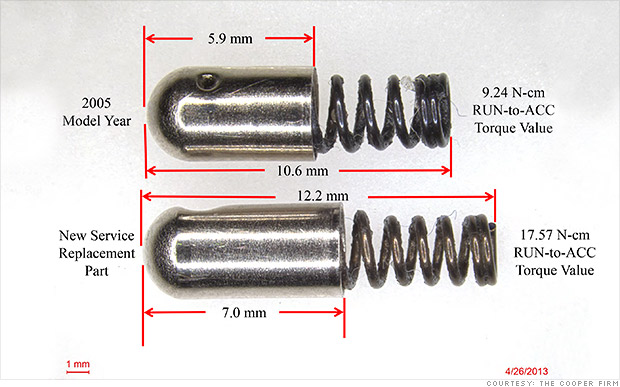
Starting in 2003, GM engineers redesigned and ordered modified ignition switches – with a torque setting that was below GM’s minimum requirements – from its supplier, Delphi. The cost of an ignition switch? 57 cents.

From 2004 to 2013, thirteen fatalities occurred involving GM cars that had the modified ignition switches installed. All but one of the accidents were single-vehicle crashes where the drivers lost control and crashed head-on into something, in most cases a tree. In none of the crashes did the airbags deploy.

Additionally, beginning around the same time period as the first accident, GM car owners began reporting that their midsize and compact-size vehicles were randomly and intermittently shutting off while they were driving them. 

In the 2004 crash involving a Saturn Ion that killed Gene Erickson, GM told federal investigators, who couldn’t understand why the car suddenly swerved into a tree and the airbags didn’t deploy, that the company didn’t have any answers as to why either.

However, just a month before GM talked with federal regulators about the accident, a GM engineer had concluded that the Ion had probably lost power, which would have prevented the airbags from deploying.

Investigations into fatal car accidents where mechanical failure is the most plausible explanation involve the National Highway Traffic Safety Administration contacting the automobile manufacturer to see if (a) they have any similar reports; (b) if their engineers have determined a cause, using the car’s “black box” data; and, (3) whether it is an isolated problem or one that could require a general recall.

GM showed its unquintessential leadership trait of self-centeredness when decided to lie and obfuscate in the Erickson case because of money. Fines for an inexpensive part not meeting the company’s minimum standard, a possible lawsuit by Mr. Erickson’s family, and a large recall would have cut into GM’s profits. The shareholders wouldn’t be happy. People might lose their jobs. 

Therefore, GM’s response to federal inquiries into the subsequent 12 fatalities involving GM cars where mechanical failure was suspected was the same: silence.

Two other unquintessential leadership traits at GM are deception and dishonesty.

faulty ignition switch unquintessential leader gm general motorsIn 2009, despite years of knowledge about the faulty ignition switch and substantial evidence of conscious coverups by GM employees at every level in the company, GM engineers finally began to internally and quietly increase the torque on the faulty ignition switches.  

(And, despite what GM executives have testified to under oath, these engineers had the consent and knowledge of every person in a leadership position in every department – including the legal department, whose head denied any knowledge of the problem until this year – at GM.

To suggest otherwise is dishonest, which is why it remains to be seen if Ms. Barra will become a quintessential leader or will continue in the unquintessential leadership tradition that has, so far, defined GM’s leadership.)

However, when GM’s engineers made the change to the ignition switch, instead of creating a new part number for the ignition switch with the higher torque, which is standard operating procedure when any change is associated with a part or item to distinguish it from similar parts and items, they used the same part number assigned to the faulty ignition switch. This was clearly an act of deception and dishonesty.

(A simple example of distinguishing similar items by part number is how the part numbers of different wattage light bulbs might read: 40-watt bulb (40WBLB); 60-watt bulb (60WBLB); 100-watt bulb (100WBLB); and, 50-100-150-watt bulb (50100150WBLB).) 

The 2.6 billion recall of GM cars now underway is directly related to this deception and dishonesty. Because the two ignition switches didn’t have unique part numbers, there is no way of telling whether GM car owners have the defective switch or the corrected switch. Therefore, GM is having to replace all ignition switches in all GM cars with that part number.

Ms. Barra has a lot left to prove that she is not the latest GM CEO to be an unquintessential leader. When a CEO, who has insurmountable evidence to the contrary, states about a month ago that “I don’t really think there was a cover-up”, followed  by a lot of justifications and excuses, it is clear that Ms. Barra has absorbed a lot of the GM unquintessential leadership in the 34 years she has been employed there and, even if it’s possible, it will take a lot of time and effort to change what to her is a normal definition of leadership.

As always, it’s easy to look at a big corporation like General Motors and objectively see the unquintessential leadership within that company and shake our heads and perhaps even pat ourselves on the backs because “we’re not like that!”

But are we? Maybe not in all areas. Maybe not on the same scale in terms of causing peoples deaths and tanking corporate profits.

But here’s what we need to remember. Even one instance of unquintessential leadership that we don’t learn from and change immediately or just one unquintessential leadership trait that we are unable or unwilling to change, no matter how few people it affects, no matter the scale of the effects, puts us in the same boat as the unquintessential leadership at GM.

There are no degrees of right or wrong, good or bad, quintessential leadership or unquintessential leadership. It either is or isn’t. We either are or aren’t. 

Therefore, my fellow quintessential leaders, we should take a close and thoughful look at why the people in leadership positions at GM are unquintessential leaders and examine ourselves in the light of the unquintessential leadership traits we’ve outlined today.

How are we doing?

Authenticity is Who and What Quintessential Leaders AreA discernible trait of quintessential leaders is that we are continually striving for authenticity in every part of who, what, and how we are. It is an easily-identifiable part of our character which is borne out by our behavior.

One of the easiest aspects of behavior that shows us what both unquintessential leadership and quintessential leadership looks like is in our verbal and written communication with others.

Whether we are authentic or unauthentic is plain to see by what words we say and write and how we say and write them. 

The words we choose and the method we use to convey those words provide vital insights into whether we are striving for authenticity or whether we are, at the heart, core, and soul of who we are, either struggling with inauthenticity or we are truly committed to being inauthentic as a matter of course.

I make the distinction between struggling with inauthenticity and being committed to it because it’s important for all of us to understand that quintessential leaders will struggle at times with inauthenticity, while unquintessential leaders don’t struggle at all with it because being inauthentic is a committed way of being for them.

So what makes the difference between struggling with inauthenticity and being committed to it?

Awareness is the difference.

Quintessential leaders who are being inauthentic are not aware of being inauthentic, but as soon as they become aware of the inauthenticity, they commit to changing it immediately.

Unquintessential leaders, on the other hand, are fully aware of being inauthentic and are determined to remain inauthentic.

How do I know this? Because I’ve struggled with inauthenticity at times and not even realized it. However, once it hit me between the eyes, opening my eyes to an area of inauthenticity, I immediately made and fulfilled the commitment to change it.

Not being aware of inauthenticity is a part of the growth cycle for humans and the mature development of quintessential leaders (if all of us were already perfect, we’d have absolutely nothing to do and no place to go and life would be interminably boring and meaningless). 

However, it is often the case – to our shame and discredit – that as we who are striving to be quintessential leaders are unaware of our own areas of inauthenticity, we are eager to and constantly pointing, in public venues and in condemning language, out the areas of inauthenticity in other growing-into-quintessential-leaders who are unaware of their own areas of inauthenticity. 

This is unquintessential leadership behavior. Quintessential leaders examine themselves and they focus on changing what they need to change. They do not constantly exalt themselves as paragons of virtue and continually look around at everyone else and proclaim, for the whole world to see, their faults and shortcomings.

Instead, they work diligently to be an example, in every area of their lives, of what quintessential leadership looks like. They know that action – their own work on themselves – can be a powerful motivator and teacher for everyone with whom their lives intersect.

They also know that constant and public criticism and condemnation is not only a powerful demotivator, but a lousy example for anyone to follow and emulate (unfortunately, human nature tends toward this kind of behavior, so there are always plenty of admirers and supporters in criticism and condemnation of other people).

So before we look at what authenticity in communication looks like, let’s first look at what it doesn’t look like.

Vladimar Nabokov wrote, “Words without experience are meaningless.” I would clarify this to say that any words spoken or written without experience or empathy (literally the ability and choice to walk in the shoes of someone else’s experience and understand that experience from their perspective) and compassion are meaningless.

Inauthenticity in communication says and writes words that are empty and hollow because the person communicating them either has never experienced what they are communicating about or they lack empathy and compassion, choosing to assume they know something they don’t or choosing to pass judgment without facts, without understanding, and without knowledge.

This is unquintessential leadership because pride and arrogance are behind the communication as well as a total lack of kindness and gentleness. In other words, the communicator believes, even though they don’t have clue nor do they care what they’re talking about, that they are entitled to say or write the words as well as being harsh and condemning in the process.

Inauthenticity in communication is also evident in the common behavior of simply parroting cliches, “conventional wisdom,” and idioms because it seems like the right thing to say or write.

There is no thought or depth that goes into these utterances. In fact, this is the cheap and easy way out: we throw a well-worn phrase that sounds good and we’ve heard all our lives at someone else, check it off our list (while patting ourselves on the back for our generosity and benevolence toward the poor souls we communicated with), erase it permanently, and go blissfully on with our unimpacted lives without missing a beat.

Parroting as a method of communication is unquintessential leadership for a couple of reasons.

The first is motivation. We’re communicating something we’ve always heard – but most of the time have not had to put to the test of veracity through experience – because it makes us feel better, not because it will make the person we’re communicating with feel better.

The second reason parroting is unquintessential leadership is because we are not taking the person we’re communicating with into account at all. We don’t seek insight and understanding by taking the time to really listen to them – we may hear them, but there’s a world of difference between just hearing and really listening – nor do we take the time to think about the kind of communication we would want from someone if we were in the same or similar circumstances. 

By simply parroting something we’ve heard but have no evidence or proof of its value and/or truth, we effectively complete dismiss the person we’re communicating with and we tell them we don’t care about them and they are not important enough to us for us to waste our time with them.

So now that we know what it doesn’t look like, let’s discuss what authenticity in communication – quintessential leadership – does look like.

Unfortunately, as Nabokov stated, experience is often how we gain the ability to be authentic in our communication with other people. However, whether we have authenticity in our communication with others still comes down to us making the choice to be authentic.

Choosing authenticity in our communication with other people requires an investment from us. In them. In time. In effort. In carefulness.

In a society where unquintessential leadership abounds, as well as entitlement and “it’s all about me,” the selflessness required for this kind of investment has all but disappeared.

The difference between empathy and sympathyBut quintessential leaders know that they don’t have to have experienced something to be authentic in their communication with other people. And because of their commitment to developing unimpeachable character, two of the highly-developed traits they have are empathy and compassion for other people.

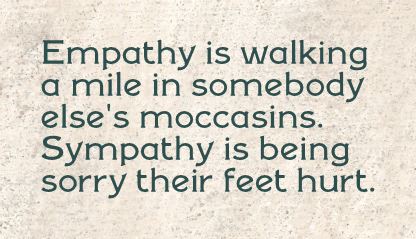
Empathy, like most of the other traits that make quintessential leaders trustworthy, is very rare and getting rarer. Most people believe that sympathy and empathy are the same thing and they are not.

Sympathy takes no long-term investment in another person: it tends to be a hands-off, “one-and-done” event.

Empathy, on the other hand, is a hands-on, long-term, hand-in-hand walk through the journey of – and with – another person. It is seeing through their eyes, understanding through their thoughts and emotions, and listening with interaction to know what is really behind their communication (often the words that are said or written have something else entirely behind them).

Compassion is always a by-product of and a companion of empathy. It is understanding, encouraging, invested, gentle, kind, and patient. It can be – and should be – the result of our own struggles, setbacks, and hard times in life. 

But because compassion and empathy are so interrelated, many people choose a lack of compassion because they offer only sympathy as a one-time-shot to other people.

These same people also, ironically, do everything in their power to evoke compassion toward themselves, including constant manipulation, self-exaltation, and telling everyone how they are not like all those other poor slobs in the world who don’t deserve anyone’s compassion.

This is the Scarlett O’Hara (Gone With the Wind) syndrome, because like Margaret Mitchell’s infamous anti-heroine, in the end, everything is all about them and they refuse to share the stage of life with anyone else.

Another area that demonstrates the authenticity of quintessential leaders in communication with other people is that quintessential leaders do not parrot cliches, “conventional wisdom,” or idioms. Instead, quintessential leaders consider carefully the impact of their words and how they use them.

Because quintessential leaders are invested in other people, they understand and are sensitive to the needs that exist.

Words have power and weightThey are also profoundly aware of the power of words, the impact of words, and the effect of words. 

They are not cavalier with words, simply letting whatever comes immediately to mind come out in their speech and writing. They always spend a considerable amount of time looking for ways to deeply and encouragingly communicate and avoiding hurt and offense. 

They know and understand that even words that may advocate a course correction should build up and not tear down. That can’t be done with parroting something someone else has said or something they’ve heard all their lives. It can only be done with original thought combined with empathy and compassion.

This is just one aspect of behavior that makes quintessential leaders rare in society today.

But each of us is striving to become a quintessential leader, so this must be a behavior we develop, grow, and exhibit everywhere in our lives and model for all the teams we lead in our lives. 

I say this often, but it cannot be repeated too much. If you breathe for a living, you lead at least one team in your life. Quintessential leadership is not confined to organizations, and can, therefore, be dismissed by everyone else. 

Somebody in your life is looking to you and depending on you to model leadership for them. It might be your children. It might be your students. It might be your family members. It might be your spouse. It might be your coworkers. It might be your friends. It might be the sports team you coach. It might be the volunteer groups you are involved with. It might be anybody.

So, as always, we must look in our own mirrors and conduct a thorough, extensive, comprehensive, and fearlessly honest evaluation of what our communication with other people looks like.

Are we inauthentic anywhere or everywhere in our communication with other people? 

If we are, is it because we lack awareness of our inauthenticity in our communication with other people?

Or is it because we’ve deliberately committed to a path of inauthenticity in our communication with other people?

If we find authenticity in our communication with other people, are we committed to preserving that and developing it to the point where it is literally a part of who and what we are all the time?

I can only answer these questions for myself. Each of you can answer them only for yourselves. Do we have the character and the courage to look, to see, to answer, and to change where and if we need to?

How are we doing?
The Unquintessential Leadership Trait of Character AssassinationWe humans have a lot of things, good and bad, in common despite all the things that make us different and unique individually from each other. Today we’re going to discuss one of the prevailing bad things we have in common, which is a hallmark trait of unquintessential leadership.

That unquintessential leadership trait is character assassination. But this unquintessential leadership trait is not isolated just to those who routinely assassinate the character of other people. It extends to those people who listen to the character assassination, who believe the character assassination without verification or proof, who perpetuate the character assassination, and who applaud the person who is assassinating another person’s character.

In other words, character assassination can be both active and passive. The active forms are initiating and perpetuating the assassination of someone else’s character. The passive forms are listening to, believing without verifying or proving, and applauding the assassination of someone else’s character.

Although any assassination of another person’s character is unquintessential leadership in action, the most hurtful types of character assassination are those that are perpetrated by, listened to, believed by, perpetuated by, and applauded by people who are supposedly friends of the people whose character is being assassinated.

Character Assassination is an Unquintessential Leadership TraitWith friends like these, who needs enemies?

We humans innately have a tendency to talk too much. In that eagerness to speak, we also tend to talk without thinking and say things in the heat of emotional upheaval. In these cases, we usually don’t mean the things we say and, if we’re quintessential leaders, as soon as we realize we’ve hurt or offended someone, we apologize and make amends.

Character assassination, on the other hand, is a calculated and deliberate campaign of words composed of outright lies, half-truths, manipulation, insinuation, and instigation that has the sole intent of destroying not only the reputation and integrity of another person, but the person themselves. Anyone who participates in this actively or passively is showing themselves to be unquintessential leaders.

With the advent of social media, character assassination has become prolific, public, egregious, and normal.

It’s as though we humans check our brains, turn off all the filters of common decency, forget the Golden Rule entirely, and embrace the darkest parts of our human nature at the door of social media.

Although the methodologies differ – and are sometimes so subtle, they are difficult to recognize  – the intent and the result is the same.

And, more often than not, the people whose character is being assassinated don’t even know that it’s happened or is happening. Others just suddenly disappear out of their lives or consciously avoid them altogether and the people who’ve been the victims of character assassination have no idea why. 

So what does the perpetration of character assassination look like in practice? 

  1. Keeping the wording vague, but malicious, and keeping the victim anonymous, the perpetrator makes sure everybody knows how “awful” the maligned person is with cutting words and harsh condemnations that indicate that the perpetrator can perfectly read thoughts, attitudes, intents, motives, actions, and hearts (if we really believe that we can do this with other people, then we are unquintessential leaders, because we can’t).
  2. Baiting people by providing tantalizing and derogatory information about someone else.
  3. Twisting words to make it look like someone said or intended something they did not.
  4. Taking innocent actions – with no knowledge of what is actually going on – and making them seem sinister, salacious, or wrong.
  5. Gossiping and spreading rumors about someone.
  6. Tearing someone down to others.

The roots of why unquintessential leaders initiate and participate in character assassation are two-fold and speak to the character of the initiators and participators. 

The first root is jealousy. Generally, people who are victims of character assassination are persistent, genuine, proactive and original, and doing everything in their power to make positive movement forward. Usually, they’re doing it steadily and quietly, but the impact is readily apparent. 

Narcissism is a Root of Character AssassinationUnquintessential leaders are generally imitators and copiers. They make a lot of noise and constantly scream “Hey, look at me!” but the noise is unoriginal, often hackneyed, and always copied from someone else. Therefore, they are jealous of people who don’t imitate and don’t copy other people, but actually do the hard work of research, innovation, and original creation.

For unquintessential leaders, the only way to quiet their jealousy and to hope to minimize or eliminate the impact of a person’s honesty, authenticity, originality and forward motion is to assassinate that person’s character.

The second root of character assassination is a darker  aspect of human nature that unquintessential leaders give in to routinely and that is finding a perverse joy and fulfillment in either watching somebody destroyed or destroying that person themselves. 

There seems to be an ugly pride and smugness among unquintessential leaders when they’ve assassinated someone’s character. Ironically, unquintessential leaders use these opportunities to talk about how awesome, how great, and how wonderful they are, sometimes in comparison to the person whose character they have assassinated, but, more often than not, because for unquintessential leaders it’s all about me, they simply sing their own praises and invite everybody else to join in their song.

And now, my friends, it’s that time when we all honestly look into our own mirrors and examine ourselves to see if we have the unquintessential leadership trait of character assassination in our lives.

Do we routinely assassinate the character of other people:

  1. Via social media or other means of communication, by stating or insinuating that those people are deficient and defective in character, attitude, motive, action, mindset, etc.? (It’s important to remember that those people aren’t there to defend themselves – and likely don’t even know what’s being said about them – nor are they able set the record straight so what we’re saying is one-sided and never the whole story.)
  2. By spreading rumors and gossip about them?
  3. By listening to a perpetrator’s character assassination of them?
  4. By believing without verification or proof a perpetrator’s character assassination of them?
  5. By perpetuating a perpetrator’s character assassination of them?
  6. By applauding a perpetrator’s character assassination of them?

I can only answer these questions for myself by honestly looking in the mirror of my own life. You can only answer them for yourself by doing the same.

How are we doing?


distortion of truth unquintessential leaderA couple of things have happened in February 2015 that have really made it obvious how thoroughly entrenched unquintessential leaders are in our society and how few quintessential leaders actually exist.

These two things may look like they are completely unrelated on the surface, but in fact they both underline how extant hypocrisy, revisionist history, and distortion are within the very fabric of our society.

That, to date, no one has looked at the big picture and connected the dots in any of these things to show the trifecta of unquintessential leadership – hypocrisy, revisionist history, and distortion – is a testimony that quintessential leaders are almost nonexistent on this planet. (more…)

Update: 12/16/14:

42 deaths from car accidents in General Motors models have now been linked to the faulty ignition switch problem. 

Update 11/11/14:

unquintessential leadership gm delphi ignition switch deathEmails uncovered by the Wall Street Journal show that General Motors ordered a half million redesigned ignition switches from Delphi two months before the auto manufacturer issued a recall on some – but not all – vehicles with the defective ignition switch installed.

As of October 30, 2014, the number of deaths acknowledged by GM to be directly linked to the faulty ignition switch has risen from 13 to 30.

However, General Motors continues to maintain that the people in leadership positions – the executive team – in the company had no idea about the ignition switch problem, the order to Delphi for replacement ignition switches that cost GM approximately $3 million, or the need for a general recall.

yellow-dividing-line

General Motors’ 2nd quarter profits, posted yesterday (July 24, 2014), dropped 85% from their 2nd quarter 2013 profits. Frankly, it’s incredulous to me, given the financial hit the U.S. automaker has taken in massive recalls due to years of knowingly using substandard and faulty equipment, which is directly tied to 13 known fatalities, that General Motors (GM) is making any profit at all. 

To those GM customers who’ve been impacted by the lack of quintessential leadership that has been in place at the auto manufacturer for decades – and, in my opinion, still could be with the current GM CEO Mary Barra, who began her career with GM since 1980 with a degree in electrical engineering, and in leadership positions within the company since earning her MBA in 1988 – that GM has any profits at all is likely a bitter pill to swallow.

faulty ignition switch unquintessential leader general motorsI will not recount the entire unquintessential leadership history of GM here. That would be a book to write and with writing a new book already currently in the works, I don’t have time to commit to another. However, I will highlight several areas where unquintessential leadership existed/exists and will include links that provide more detailed information about them.

The paramount unquintessential leadership trait of GM is they routinely put corporate profits above the safety of their customers

Starting in 2003, GM engineers redesigned and ordered modified ignition switches – with a torque setting that was below GM’s minimum requirements – from its supplier, Delphi. The cost of an ignition switch? 57 cents.

From 2004 to 2013, thirteen fatalities occurred involving GM cars that had the modified ignition switches installed. All but one of the accidents were single-vehicle crashes where the drivers lost control and crashed head-on into something, in most cases a tree. In none of the crashes did the airbags deploy.

Additionally, beginning around the same time period as the first accident, GM car owners began reporting that their midsize and compact-size vehicles were randomly and intermittently shutting off while they were driving them. 

In the 2004 crash involving a Saturn Ion that killed Gene Erickson, GM told federal investigators, who couldn’t understand why the car suddenly swerved into a tree and the airbags didn’t deploy, that the company didn’t have any answers as to why either.

However, just a month before GM talked with federal regulators about the accident, a GM engineer had concluded that the Ion had probably lost power, which would have prevented the airbags from deploying.

Investigations into fatal car accidents where mechanical failure is the most plausible explanation involve the National Highway Traffic Safety Administration contacting the automobile manufacturer to see if (a) they have any similar reports; (b) if their engineers have determined a cause, using the car’s “black box” data; and, (3) whether it is an isolated problem or one that could require a general recall.

GM showed its unquintessential leadership trait of self-centeredness when decided to lie and obfuscate in the Erickson case because of money. Fines for an inexpensive part not meeting the company’s minimum standard, a possible lawsuit by Mr. Erickson’s family, and a large recall would have cut into GM’s profits. The shareholders wouldn’t be happy. People might lose their jobs. 

Therefore, GM’s response to federal inquiries into the subsequent 12 fatalities involving GM cars where mechanical failure was suspected was the same: silence.

Two other unquintessential leadership traits at GM are deception and dishonesty.

faulty ignition switch unquintessential leader gm general motorsIn 2009, despite years of knowledge about the faulty ignition switch and substantial evidence of conscious coverups by GM employees at every level in the company, GM engineers finally began to internally and quietly increase the torque on the faulty ignition switches.  

(And, despite what GM executives have testified to under oath, these engineers had the consent and knowledge of every person in a leadership position in every department – including the legal department, whose head denied any knowledge of the problem until this year – at GM.

To suggest otherwise is dishonest, which is why it remains to be seen if Ms. Barra will become a quintessential leader or will continue in the unquintessential leadership tradition that has, so far, defined GM’s leadership.)

However, when GM’s engineers made the change to the ignition switch, instead of creating a new part number for the ignition switch with the higher torque, which is standard operating procedure when any change is associated with a part or item to distinguish it from similar parts and items, they used the same part number assigned to the faulty ignition switch. This was clearly an act of deception and dishonesty.

(A simple example of distinguishing similar items by part number is how the part numbers of different wattage light bulbs might read: 40-watt bulb (40WBLB); 60-watt bulb (60WBLB); 100-watt bulb (100WBLB); and, 50-100-150-watt bulb (50100150WBLB).) 

The 2.6 billion recall of GM cars now underway is directly related to this deception and dishonesty. Because the two ignition switches didn’t have unique part numbers, there is no way of telling whether GM car owners have the defective switch or the corrected switch. Therefore, GM is having to replace all ignition switches in all GM cars with that part number.

Ms. Barra has a lot left to prove that she is not the latest GM CEO to be an unquintessential leader. When a CEO, who has insurmountable evidence to the contrary, states about a month ago that “I don’t really think there was a cover-up”, followed  by a lot of justifications and excuses, it is clear that Ms. Barra has absorbed a lot of the GM unquintessential leadership in the 34 years she has been employed there and, even if it’s possible, it will take a lot of time and effort to change what to her is a normal definition of leadership.

As always, it’s easy to look at a big corporation like General Motors and objectively see the unquintessential leadership within that company and shake our heads and perhaps even pat ourselves on the backs because “we’re not like that!”

But are we? Maybe not in all areas. Maybe not on the same scale in terms of causing peoples deaths and tanking corporate profits.

But here’s what we need to remember. Even one instance of unquintessential leadership that we don’t learn from and change immediately or just one unquintessential leadership trait that we are unable or unwilling to change, no matter how few people it affects, no matter the scale of the effects, puts us in the same boat as the unquintessential leadership at GM.

There are no degrees of right or wrong, good or bad, quintessential leadership or unquintessential leadership. It either is or isn’t. We either are or aren’t. 

Therefore, my fellow quintessential leaders, we should take a close and thoughful look at why the people in leadership positions at GM are unquintessential leaders and examine ourselves in the light of the unquintessential leadership traits we’ve outlined today.

How are we doing?