Posts Tagged ‘quintessential leader’

Unquintessential leaders don't acknowledge their limitations and are chameleonsIt seems to be more and more difficult – if not impossible – for people to acknowledge their limitations in any area of life. Because of the ubiquitous influence of technology – and our exploding addiction to it – society in general seems to have been lulled into the deception that everyone’s an expert, everyone knows everything, and no one has any limitations.

Quintessential leaders stand out as the increasingly rare exceptions to this general trend. We know our areas of expertise, but equally important, we know our limitations even in those areas as well as our limitations in all the other areas where we are either not experts or truly don’t have clue. 

What does not acknowledging our limitations, which is what unquintessential leaders do, look like? What causes it? And what are the results?

Do you know people who seem to be chameleons? Are you a chameleon?

Chameleons – the reptiles – are notorious for adapting to whatever environment they are in by changing their skin color to match the environment around them. This is both a protective function (you can’t be eaten if you can’t be seen) and a predatory function (if your prey can’t see you, they’ll willingly stroll casually right into being your dinner). 

In many ways, human chameleons can have the same protective and predatory functions.

Not all human chameleons are even aware that they are chameleons. In this case, the chameleon function is protective.

Protective chameleonThe way it looks in humans as protective function is that they change completely to fit in whatever group they are in at a given time. They literally look like several different people in one body.

Perhaps these chameleons are unaware of the striking contradictions this presents in the big picture of their lives. Perhaps it doesn’t matter because the reward they receive is what matters most.

These protective chameleons are insecure with themselves and with their abilities. They are people-pleasers and they want everybody to like them and to accept them. They are consummate “yes” people to everybody. They’re always the first to agree, the first to raise their hands, and the first to say they’re on board with anything in any group they are in.

The results of being a protective chameleon bring about the exact opposite of what protective chameleons are trying to achieve.

Because they can’t possibly do everything they agree to do, they either just simply don’t do most of what they say they will do or they take so long to do it that someone else ends up having to get it done.

This often looks like procrastination, but in reality it’s the result of needing to be liked and accepted to such a great extent that protective chameleons overpromise and overcommit, knowing they can’t do – and perhaps not even intending to do – what they’ve promised and committed to do. 

Therefore, protective chameleons are undependable. They appear to be wishy-washy. And they destroy trust.

Predatory chameleonPredatory chameleons are consciously duplicitous and deceitful. They knowingly pretend to be an integral part of whatever group of people they are with. These people are often charming and engaging, and they will encourage full disclosure with assurances of confidentiality in each group they’re with.

Predatory chameleons are information brokers. Their sole intent is to get information and use that information for their own gain (money or power or both).

Predatory chameleons have played the game a long, long time and they know exactly what they are doing and they know the rewards it will bring them. In other words, they don’t care as long as they get what they want.

Like protective chameleons, predatory chameleons also destroy destroy trust. Unlike most protective chameleons, predatory chameleons also intentionally destroy lives. That is actually part of the reward for them.

No matter which type of chameleon these people are, one of the common characteristics they share is the inability and the unwillingness to ever acknowledge their limitations. In other words, they are fundamentally, whether its conscious or not, dishonest.

Quintessential leaders, on the other hand, value honesty and integrity as essential parts of their character.

Quintessential leaders are not going to pretend to be somebody they are not or to know something they don’t or to do something they either can’t do or don’t want to do.

Saying “no” is not taboo. In fact, it’s often the right thing to do. It is often the smart thing to do. It is often the sane thing to do. 

But we live in a society where saying “yes,” even if it’s a lie, to everything is not only accepted, but expected.

That’s a significant integrity problem that the entire human race is saddled with now. And, sadly, few people recognize it and even fewer people struggle against it to do the right thing.

Shame on us.

There is also a lot of integrity in saying “I don’t know,” which is what quintessential leaders do when they really don’t know something.

Of course, they always offer to find out if that “I don’t know” is just something they are unfamiliar with, but would be able to do with the right resources or if that “I don’t know” means they really aren’t able to do something.

So, quintessential leaders not only recognize their limitations, but they also acknowledge them. They believe in and practice full disclosure of what they are able do and what they aren’t able to do at all times.

It might cost them financially because they lose potential business and income to someone else who can do what they can’t.

It might cost them socially because they won’t conform to norms that violate their principles and beliefs.

But here is the one thing it won’t cost them: trust. Even if quintessential leaders lose potential customers (and income) or they lose social relationships because they acknowledge their limitations, they will have built trust.

The social relationships generally don’t come back and that, in the end, is just as well. But even those people will remember the quintessential leader as someone who had integrity and courage even if they vehemently disagree with them.

Potential customers, on the other hand, even though they may have chosen a different route, will remember the trustworthiness of quintessential leaders and they will come back in the future. That’s a guarantee.

Especially in a world where honesty and trust is in short supply and each passing day reveals more broken trust and dishonesty everywhere we look.

Once trust is broken, it is, seldom, if ever, possible to regain it and/or repair it. It is one of the most valuable things that each us has and it is heartbreaking to see how lightly and casually we treat it. 

So now is the time for you and me who are striving to become quintessential leaders to look into our own lives and see where we stand in the area of acknowledging our own limitations.

chameleon-unquintessential-leaderAre we chameleons? 

If we are chameleons, are we protective chameleons or are we predatory chameleons?

If we are chameleons, are we okay with being chameleons, no matter which type we are?

Are we consistently striving to be quintessential leaders in this area of our lives?

No matter what you and I answer to these questions, if we aren’t happy with the answer, there is a remedy.

The remedy is change. Change requires us to be rigorously honest with ourselves. Change requires us to be conscious of the things that we are doing and why. Change requires us to consciously replace the behavior we don’t want with the behavior we do want.

As always, change is a process and none of us change easily or perfectly or overnight. But we can’t change if we don’t commit to it and don’t take that first step and follow it up with every other step toward the right direction.

How are we doing?

 

Technology gives society the false idea that is perfectWe live in a society that has, in large part due to technology, been hoodwinked into the beliefs that each of us knows everything, sees everything, understands everything, and is an expert about everything.

In other words, most of us never give – because we don’t have to – everybody the benefit of the doubt.

More of us have been entrapped by this fallacy than we might believe. Before we jump in – this is one of the signs that we are in the majority of the entrapped – and say, “That doesn’t apply to me!” let’s examine what it not applying to us looks like.

We may be surprised at what we find if we’re willing to listen and are willing to be honest with ourselves. Unfortunately, those traits are very rare anymore because most of us are convinced that we already know all the answers so there’s nothing else that we can learn.

Learning and the change and growth that comes from that, my friends, is at the heart of unquintessential leadership.

However, if we believe we already know everything and there’s nothing else for us to learn, then that is our death kneel to becoming quintessential leaders. We will never become quintessential leaders if this is our mindset and our attitude going in.

It is in this aspect of the societal tendency to not give the benefit of the doubt that quintessential leaders stand out from everybody else.

benefit-of-the-doubt-wordsQuintessential leaders distinguish themselves as being willing to give the benefit of the doubt to other people by what they are and what they understand about themselves and what they don’t do.

Quintessential leaders are humble. They do not elevate themselves in their own minds nor do they try to elevate themselves in others’ minds.

They’re not always clamoring for people to look at them or to be the center of attention. They understand that it’s never “all about me,” but instead quintessential leaders understand it’s “all about others, and in reality, very little in life is actually about me.”

Social media has done a lot to destroy humility in general.

All the selfies and “Hey, look at me!” tweets, instagrams, and status updates have played right into the pride, vanity, and narcissism that seems to be hardwired into human nature. 

To achieve, maintain, and grow in humility, then, in this environment of easy self-centeredness and self-absorption, takes constant, diligent, and honest effort along with persistent self-control.

Quintessential leaders exercise self-control and they are constantly inventorying themselves: their attitudes, their motives, their thoughts, their words, and their actions.

As a result, quintessential leaders know their limitations and they know their strengths and weaknesses and that leads them to give the benefit of the doubt to others.

What does giving the benefit of the doubt to other people look like in quintessential leaders? (The opposite of these are what unquintessential leadership and not giving the benefit of the doubt look like.)

Quintessential leaders recognize we are not omniscient. We can’t read minds. We can’t read hearts. We don’t know The Great Gatsby's symbol for omniscienceeverything about everything.

Quintessential leaders don’t know everybody. We don’t know everything about everybody And while quintessential leaders may be experts in a few areas, we are not experts in everything.

And we are certainly not experts on everybody, because we know we aren’t even experts on ourselves (in other words, there’s a lot about ourselves that we don’t even know).

Therefore, because quintessential leaders know we are not omniscient, we are not always at the ready with answers for everybody about everything with the understood premise that these are the right answers and these are the only answers.

Quintessential leaders know that is the height of vanity and foolishness.

Life and people are way, way more complicated than that and none of us mere mortals is up to the challenge of knowing everything about there is to know about everyone and everything.

Because they listen to hear instead of running roughshod over everybody else to talk more loudly and to make and remake their point because they’re right and it’s so important that Jumping to conclusionseverybody knows it, quintessential leaders don’t jump to conclusions.

Quintessential leaders understand that jumping to conclusions will always lead us down the furthest path from the truth. And it will damage, sometimes irreparably, our relationships with other people because it creates chasms and builds walls, instead of building bridges.

Quintessential leaders understand that there is an unknown backstory behind every human being and that our experiences in life are customized and unique, so they don’t make presumptions and assumptions based on their backstories and their life experiences.

PresumptionSince quintessential leaders aren’t living life from a self-centered and self-absorbed perspective, we don’t inject ourselves and our lives into the lives of other people by being presumptive and making assumptions.

AssumptionBeing presumptive and making assumptions are another sure way to go down a path that is the furthest from the truth. And this damages relationships too. Sometimes beyond repair in this lifetime.

Quintessential leaders are not quick to accuse and are not quick to criticize other people. 

While quintessential leaders evaluate behavior (actions and words) at the highest ethical and moral standards and are responsible for bringing that behavior to light and correcting it by coaching, they are careful not to personally quick to accuseattack the people who have the behavior that needs to be corrected by accusation and criticism.

This is probably the most difficult part of giving the benefit of the doubt. We who are striving to be quintessential leaders fail in this part, hopefully not regularly, more than we should.

Being quick to criticize and being quick to accuse other people quick to accuseshows a lack of mercy and this will also lead quintessential leaders down the furthest path from truth and it will damage – almost certainly beyond the ability to fix in this life – the relationships.

There is an constructive, big-picture method that quintessential leaders use to coach toward correct behavior.

Very few people know and understand this method, nor are more than a small minority adept at it. And, of course, there are always people who just don’t care.

Coaching a wrong, misguided, or negative behavior looks like this:

  • This is wrong (misguided, negative).
  • This is why (concrete facts, not feelings).
  • This is what you replace that with (concrete facts, not feelings).
  • This is the framework of what it looks like, step-by-step, from start to finish (the big picture).
  • I’ll be right here beside you to guide and help you, as you need me, through the process (investment in the process).
  • We’ll succeed (common shared goal).

Unfortunately the “reward” of quick accusation and quickly criticizing other people on a personal, below-the-belt level is much more attractive and much stronger to the majority of people than the reward of actually offering to invest in the process of coaching and helping someone change and correct a behavior.

So the time has come for us to look into our own quintessential leader mirrors to see if we strive all the time to give people the benefit of the doubt.

Don’t look at anybody else. This is about you and your mirror. This is about me and my mirror.

I can’t change anybody else, but I can certainly change me. You can’t change anybody else, but you can certainly change you.

Do we usually give other people the benefit of the doubt?

Do we give the people we like and/or are most like us in personality, temperament, background, and interests the benefit of the doubt, but not the people we don’t like and/or who are unlike us in personality, temperament, background, and interests?

Do we never give anyone the benefit of the doubt?

We need to look in our mirrors closely, honestly, and rigorously to answer these questions. 

Do we have the character, the desire or the courage to look in our mirrors, or will we assume it doesn’t apply to us and on go on doing what we’ve always done.

I have the character. I have the courage. I have the desire.

Do you?

Emotions run very high in the heat of the moment“I’m so…you make me…I just can’t be around you anymore! I’m leaving!”

“Fine! Go! Walk away!”

“Fine! I will!”

Two otherwise-mature adults, their bodies defensive and tight with rage, turn their backs on and stomp away from each other with whatever led to this emotional climax unresolved in the heat of the moment like two three-year-olds fighting over a toy.

Immature? Yes.

Can we all identify? Yes.

Have we all done it? Yes.

The purpose of this blog is to define what quintessential leadership is, what it is not, and to show what it looks like in practice.

Being quintessential leaders is the goal. Becoming quintessential leaders is a process. And the reality is that none of us are completely there yet.

But we all, if we’re reading this, want to become and are on the path to being quintessential leaders.

Sometimes it’s helpful to take a unquintessential leader moment – we all have them – and analyze it to see what happened and why it happened.

Then, as we think it through, we can identify what steps (i.e., what it looks like) we could have taken and, hopefully, in the future will take to be a quintessential leader in this area of our lives.

Handling the heat of the moment consistently as a quintessential leader is one of the most difficult areas we will routinely encounter in our lives.

We face it, sometimes on a daily basis, as parents, as children, as siblings, as spouses, as friends, and as team members.

Because intense emotions rise to the surface in these encounters, it is difficult, at times, to step back, so to speak, dial down the emotional aspect, and exercise the discipline and self-control not to end up saying things we don’t mean, hurting feelings, and stomping away in anger with nothing resolved.

And sometimes the words we say are so harsh, the feelings are so deeply hurt, and the abandonment so angry and final that incurable wounds are left and relationships are damaged beyond repair in this lifetime.

No one wants this.

So let’s examine what quintessential leadership looks like in the heat of the moment. In the process we will see the places in these encounters where things can quickly either go right or wrong, leading to a domino effect that either leads to strengthening the relationship between two people or, at worst, destroying it permanently.

What causes the heat of the moment?

It’s usually something as simple as a word or a gesture.

Whichever it is, it pushes our buttons on such a fundamental level that our first reaction is extreme and negative emotionally.

When this happens, our gut response is to immediately turn off, shut down, and shut off whatever provoked our emotional firestorm.

We do this with defensive and angry words – most often in the form of a vicious verbal attack designed to hit below the belt for maximum effect – and defensive gestures (finger pointing, aggressive leaning in, etc.).

If this doesn’t shut up the person who has pushed our buttons and they try to explain why they said or did what they said or did, then we get angrier and more determined to stop the source of our emotional turmoil.

We pull out all the big guns of accusation and intimidation, talking over the other person, refusing to listen to anything they say, getting louder, angrier, and more aggressive to stop them.

If that doesn’t work, then finally we spit out the words at the very beginning of this post that convey that our disgust, our hatred (in that moment), and our rejection of that person is so deep that it has rendered us unable to even to complete a thought or a sentence so we have no choice but to leave.

This is an unquintessential leader response.

And our actions and words create anger, hurt, and frustration in the person we’re trying to shut down, so they have an unquintessential leader response as well.

Unquintessential leadership in the heat of the moment can lead to irreparable relationship chasmsIn other words, everyone fails to be a quintessential leader. And if the chasm we’ve created is too wide and too deep to be filled or bridged, we’ve also destroyed a relationship.

What does quintessential leadership look like in the heat of the moment?

First, quintessential leaders put the brakes on after the first gust of their emotional upheaval appears. They know their triggers well, but they also recognize that words and gestures that may mean one thing to them may not mean the same thing to other people.

So, instead of jumping to the conclusion that they know what the other person means by a word or a gesture, quintessential leaders engage with the person to find out what is behind the word or the gesture.

In other words, quintessential leaders put their own ideas, reactions, and assumptions aside and they start a conversation with the other person.

But starting a conversation is not enough.

Quintessential leaders listen to the other person. By listening, I mean they let the other person explain fully what they meant by what they said or did (there might even be an apology if they realize it was wrong or inappropriate) without interruption.

Quintessential leaders hear the words, they process the words, and they don’t make mental assumptions and arguments while impatiently waiting for the other person to get through talking.

Quintessential leaders then affirm that they heard the other person by summarizing what that person said. There may be a place here – if it is appropriate (most of the time it is not) and if it can be done peaceably, kindly, and gently – for quintessential leaders to explain their initial response to the word or gesture the other person used.

It is at this point that potential conflict is defused and a meaningful dialogue that can benefit both people starts. This is part of how we get to know, to understand, and to learn about each other, which is the quintessential leader way.

But what if neither person was a quintessential leader in the heat of the moment and they both ended up stomping off in anger?

There is still an opportunity to be a quintessential leader.

One action does not define who we are. If it did, we’d all be toast.

It is the sum total of our actions that show whether, in the balance, we’re on the path to becoming quintessential leaders or not.

The next opportunity to be a quintessential leader for both people is to reach out and apologize and extend peace.

Quintessential leaders extend peace after conflict regardless of faultIt doesn’t matter whether we were the attacker or the recipient of the attack in the heat of the moment.

As quintessential leaders we bear the responsibility to, as much as lies within our ability, do the right thing.

It may be that there is no acceptance of or response to our overture to make peace. That doesn’t mean we don’t do it anyway. It is the right thing to do. Always.

If the other person doesn’t accept it or respond to it, then we know that we’ve done what quintessential leaders do and we can have a clear conscience going forward.

And we’ve had a teachable moment for how we need to respond to all our future in the heat of the moments. We can learn valuable lessons even in the worst circumstances and those lessons should change us for the better.

Now is the time we all look in our own mirrors of our own lives. No, as tempting as it is, we don’t look around at everybody else. Look at yourself, just as I look at myself.

Are you and I quintessential leaders all the time in the heat of the moment?

Are you and I quintessential leaders sometimes and unquintessential leaders other times in the heat of the moment?

Are you and I always unquintessential leaders in the heat of the moment?

The odds are favorable that most of us fall into the category of the second question I asked. And that means we need to do some homework.

We need to figure out when we are sometimes unquintessential leaders in the heat of the moment what causes it (triggers, buttons) and why (response) we are.

Then we need to work on addressing those whats and whys so that they don’t light the emotional fire in us that makes us unquintessential leaders.

We can’t hold other people responsible for them (“well, if XYZ hadn’t said or done that, I wouldn’t have reacted that way”). That’s an excuse and a justification that makes everybody but us responsible for the changes we need to make.

This is our work on ourselves in becoming quintessential leaders and no one can do that but us. And some of this work may be extremely painful and it may last the rest of our lives.

But if we’re committed to becoming quintessential leaders, then whatever it takes to reach that goal is worth it.

How are we doing?


Quintessential leaders engage and stay engaged with other people

One thing that separates quintessential leaders from everyone else is that they initiate engagement with other people – at a relationship level – and they work very hard at being engaged and staying engaged with people at the relationship level, no matter what else they have on their plates.

While many people in leadership positions today talk about the importance of engagement with other people at the relationship level and purport themselves to be examples of that, the reality is that very little of that talk translates into sustained action.

Talk is cheap. Actions speak volumes.

And it is precisely through actions that we can discern whether we are quintessential leaders in the area of engagement with other people. (more…)

Authenticity is Who and What Quintessential Leaders AreA discernible trait of quintessential leaders is that we are continually striving for authenticity in every part of who, what, and how we are. It is an easily-identifiable part of our character which is borne out by our behavior.

One of the easiest aspects of behavior that shows us what both unquintessential leadership and quintessential leadership looks like is in our verbal and written communication with others.

Whether we are authentic or unauthentic is plain to see by what words we say and write and how we say and write them. 

The words we choose and the method we use to convey those words provide vital insights into whether we are striving for authenticity or whether we are, at the heart, core, and soul of who we are, either struggling with inauthenticity or we are truly committed to being inauthentic as a matter of course.

I make the distinction between struggling with inauthenticity and being committed to it because it’s important for all of us to understand that quintessential leaders will struggle at times with inauthenticity, while unquintessential leaders don’t struggle at all with it because being inauthentic is a committed way of being for them.

So what makes the difference between struggling with inauthenticity and being committed to it?

Awareness is the difference.

Quintessential leaders who are being inauthentic are not aware of being inauthentic, but as soon as they become aware of the inauthenticity, they commit to changing it immediately.

Unquintessential leaders, on the other hand, are fully aware of being inauthentic and are determined to remain inauthentic.

How do I know this? Because I’ve struggled with inauthenticity at times and not even realized it. However, once it hit me between the eyes, opening my eyes to an area of inauthenticity, I immediately made and fulfilled the commitment to change it.

Not being aware of inauthenticity is a part of the growth cycle for humans and the mature development of quintessential leaders (if all of us were already perfect, we’d have absolutely nothing to do and no place to go and life would be interminably boring and meaningless). 

However, it is often the case – to our shame and discredit – that as we who are striving to be quintessential leaders are unaware of our own areas of inauthenticity, we are eager to and constantly pointing, in public venues and in condemning language, out the areas of inauthenticity in other growing-into-quintessential-leaders who are unaware of their own areas of inauthenticity. 

This is unquintessential leadership behavior. Quintessential leaders examine themselves and they focus on changing what they need to change. They do not constantly exalt themselves as paragons of virtue and continually look around at everyone else and proclaim, for the whole world to see, their faults and shortcomings.

Instead, they work diligently to be an example, in every area of their lives, of what quintessential leadership looks like. They know that action – their own work on themselves – can be a powerful motivator and teacher for everyone with whom their lives intersect.

They also know that constant and public criticism and condemnation is not only a powerful demotivator, but a lousy example for anyone to follow and emulate (unfortunately, human nature tends toward this kind of behavior, so there are always plenty of admirers and supporters in criticism and condemnation of other people).

So before we look at what authenticity in communication looks like, let’s first look at what it doesn’t look like.

Vladimar Nabokov wrote, “Words without experience are meaningless.” I would clarify this to say that any words spoken or written without experience or empathy (literally the ability and choice to walk in the shoes of someone else’s experience and understand that experience from their perspective) and compassion are meaningless.

Inauthenticity in communication says and writes words that are empty and hollow because the person communicating them either has never experienced what they are communicating about or they lack empathy and compassion, choosing to assume they know something they don’t or choosing to pass judgment without facts, without understanding, and without knowledge.

This is unquintessential leadership because pride and arrogance are behind the communication as well as a total lack of kindness and gentleness. In other words, the communicator believes, even though they don’t have clue nor do they care what they’re talking about, that they are entitled to say or write the words as well as being harsh and condemning in the process.

Inauthenticity in communication is also evident in the common behavior of simply parroting cliches, “conventional wisdom,” and idioms because it seems like the right thing to say or write.

There is no thought or depth that goes into these utterances. In fact, this is the cheap and easy way out: we throw a well-worn phrase that sounds good and we’ve heard all our lives at someone else, check it off our list (while patting ourselves on the back for our generosity and benevolence toward the poor souls we communicated with), erase it permanently, and go blissfully on with our unimpacted lives without missing a beat.

Parroting as a method of communication is unquintessential leadership for a couple of reasons.

The first is motivation. We’re communicating something we’ve always heard – but most of the time have not had to put to the test of veracity through experience – because it makes us feel better, not because it will make the person we’re communicating with feel better.

The second reason parroting is unquintessential leadership is because we are not taking the person we’re communicating with into account at all. We don’t seek insight and understanding by taking the time to really listen to them – we may hear them, but there’s a world of difference between just hearing and really listening – nor do we take the time to think about the kind of communication we would want from someone if we were in the same or similar circumstances. 

By simply parroting something we’ve heard but have no evidence or proof of its value and/or truth, we effectively complete dismiss the person we’re communicating with and we tell them we don’t care about them and they are not important enough to us for us to waste our time with them.

So now that we know what it doesn’t look like, let’s discuss what authenticity in communication – quintessential leadership – does look like.

Unfortunately, as Nabokov stated, experience is often how we gain the ability to be authentic in our communication with other people. However, whether we have authenticity in our communication with others still comes down to us making the choice to be authentic.

Choosing authenticity in our communication with other people requires an investment from us. In them. In time. In effort. In carefulness.

In a society where unquintessential leadership abounds, as well as entitlement and “it’s all about me,” the selflessness required for this kind of investment has all but disappeared.

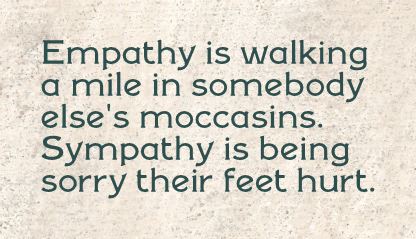
The difference between empathy and sympathyBut quintessential leaders know that they don’t have to have experienced something to be authentic in their communication with other people. And because of their commitment to developing unimpeachable character, two of the highly-developed traits they have are empathy and compassion for other people.

Empathy, like most of the other traits that make quintessential leaders trustworthy, is very rare and getting rarer. Most people believe that sympathy and empathy are the same thing and they are not.

Sympathy takes no long-term investment in another person: it tends to be a hands-off, “one-and-done” event.

Empathy, on the other hand, is a hands-on, long-term, hand-in-hand walk through the journey of – and with – another person. It is seeing through their eyes, understanding through their thoughts and emotions, and listening with interaction to know what is really behind their communication (often the words that are said or written have something else entirely behind them).

Compassion is always a by-product of and a companion of empathy. It is understanding, encouraging, invested, gentle, kind, and patient. It can be – and should be – the result of our own struggles, setbacks, and hard times in life. 

But because compassion and empathy are so interrelated, many people choose a lack of compassion because they offer only sympathy as a one-time-shot to other people.

These same people also, ironically, do everything in their power to evoke compassion toward themselves, including constant manipulation, self-exaltation, and telling everyone how they are not like all those other poor slobs in the world who don’t deserve anyone’s compassion.

This is the Scarlett O’Hara (Gone With the Wind) syndrome, because like Margaret Mitchell’s infamous anti-heroine, in the end, everything is all about them and they refuse to share the stage of life with anyone else.

Another area that demonstrates the authenticity of quintessential leaders in communication with other people is that quintessential leaders do not parrot cliches, “conventional wisdom,” or idioms. Instead, quintessential leaders consider carefully the impact of their words and how they use them.

Because quintessential leaders are invested in other people, they understand and are sensitive to the needs that exist.

Words have power and weightThey are also profoundly aware of the power of words, the impact of words, and the effect of words. 

They are not cavalier with words, simply letting whatever comes immediately to mind come out in their speech and writing. They always spend a considerable amount of time looking for ways to deeply and encouragingly communicate and avoiding hurt and offense. 

They know and understand that even words that may advocate a course correction should build up and not tear down. That can’t be done with parroting something someone else has said or something they’ve heard all their lives. It can only be done with original thought combined with empathy and compassion.

This is just one aspect of behavior that makes quintessential leaders rare in society today.

But each of us is striving to become a quintessential leader, so this must be a behavior we develop, grow, and exhibit everywhere in our lives and model for all the teams we lead in our lives. 

I say this often, but it cannot be repeated too much. If you breathe for a living, you lead at least one team in your life. Quintessential leadership is not confined to organizations, and can, therefore, be dismissed by everyone else. 

Somebody in your life is looking to you and depending on you to model leadership for them. It might be your children. It might be your students. It might be your family members. It might be your spouse. It might be your coworkers. It might be your friends. It might be the sports team you coach. It might be the volunteer groups you are involved with. It might be anybody.

So, as always, we must look in our own mirrors and conduct a thorough, extensive, comprehensive, and fearlessly honest evaluation of what our communication with other people looks like.

Are we inauthentic anywhere or everywhere in our communication with other people? 

If we are, is it because we lack awareness of our inauthenticity in our communication with other people?

Or is it because we’ve deliberately committed to a path of inauthenticity in our communication with other people?

If we find authenticity in our communication with other people, are we committed to preserving that and developing it to the point where it is literally a part of who and what we are all the time?

I can only answer these questions for myself. Each of you can answer them only for yourselves. Do we have the character and the courage to look, to see, to answer, and to change where and if we need to?

How are we doing?

What Transparency Looks LikeOne of the new organizational buzzwords is transparency. Today’s post will talk about what transparency looks like with quintessential leaders and what transparency looks like with everyone else.

You may be surprised to find that transparency among most people in leadership positions is illusionary, conditional, selective, and, in fact, is a lie because it doesn’t exist.

The word transparent at its simplest means to see through. Nothing is obscured, blurry, fuzzy, or out of view. Transparency, then, is the state or condition of being transparent. So anyone or any organization claiming transparency is describing their or its continual state or condition.

But is that true?

In most cases, the answer is “no.” While there is usually a lot of activity and A Smokescreen is Not Transparencycommunication to give the impression of transparency to the teams, what is done and what is said for everyone to see is essentially a smokescreen to keep teams feeling informed and included, while the real heart of the activity and communication – the business core – is conducted in secret behind closed doors among a small inner circle that has been sworn to secrecy.

So how do we know if a person or an organization is truly in a state or condition of transparency or not?

It’s quite simple.

Listen to them.

Anyone who or any organization that is constantly saying they are transparent is not.

People and organizations that are really see-through don’t ever have to say they are because it’s visible and obvious.

Only people and organizations with something to hide will make a conscious effort to regularly reiterate that they are committed to transparency. Just as liars will keep repeating their lies to try to convince others they are telling the truth, so will people and organizations that are not transparent who say over and over that they are.

So what are some key pieces of evidence that we can look for to see what transparency does not look like?

  1. A superficial and protective outer layer of smoke and mirrors that looks clear until it is placed on top of all the hidden layers and then nothing is clear. This looks like a plexiglass cover that is placed on top of wood-stained coffee table to protect it from damage and scratches.
  2. The Wizard of Oz behind the curtainA continuous barrage of stimulating, but meaningless, information designed to deflect attention and shift focus away from the nuts and bolts of what’s really happening and what’s substantive. This looks like the Wizard of Oz behind the curtain projecting an illusionary image of reality.
  3. Saying one thing, but being the opposite. Actions always speak louder than words. There are far too many, since this reflects the majority of people who are currently in leadership positions, for me to name the most obvious examples I can see and think of. Look around your venue on the world. You won’t have to look far to find this behavior.

So then, now that we have seen what transparency doesn’t look like, since we are all striving to be quintessential leaders and transparency is a quality of quintessential leadership, then we must know what transparency does look like in action.

Real transparency lays all the cards on the tableReal transparency lays all the cards on the table up front. It takes a proactive approach to full disclosure of the facts and relevant circumstances, providing a big-picture framework to fully and completely encompass and describe the genesis and the outcome of decision-making.

Real transparency doesn’t sidestep controversy or issues, actions, words, etc. that are either perceived as a liability or were part of poor or ill-informed decision-making. We all have these in our realm of experience. 

Quintessential leaders, however, don’t try to sweep them under the rug and pretend they never happened, nor do they try to excuse, clarify, or blame them away. Instead, quintessential leaders own their missteps and mistakes and use them as teaching opportunities for the quintessential leaders they are developing on their teams.

The lessons of our failures and how we addressed and overcame them are the most valuable we can pass on to the next generation of quintessential leaders for several reasons.

First, future quintessential leaders understand that nobody is perfect and screwing up is sometimes part of the learning process.

Second, by our showing them step-by-step how we recovered, we are modeling a tangible and realistic example – showing them what it looks like in practice – of how to overcome, grow, and move forward.

Third, we are helping them, by sharing our experiences, hopefully not to repeat our missteps and mistakes. (When people portray themselves as perfect, there is no knowledge or experience to pass on to the next generation, who will find themselves in missteps and mistakes, but will model the unquintessential leadership example of no transparency that was modeled to them, ensuring that and perpetuating the same mistakes down the line to successive generations.)

Real transparency is WYSIWYGReal transparency doesn’t deceive, lie, or cover up anything. Everything’s an open book of reality, honesty, and what-you-see-is-what-you-get.

What unquintessential leaders don’t realize is that by not being transparent, they often spend most of their time dealing with the past (you will always hear more references to the past and especially to a mythical past of “glory days” than you will ever hear about detailed and actionable plans for how to navigate successfully through right here, right now and for navigating successfully through the future) and they, therefore, have little to no time to deal with the present and the future.

So, as always, we take the subject of transparency and we look critically, honestly and objectively into the mirrors of our own lives.

Do we faithfully practice total transparency in every aspect of our lives?

Do we practice transparency in some areas of our lives, but not others?

Do we not practice transparency anywhere in our lives?

Each of us can only answer these questions for ourselves. But we have to be willing to be honest and candid and to change, if we find anything less than total transparency in every aspect of our lives.

How are we doing?