Archive for the ‘Qualities of a Quintessential Leader’ Category

Unquintessential leaders don't acknowledge their limitations and are chameleonsIt seems to be more and more difficult – if not impossible – for people to acknowledge their limitations in any area of life. Because of the ubiquitous influence of technology – and our exploding addiction to it – society in general seems to have been lulled into the deception that everyone’s an expert, everyone knows everything, and no one has any limitations.

Quintessential leaders stand out as the increasingly rare exceptions to this general trend. We know our areas of expertise, but equally important, we know our limitations even in those areas as well as our limitations in all the other areas where we are either not experts or truly don’t have clue. 

What does not acknowledging our limitations, which is what unquintessential leaders do, look like? What causes it? And what are the results?

Do you know people who seem to be chameleons? Are you a chameleon?

Chameleons – the reptiles – are notorious for adapting to whatever environment they are in by changing their skin color to match the environment around them. This is both a protective function (you can’t be eaten if you can’t be seen) and a predatory function (if your prey can’t see you, they’ll willingly stroll casually right into being your dinner). 

In many ways, human chameleons can have the same protective and predatory functions.

Not all human chameleons are even aware that they are chameleons. In this case, the chameleon function is protective.

Protective chameleonThe way it looks in humans as protective function is that they change completely to fit in whatever group they are in at a given time. They literally look like several different people in one body.

Perhaps these chameleons are unaware of the striking contradictions this presents in the big picture of their lives. Perhaps it doesn’t matter because the reward they receive is what matters most.

These protective chameleons are insecure with themselves and with their abilities. They are people-pleasers and they want everybody to like them and to accept them. They are consummate “yes” people to everybody. They’re always the first to agree, the first to raise their hands, and the first to say they’re on board with anything in any group they are in.

The results of being a protective chameleon bring about the exact opposite of what protective chameleons are trying to achieve.

Because they can’t possibly do everything they agree to do, they either just simply don’t do most of what they say they will do or they take so long to do it that someone else ends up having to get it done.

This often looks like procrastination, but in reality it’s the result of needing to be liked and accepted to such a great extent that protective chameleons overpromise and overcommit, knowing they can’t do – and perhaps not even intending to do – what they’ve promised and committed to do. 

Therefore, protective chameleons are undependable. They appear to be wishy-washy. And they destroy trust.

Predatory chameleonPredatory chameleons are consciously duplicitous and deceitful. They knowingly pretend to be an integral part of whatever group of people they are with. These people are often charming and engaging, and they will encourage full disclosure with assurances of confidentiality in each group they’re with.

Predatory chameleons are information brokers. Their sole intent is to get information and use that information for their own gain (money or power or both).

Predatory chameleons have played the game a long, long time and they know exactly what they are doing and they know the rewards it will bring them. In other words, they don’t care as long as they get what they want.

Like protective chameleons, predatory chameleons also destroy destroy trust. Unlike most protective chameleons, predatory chameleons also intentionally destroy lives. That is actually part of the reward for them.

No matter which type of chameleon these people are, one of the common characteristics they share is the inability and the unwillingness to ever acknowledge their limitations. In other words, they are fundamentally, whether its conscious or not, dishonest.

Quintessential leaders, on the other hand, value honesty and integrity as essential parts of their character.

Quintessential leaders are not going to pretend to be somebody they are not or to know something they don’t or to do something they either can’t do or don’t want to do.

Saying “no” is not taboo. In fact, it’s often the right thing to do. It is often the smart thing to do. It is often the sane thing to do. 

But we live in a society where saying “yes,” even if it’s a lie, to everything is not only accepted, but expected.

That’s a significant integrity problem that the entire human race is saddled with now. And, sadly, few people recognize it and even fewer people struggle against it to do the right thing.

Shame on us.

There is also a lot of integrity in saying “I don’t know,” which is what quintessential leaders do when they really don’t know something.

Of course, they always offer to find out if that “I don’t know” is just something they are unfamiliar with, but would be able to do with the right resources or if that “I don’t know” means they really aren’t able to do something.

So, quintessential leaders not only recognize their limitations, but they also acknowledge them. They believe in and practice full disclosure of what they are able do and what they aren’t able to do at all times.

It might cost them financially because they lose potential business and income to someone else who can do what they can’t.

It might cost them socially because they won’t conform to norms that violate their principles and beliefs.

But here is the one thing it won’t cost them: trust. Even if quintessential leaders lose potential customers (and income) or they lose social relationships because they acknowledge their limitations, they will have built trust.

The social relationships generally don’t come back and that, in the end, is just as well. But even those people will remember the quintessential leader as someone who had integrity and courage even if they vehemently disagree with them.

Potential customers, on the other hand, even though they may have chosen a different route, will remember the trustworthiness of quintessential leaders and they will come back in the future. That’s a guarantee.

Especially in a world where honesty and trust is in short supply and each passing day reveals more broken trust and dishonesty everywhere we look.

Once trust is broken, it is, seldom, if ever, possible to regain it and/or repair it. It is one of the most valuable things that each us has and it is heartbreaking to see how lightly and casually we treat it. 

So now is the time for you and me who are striving to become quintessential leaders to look into our own lives and see where we stand in the area of acknowledging our own limitations.

chameleon-unquintessential-leaderAre we chameleons? 

If we are chameleons, are we protective chameleons or are we predatory chameleons?

If we are chameleons, are we okay with being chameleons, no matter which type we are?

Are we consistently striving to be quintessential leaders in this area of our lives?

No matter what you and I answer to these questions, if we aren’t happy with the answer, there is a remedy.

The remedy is change. Change requires us to be rigorously honest with ourselves. Change requires us to be conscious of the things that we are doing and why. Change requires us to consciously replace the behavior we don’t want with the behavior we do want.

As always, change is a process and none of us change easily or perfectly or overnight. But we can’t change if we don’t commit to it and don’t take that first step and follow it up with every other step toward the right direction.

How are we doing?


Technology gives society the false idea that is perfectWe live in a society that has, in large part due to technology, been hoodwinked into the beliefs that each of us knows everything, sees everything, understands everything, and is an expert about everything.

In other words, most of us never give – because we don’t have to – everybody the benefit of the doubt.

More of us have been entrapped by this fallacy than we might believe. Before we jump in – this is one of the signs that we are in the majority of the entrapped – and say, “That doesn’t apply to me!” let’s examine what it not applying to us looks like.

We may be surprised at what we find if we’re willing to listen and are willing to be honest with ourselves. Unfortunately, those traits are very rare anymore because most of us are convinced that we already know all the answers so there’s nothing else that we can learn.

Learning and the change and growth that comes from that, my friends, is at the heart of unquintessential leadership.

However, if we believe we already know everything and there’s nothing else for us to learn, then that is our death kneel to becoming quintessential leaders. We will never become quintessential leaders if this is our mindset and our attitude going in.

It is in this aspect of the societal tendency to not give the benefit of the doubt that quintessential leaders stand out from everybody else.

benefit-of-the-doubt-wordsQuintessential leaders distinguish themselves as being willing to give the benefit of the doubt to other people by what they are and what they understand about themselves and what they don’t do.

Quintessential leaders are humble. They do not elevate themselves in their own minds nor do they try to elevate themselves in others’ minds.

They’re not always clamoring for people to look at them or to be the center of attention. They understand that it’s never “all about me,” but instead quintessential leaders understand it’s “all about others, and in reality, very little in life is actually about me.”

Social media has done a lot to destroy humility in general.

All the selfies and “Hey, look at me!” tweets, instagrams, and status updates have played right into the pride, vanity, and narcissism that seems to be hardwired into human nature. 

To achieve, maintain, and grow in humility, then, in this environment of easy self-centeredness and self-absorption, takes constant, diligent, and honest effort along with persistent self-control.

Quintessential leaders exercise self-control and they are constantly inventorying themselves: their attitudes, their motives, their thoughts, their words, and their actions.

As a result, quintessential leaders know their limitations and they know their strengths and weaknesses and that leads them to give the benefit of the doubt to others.

What does giving the benefit of the doubt to other people look like in quintessential leaders? (The opposite of these are what unquintessential leadership and not giving the benefit of the doubt look like.)

Quintessential leaders recognize we are not omniscient. We can’t read minds. We can’t read hearts. We don’t know The Great Gatsby's symbol for omniscienceeverything about everything.

Quintessential leaders don’t know everybody. We don’t know everything about everybody And while quintessential leaders may be experts in a few areas, we are not experts in everything.

And we are certainly not experts on everybody, because we know we aren’t even experts on ourselves (in other words, there’s a lot about ourselves that we don’t even know).

Therefore, because quintessential leaders know we are not omniscient, we are not always at the ready with answers for everybody about everything with the understood premise that these are the right answers and these are the only answers.

Quintessential leaders know that is the height of vanity and foolishness.

Life and people are way, way more complicated than that and none of us mere mortals is up to the challenge of knowing everything about there is to know about everyone and everything.

Because they listen to hear instead of running roughshod over everybody else to talk more loudly and to make and remake their point because they’re right and it’s so important that Jumping to conclusionseverybody knows it, quintessential leaders don’t jump to conclusions.

Quintessential leaders understand that jumping to conclusions will always lead us down the furthest path from the truth. And it will damage, sometimes irreparably, our relationships with other people because it creates chasms and builds walls, instead of building bridges.

Quintessential leaders understand that there is an unknown backstory behind every human being and that our experiences in life are customized and unique, so they don’t make presumptions and assumptions based on their backstories and their life experiences.

PresumptionSince quintessential leaders aren’t living life from a self-centered and self-absorbed perspective, we don’t inject ourselves and our lives into the lives of other people by being presumptive and making assumptions.

AssumptionBeing presumptive and making assumptions are another sure way to go down a path that is the furthest from the truth. And this damages relationships too. Sometimes beyond repair in this lifetime.

Quintessential leaders are not quick to accuse and are not quick to criticize other people. 

While quintessential leaders evaluate behavior (actions and words) at the highest ethical and moral standards and are responsible for bringing that behavior to light and correcting it by coaching, they are careful not to personally quick to accuseattack the people who have the behavior that needs to be corrected by accusation and criticism.

This is probably the most difficult part of giving the benefit of the doubt. We who are striving to be quintessential leaders fail in this part, hopefully not regularly, more than we should.

Being quick to criticize and being quick to accuse other people quick to accuseshows a lack of mercy and this will also lead quintessential leaders down the furthest path from truth and it will damage – almost certainly beyond the ability to fix in this life – the relationships.

There is an constructive, big-picture method that quintessential leaders use to coach toward correct behavior.

Very few people know and understand this method, nor are more than a small minority adept at it. And, of course, there are always people who just don’t care.

Coaching a wrong, misguided, or negative behavior looks like this:

  • This is wrong (misguided, negative).
  • This is why (concrete facts, not feelings).
  • This is what you replace that with (concrete facts, not feelings).
  • This is the framework of what it looks like, step-by-step, from start to finish (the big picture).
  • I’ll be right here beside you to guide and help you, as you need me, through the process (investment in the process).
  • We’ll succeed (common shared goal).

Unfortunately the “reward” of quick accusation and quickly criticizing other people on a personal, below-the-belt level is much more attractive and much stronger to the majority of people than the reward of actually offering to invest in the process of coaching and helping someone change and correct a behavior.

So the time has come for us to look into our own quintessential leader mirrors to see if we strive all the time to give people the benefit of the doubt.

Don’t look at anybody else. This is about you and your mirror. This is about me and my mirror.

I can’t change anybody else, but I can certainly change me. You can’t change anybody else, but you can certainly change you.

Do we usually give other people the benefit of the doubt?

Do we give the people we like and/or are most like us in personality, temperament, background, and interests the benefit of the doubt, but not the people we don’t like and/or who are unlike us in personality, temperament, background, and interests?

Do we never give anyone the benefit of the doubt?

We need to look in our mirrors closely, honestly, and rigorously to answer these questions. 

Do we have the character, the desire or the courage to look in our mirrors, or will we assume it doesn’t apply to us and on go on doing what we’ve always done.

I have the character. I have the courage. I have the desire.

Do you?

Authenticity is Who and What Quintessential Leaders AreA discernible trait of quintessential leaders is that we are continually striving for authenticity in every part of who, what, and how we are. It is an easily-identifiable part of our character which is borne out by our behavior.

One of the easiest aspects of behavior that shows us what both unquintessential leadership and quintessential leadership looks like is in our verbal and written communication with others.

Whether we are authentic or unauthentic is plain to see by what words we say and write and how we say and write them. 

The words we choose and the method we use to convey those words provide vital insights into whether we are striving for authenticity or whether we are, at the heart, core, and soul of who we are, either struggling with inauthenticity or we are truly committed to being inauthentic as a matter of course.

I make the distinction between struggling with inauthenticity and being committed to it because it’s important for all of us to understand that quintessential leaders will struggle at times with inauthenticity, while unquintessential leaders don’t struggle at all with it because being inauthentic is a committed way of being for them.

So what makes the difference between struggling with inauthenticity and being committed to it?

Awareness is the difference.

Quintessential leaders who are being inauthentic are not aware of being inauthentic, but as soon as they become aware of the inauthenticity, they commit to changing it immediately.

Unquintessential leaders, on the other hand, are fully aware of being inauthentic and are determined to remain inauthentic.

How do I know this? Because I’ve struggled with inauthenticity at times and not even realized it. However, once it hit me between the eyes, opening my eyes to an area of inauthenticity, I immediately made and fulfilled the commitment to change it.

Not being aware of inauthenticity is a part of the growth cycle for humans and the mature development of quintessential leaders (if all of us were already perfect, we’d have absolutely nothing to do and no place to go and life would be interminably boring and meaningless). 

However, it is often the case – to our shame and discredit – that as we who are striving to be quintessential leaders are unaware of our own areas of inauthenticity, we are eager to and constantly pointing, in public venues and in condemning language, out the areas of inauthenticity in other growing-into-quintessential-leaders who are unaware of their own areas of inauthenticity. 

This is unquintessential leadership behavior. Quintessential leaders examine themselves and they focus on changing what they need to change. They do not constantly exalt themselves as paragons of virtue and continually look around at everyone else and proclaim, for the whole world to see, their faults and shortcomings.

Instead, they work diligently to be an example, in every area of their lives, of what quintessential leadership looks like. They know that action – their own work on themselves – can be a powerful motivator and teacher for everyone with whom their lives intersect.

They also know that constant and public criticism and condemnation is not only a powerful demotivator, but a lousy example for anyone to follow and emulate (unfortunately, human nature tends toward this kind of behavior, so there are always plenty of admirers and supporters in criticism and condemnation of other people).

So before we look at what authenticity in communication looks like, let’s first look at what it doesn’t look like.

Vladimar Nabokov wrote, “Words without experience are meaningless.” I would clarify this to say that any words spoken or written without experience or empathy (literally the ability and choice to walk in the shoes of someone else’s experience and understand that experience from their perspective) and compassion are meaningless.

Inauthenticity in communication says and writes words that are empty and hollow because the person communicating them either has never experienced what they are communicating about or they lack empathy and compassion, choosing to assume they know something they don’t or choosing to pass judgment without facts, without understanding, and without knowledge.

This is unquintessential leadership because pride and arrogance are behind the communication as well as a total lack of kindness and gentleness. In other words, the communicator believes, even though they don’t have clue nor do they care what they’re talking about, that they are entitled to say or write the words as well as being harsh and condemning in the process.

Inauthenticity in communication is also evident in the common behavior of simply parroting cliches, “conventional wisdom,” and idioms because it seems like the right thing to say or write.

There is no thought or depth that goes into these utterances. In fact, this is the cheap and easy way out: we throw a well-worn phrase that sounds good and we’ve heard all our lives at someone else, check it off our list (while patting ourselves on the back for our generosity and benevolence toward the poor souls we communicated with), erase it permanently, and go blissfully on with our unimpacted lives without missing a beat.

Parroting as a method of communication is unquintessential leadership for a couple of reasons.

The first is motivation. We’re communicating something we’ve always heard – but most of the time have not had to put to the test of veracity through experience – because it makes us feel better, not because it will make the person we’re communicating with feel better.

The second reason parroting is unquintessential leadership is because we are not taking the person we’re communicating with into account at all. We don’t seek insight and understanding by taking the time to really listen to them – we may hear them, but there’s a world of difference between just hearing and really listening – nor do we take the time to think about the kind of communication we would want from someone if we were in the same or similar circumstances. 

By simply parroting something we’ve heard but have no evidence or proof of its value and/or truth, we effectively complete dismiss the person we’re communicating with and we tell them we don’t care about them and they are not important enough to us for us to waste our time with them.

So now that we know what it doesn’t look like, let’s discuss what authenticity in communication – quintessential leadership – does look like.

Unfortunately, as Nabokov stated, experience is often how we gain the ability to be authentic in our communication with other people. However, whether we have authenticity in our communication with others still comes down to us making the choice to be authentic.

Choosing authenticity in our communication with other people requires an investment from us. In them. In time. In effort. In carefulness.

In a society where unquintessential leadership abounds, as well as entitlement and “it’s all about me,” the selflessness required for this kind of investment has all but disappeared.

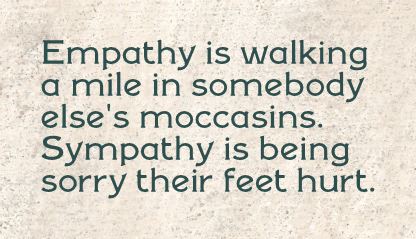
The difference between empathy and sympathyBut quintessential leaders know that they don’t have to have experienced something to be authentic in their communication with other people. And because of their commitment to developing unimpeachable character, two of the highly-developed traits they have are empathy and compassion for other people.

Empathy, like most of the other traits that make quintessential leaders trustworthy, is very rare and getting rarer. Most people believe that sympathy and empathy are the same thing and they are not.

Sympathy takes no long-term investment in another person: it tends to be a hands-off, “one-and-done” event.

Empathy, on the other hand, is a hands-on, long-term, hand-in-hand walk through the journey of – and with – another person. It is seeing through their eyes, understanding through their thoughts and emotions, and listening with interaction to know what is really behind their communication (often the words that are said or written have something else entirely behind them).

Compassion is always a by-product of and a companion of empathy. It is understanding, encouraging, invested, gentle, kind, and patient. It can be – and should be – the result of our own struggles, setbacks, and hard times in life. 

But because compassion and empathy are so interrelated, many people choose a lack of compassion because they offer only sympathy as a one-time-shot to other people.

These same people also, ironically, do everything in their power to evoke compassion toward themselves, including constant manipulation, self-exaltation, and telling everyone how they are not like all those other poor slobs in the world who don’t deserve anyone’s compassion.

This is the Scarlett O’Hara (Gone With the Wind) syndrome, because like Margaret Mitchell’s infamous anti-heroine, in the end, everything is all about them and they refuse to share the stage of life with anyone else.

Another area that demonstrates the authenticity of quintessential leaders in communication with other people is that quintessential leaders do not parrot cliches, “conventional wisdom,” or idioms. Instead, quintessential leaders consider carefully the impact of their words and how they use them.

Because quintessential leaders are invested in other people, they understand and are sensitive to the needs that exist.

Words have power and weightThey are also profoundly aware of the power of words, the impact of words, and the effect of words. 

They are not cavalier with words, simply letting whatever comes immediately to mind come out in their speech and writing. They always spend a considerable amount of time looking for ways to deeply and encouragingly communicate and avoiding hurt and offense. 

They know and understand that even words that may advocate a course correction should build up and not tear down. That can’t be done with parroting something someone else has said or something they’ve heard all their lives. It can only be done with original thought combined with empathy and compassion.

This is just one aspect of behavior that makes quintessential leaders rare in society today.

But each of us is striving to become a quintessential leader, so this must be a behavior we develop, grow, and exhibit everywhere in our lives and model for all the teams we lead in our lives. 

I say this often, but it cannot be repeated too much. If you breathe for a living, you lead at least one team in your life. Quintessential leadership is not confined to organizations, and can, therefore, be dismissed by everyone else. 

Somebody in your life is looking to you and depending on you to model leadership for them. It might be your children. It might be your students. It might be your family members. It might be your spouse. It might be your coworkers. It might be your friends. It might be the sports team you coach. It might be the volunteer groups you are involved with. It might be anybody.

So, as always, we must look in our own mirrors and conduct a thorough, extensive, comprehensive, and fearlessly honest evaluation of what our communication with other people looks like.

Are we inauthentic anywhere or everywhere in our communication with other people? 

If we are, is it because we lack awareness of our inauthenticity in our communication with other people?

Or is it because we’ve deliberately committed to a path of inauthenticity in our communication with other people?

If we find authenticity in our communication with other people, are we committed to preserving that and developing it to the point where it is literally a part of who and what we are all the time?

I can only answer these questions for myself. Each of you can answer them only for yourselves. Do we have the character and the courage to look, to see, to answer, and to change where and if we need to?

How are we doing?

Leaders Must Have Ethics and Morals - Strength Alone is Not EnoughIt seems to me that the term “leader” has now begun to ring hollow because it’s applied to anybody and everybody in the world who emerges in the top tier of the heap of any social, religious, academic, governmental, or organizational structure, regardless of how they got there.

The reality is that how they got to the top of the heap matters. A lot. Just because people end up in the top tier of any of these venues does not automatically mean they are leaders. Anymore, it often means just the opposite.

Why?

Because how people get to the top of the heap shows the kind of ethical-moral foundation they have. Or don’t have.

While we seem to routinely disconnect how people behave from their intellect, knowledge, and skills, we do ourselves a huge disservice when we don’t consider the whole person, especially when they’re begging us to unconditionally (which, by the way, is unquintessential leadership) follow them.

The presence or absence of an ethical-moral foundation in a person is directly proportional to whether they build trust and are trustworthy or they destroy trust and are not trustworthy.

The reality is that there is very little trust and trustworthiness in the world today. Time and again, most of us prove, often in what we believe are “little things,” that we cannot be trusted and we are not trustworthy. 

Little things,” it turns out, are symptomatic of big things and those big things show whether we have an ethical-moral foundation or not. How is this translated practically? In a word, character. Character embodies these elements: who we are, what we are, our motives, our attitudes, our thoughts, our words, and our actions.

If one or more of those elements doesn’t sync up with the rest, or what we claim to be, then we have a problem with our ethical-moral foundation and we are deficient in character.

There are certain external behaviors that reveal more than others whether we have an ethical-moral foundation. They are:

  1. A pattern of questionable and surreptitious actions that have built-in plausible deniability;
  2. A history of deflecting responsibility and/or changing the subject (avoiding the subject altogether) when confronted with substantiated actions and words;
  3. A prevailing sense of anger and outrage each time these kinds of actions and words occur and we are called on it;
  4. A history of twisting, spinning, angling, deception, and dishonesty that threads through our entire lives;
  5. An overarching pride and arrogance that literally oozes from our pores continually;
  6. An inability to ever admit we are wrong, we’ve done something wrong, and we need to make amends and change those wrongs in a demonstrable way.

I am very rarely completely on the same page as New York Times columnist David Brooks (I find him to be myopic, elitist, and without an objective view of the big picture most of the time, and that leads him to conclusions that are generally lopsided and not entirely accurate), but in his April 28, 2015 op-ed piece, “Goodness and Power,” Brooks nails the integrated relationship between quintessential leadership and an ethical-moral foundation.

Hillary Clinton Dishonest and UntrustworthyBrooks began the piece with the results of a Quinnipiac Poll that showed that 60% of independent voters rated Hillary Clinton as a strong leader. But 61% of those same voters said that Hillary Clinton is not honest and is not trustworthy (here’s the disconnect I referred to before between behavior and intellect, knowledge, and skills).

Then Brooks moves out to the long view that the real ability to lead is directly tied to honesty and trustworthiness by asking the right question: “Can you be a bad person but a strong leader?”

As those of us who are striving to be quintessential leaders know already, the answer is “no.” To paraphrase Brooks, putting “…someone with bad private morals [in a leadership position] is like setting off on a battleship with awesome guns and a rotting hull. There’s a good chance you’re going to sink before the voyage is over.”

Why?

As Brooks notes, people who have no ethical-moral foundation are Machiavellian in their behavior and the end always justifies the means, and in the end what we get is not leadership, but tyranny and despotism.

The lust for power and control is the driving force behind these unquintessential leaders. The dishonesty is that they obscure their real motives with platitudes that sound like they are selfless, sacrificing, giving, and doing this for the good of the people that they actually want power over and want to control.

And here’s the proof. They’ll talk a good talk until they get what they want, but there are always shadows of impropriety, of shadiness, of manipulation, and of deception hanging around them. Nobody trusts them, even if they manage to get a leadership position.

Once they do get a leadership position, these unquintessential leaders reveal their total lack of an ethical-moral foundation in everything they are, they say, and they do.

What does that look like in practice? As we strive to become quintessential leaders, we must be able to not only know what quintessential leadership looks like, but also what it doesn’t look like and we need to make sure we’re always monitoring ourselves to make sure we’re on the right path and haven’t veered off onto the wrong one.

When people without an ethical-moral foundation get into leadership positions, these are the tell-tale signs:

  • Tightened control over everything and everyone (it will be loose during their campaign to be in charge and promises of egalitarianism will abound)
  • A closed inner circle that is an existing network and that is severely limited with very specific criteria so that only those who are already in it can meet them
  • All-or-nothing demands for loyalty and allegiance
  • Big Brother Lack of Ethical-Moral FoundationConstrictive and restrictive rules and regulations
  • Continual threats of retribution and adverse actions if rules and regulations are believed to be broken
  • Constant assertion of authority and superiority to everyone else
  • Constant devaluing of others in attempts to promote and enhance their own value
  • Mistrust and suspicion of everyone else

Look around in your life and see if this looks familiar. It does in my life, because, unfortunately, this is the general tenor of the kind of people in leadership positions in every area of our lives.

It’s become acceptable to not have an ethical-moral foundation and be in a leadership position. Not only is it acceptable, but it is, indeed, preferred.

But as we strive to become quintessential leaders, we can’t just follow the crowd. We can’t use the excuse that everybody else is doing it. We can’t allow ourselves, even if it means we end up being the only person on the planet doing the right thing because we have and we hold on to the right foundation, to ever lose sight of what makes us quintessential leaders.

We are rare for a reason. But there are people, those whom we serve on every team in our lives, who count on the rarity of us having, continuing to fortify, and adhering to an unshakeable ethical-moral foundation.

How are we doing?


Dr. Ned M. RossThe first – and one of less than a handful of people whose lives have intersected with mine in which I’ve seen an unwavering commitment to quintessential leadership – quintessential leader in my life was my dad. He modeled quintessential leadership  in everything he was, he did, and he said.

When I was younger, I didn’t appreciate it as much. Now that I’m older, I appreciate it – and my dad – more and more with each passing day.

My dad’s been gone almost 17 years, but his example and the lessons he taught me about what quintessential leadership is and what it looks like in practice have taken root over the years, with those roots getting more deeply entrenched and stronger with time and practice, and have now begun to blossom and bear fruit in my own life.

I wish my dad were here to see that, although it was hard to tell then, I watched, I listened, I absorbed, and I took everything to heart. His experience, his counsel, and his wisdom have permeated my mind, my conscience, and my life as I’ve tried them, tested them, proved them, and found them to be true.

The older me would tell my dad that he was right (the younger me had a hard time admitting that anyone else was ever right) and would never stop expressing my gratitude and my love. That, for my dad, will have to wait for another day, one that I am looking forward to very much.

In the meantime, though, I have the opportunity to pass the lessons on in developing other quintessential leaders. I don’t claim to have mastered them nor to execute them perfectly. But that is a front-of-my-mind-always goal and nothing I think, say, or do isn’t within the context of that goal. That, my friends, is the first step to becoming a quintessential leader.

One of the ongoing lessons my dad taught me was to show respect to everybody. In my words. In my actions. In every area of my life. I can still hear him saying “Be nice to everyone you meet on the way up, because you’ll meet the same people on your way back down.”

Respect can be a complicated thing for us as people and us as quintessential leaders. It shouldn’t be, as I hope to show, since respect is an outward manifestation of our understanding of the brotherhood of humanity and of the integrity of our character, but it can be until we understand the essence of what respect is.

Respect is not tied to our likes or dislikes, our feelings and emotions, nor to what we agree or disagree about.

Instead, it is an acknowledgement that each of us has the exact same value in terms of our humanness – at our most basic structure, each of us is just a little dirt and a little water mixed together, and when death, the great equalizer, comes that is what we all return to, minus the water – and in terms of our purpose and our potential.

Most of the people in leadership positions today lack respect for anyone else. They may show favoritism to their lackeys as long as they support and help them and push their agendas – which are power, greed, and control – but favoritism is fickle and disappears when lackeys are inconvenient or no longer useful.

Respect is not fickle, nor is it tied to what someone else can do for us. That is simply beyond the grasp of most people in leadership positions today. 

respect quintessential leaderDisrespect is in vogue. It is wrapped up in the forms of tearing others down, name-calling, and put downs. It is characterized by people exposing the “weaknesses” of others, ripping those weaknesses – and those people – to shreds, and then the disrespecters exalting themselves to show how superior and better they are than the lowlifes they just called out.

As shameful and as disgusting as this conduct is, those who do it have no shame and no remorse. In fact, with social media, they’ve found a bigger and more public venue in which to flagrantly disrespect other people. As a result, disrespect has become the norm, while respect is becoming harder and harder to find.

A recent example of this pervasive disrespect – and this is a pattern of behavior with this individual – from someone in a leadership position, but who is not a quintessential leader, brought this back to the forefront of my thinking.

Here are a few excerpts from an email this person in a leadership position wrote to somebody he disagrees with:

“…that you remain a congenital liar incapable of telling the truth.”

“You seem to fail to grasp that you were used as a useful idiot…”

“…you were too stupid to realize that you were being used.”

“I have no time for lying fools whose mission in life is to slander and spread division…”

“Take your vomit somewhere else and don’t waste my time.”

I disagree, for different reasons, with almost all that the recipient of this email says as well. However, I would never communicate with this person – or anyone else on the planet – in a disrespectful manner. The person in a leadership position, though, had absolutely no qualms about it. 

As quintessential leaders, each of is responsible for showing respect to everyone and to modeling that to the quintessential leaders we are developing. Since that’s our responsibility, what does it look like in practice?

Not everybody is going to like everybody else. That’s a fact of life.

My dad, I think, came the closest of anybody I know to liking almost every person he ever met. I can think of two people I know for a fact that he didn’t like, and there may be two others, but he never said one way or the other.

I, on the other hand, have a longer list of people that I don’t care for and would rather not have to be within 300 miles of on any given day (and, frankly, the same is probably true for them with me). It’s not that they are awful people or bad people, but our personalities and temperaments are so different that we just don’t sync up on any kind of tangible level.

Given the choice to spend any kind of extended time with them or face a firing squad, I’d most likely choose the firing squad. Both are excruciating, but one is fast and one-and-done. Social pain is difficult for me, so quick elimination – my own – is generally my preference.

However, whether we are more like my dad and there’s almost nobody we don’t like or we’re more like me and have a pricklier personality and temperament, we still are responsible for being respectful to everybody.

We all have emotions and feelings and sometimes we get hurt, we get angry, and we get sad at what other people do to us and say to us. Disrespecting them – revenge and getting even – is our default response tendency as humans.

But quintessential leaders never forget their responsibility to be respectful and to be reminded that we have also hurt, angered, and saddened other people in our travels through life, and we’ve been shown respect, along with mercy and restraint, at times along the way when we didn’t deserve it. We pay that forward. It’s that simple.

As human beings, it’s often easier to find things we disagree on than things we agree on. That, too, is part of life. Sometimes those disagreements are deep and intense. Sometimes they are so fundamental, moral-wise, character-wise, and principle-wise, that they force a relationship between or among people to break – at least for the rest of this temporary existence of physical life.

However, no matter how strong the disagreement, even to the point of breaking relationships for the remainder of our physical lives, we may have with other people, we are still responsible for showing them respect.

I suspect that when this life is done and the next iteration occurs that we’ll all find that all the things we thought we knew were in fact next to nothing (and that little splinter where there was a minute bit of understanding and insight was more wrong than right) and all that we argued over, disagreed over, and fought over was basically a waste of time because none of us got it right.

If that’s the case, then our responsibility for being respectful to everybody else – even if they disrespect us – should weigh even heavier in who and what we as quintessential leaders are.

So how do quintessential leaders show respect? What does it look like?

  • Never personally attack anyone else. You can disagree and be respectful. You can dislike and be respectful. You can experience negative emotions and feelings and be respectful. You can break a relationship, because it’s the healthiest thing to do, and be respectful.
  • Never tear anyone else down. You are not anyone’s judge and jury. You have never value purpose potential equals respectwalked in their shoes, so whatever you think you know about them is not even close to their whole story. Show mercy.
  • Never badmouth anyone to anyone else. This an emotional response to anger, frustration, and impatience with other people. It says a whole lot more about you as a person than it does about the person you’re badmouthing.
  • Silence can be a form of respect, especially when it comes to anyone that we are hard-pressed to find or see anything positive about. Just because we don’t see it or haven’t found it doesn’t mean it’s not there. Silence ensures that we recognize that everyone has value, even if we don’t know personally what it is. It is often the better part of wisdom.

What would you add to this list of what respect looks like?

More importantly, how are we doing?

Narcissus Falling In Love With HimselfEntitlement and the narcissism epidemic is something that all of us as quintessential leaders have to deal with today. But where we have to deal with that may surprise us.

I’ve just finished reading Living in the Age of Entitlement: The Narcissism Epidemic by Jean M. Twenge, Ph.D. and W. Keith Campbell, Ph.D.

Since the beginning of the entitlement/narcissism epidemic that started in the 1970’s, with the “me” generation that the Baby Boomers of the 1960’s morphed into, it has exploded as the Baby Boomers have moved from young adulthood to now being senior citizens. The mess they have left in their tsunami wake as revolutionaries is the mess that we, in subsequent generations, have not only inherited but have also adapted to in many respects. Parents, since then, have been the cultivators of narcissistic children from birth, and society and culture pick up that ball and carriy it after children are old enough to go to daycare or go to school.

Before the 1970’s, entitlement and narcissism were rare in the general population. It was confined to the ranks of royalty and celebrities, but even in those ranks, it was not across the board.

I think knowing that was why I was surprised by the saying that Aibeelene, in the novel The Help (published in 2011), repeats again and again to Mae Mobley: “You is kind. You is smart. You is important.” This is completely out of character for anybody to say in the world of 1963 Jackson, Mississippi – or anywhere else for that matter.

And yet this is an excellent example of how deeply rooted entitlement and narcissism are in our culture, in our society, and in ourselves. While this phrase would have never been uttered by anyone in 1963, by 2011, an equivalent of it would be a mainstay in the mouths of almost every parent and every elementary school teacher in the United States.

it's-all-about-meAlthough I have been keenly aware for quite some time of the “it’s all about me” attitude and belief that is everywhere in society today and is seemingly more overtly prevalent among the Millennials, there were incidents discussed in Living in the Age of Entitlement: The Narcissism Epidemic that surprised even me as to how early this indoctrination starts and how all of us, including Gen Xer’s like me and my generation (whose most recent parallel generation was the Lost Generation of the 1920’s) can be (and most have been) affected by it to one degree or another.

Narcissism is an epidemic in our society because it has infected every part of our lives and it has changed us in fundamental ways. Not all of us, but most of us. And that affects us as quintessential leaders because we’re not immune to the infection, and it affects the teams that we lead.

However, the one thing that should not be affected – and we have to get rid of any traces of the entitlement infection that we may have acquired along the way for this to be authentic, genuine, and effective – is how we lead.

If you have not yet read Building Trust and Being Trustworthy, I strongly urge you to read it. The must-have traits to build trust and be trustworthy are the core of quintessential leadership and they are the complete antithesis of – and the antidote to – entitlement and narcissism.

So you’re reading this and thinking “I don’t think I’m entitled and I’m certainly not a narcissist! I don’t need to read this because it doesn’t apply to me.” 

Keep reading. You are in for enlightenment if you are brave enough and honest enough to go on. And with enlightenment comes understanding and with understanding comes the potential to change. The choice to change is individual. And that’s on you. And that’s on me.

While not every person who feels entitled is a full-blown narcissist, most of American society has absorbed many of the narcissistic components of entitlement without even being aware of it. Everything in our culture is narcissistic and feeds our sense of entitlement if we don’t recognize it and consciously reject it.

Recognition is the first step to fighting the narcissism infection in our own lives. Pay attention to advertising (all forms of media). The underlying message is always “You’re special and you deserve this.” That idea of specialness and I’m owed this takes root and it begins the process of narcissism infection.

The reality, however, is that if everyone is special, then no one is special because the word “special” – which denotes being exceptional, unusual, singular, uncommon, notable, noteworthy, remarkable, and outstanding – loses its meaning.

We can’t all be special. In fact, we’re not all special. And, yet, that underlying notion of being special is rampant in our society. What this message of being special does is separate us from each other and it turns a blind eye to the fact that we, humanity, you and I, have much, much more in common than we have that makes us different. 

The idea of being special also causes us to think better of ourselves than we should and certainly exalts our opinions of ourselves compared to other people to dizzying heights. And because we’re inherently superior, in our own minds, to all the other lowly humans on the planet, we simultaneously turn our all attention completely to ourselves and expect the other 7+ billion people on the planet to turn all their attention to us too.

I doubt many of us are aware of how this narcissistic tendency has taken hold in our lives because we have absorbed the subliminal and not-so-subliminal messages that our culture throws at us at every turn. 

But I’m asking us to take the time to examine our lives and see where we’ve become narcissistic and entitled in our own lives.

As quintessential leaders – and as I’ve said before, we all lead a team or teams somewhere in our lives, as parents, as teachers, as athletic coaches, as pastors, as organizational leaders, as team leaders in an organizational setting, so this applies to all of us – we must be aware of how much this has infected our own lives and make an immediate and diligent effort to eradicate it, not only from ourselves, but also from our teams.

Nowhere is the narcissism epidemic more visible and more prevalent than on social media. That’s the first place that I suggest that each of us goes to examine ourselves because the volume and content of our social media accounts will give us a pretty good indication of how much entitlement and narcissism we’ve acquired in our own thinking and our own beliefs. 

Examples are constant updates that try to garner attention to ourselves, whether they are a non-ending stream of selfies or things that draw attention to us personally, or they are cryptic one or two-word messages like “Confused…” or “Sad…” or “SMH (shaking my head)…” or “Oh, bother!” that literally scream out “I need attention. I need an audience. Come talk to me. NOW!” 

Or they are simply a blow-by-blow account of every little part of our normal, ordinary, mundane, and, for the most part, boring lives, which is an unconscious way of saying “my normal, ordinary, mundane, and, for the most part, boring life is so important that you all need to know about it and pay attention to it.” In other words, my life and I are special.

If you have not read my three-part book review series on Michael Harris’ The End of Absence: Reclaiming What We’ve Lost in a World of Constant Connection, please take some time to do that because digital technology and our constant connection to it plays a vital role in the widespread, across generational lines, infection of entitlement and narcissism in our society and in our culture. 
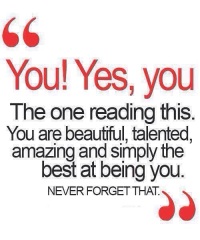
awesome special or narcissism?
This idea of specialness is insidious. 
These two images with this paragraph look harmless enough, right? And, yet, what is the real message here? You’re special. And being special means that the rules don’t apply to self-esteem or narcissism?you. You’re above correction, you’re your own person, you deserve the best, and you deserve everything you want whenever you want it just because you want it. You don’t have to cooperate with anyone. You don’t have to think about anybody but yourself.

And, if things don’t go right for you, well, everybody else is the problem, because it can’t possibly be such an awesome, wonderful, special, fabulous, spectacular, nobody-else-in-the-world-like-you, pinnacle-of-all-the-best-that-defines-humanity person that you are.

Writing that last paragraph made me queasy. But I think my queasiness comes from a realization that what that paragraph says is not far from the truth of how the majority of people see themselves in U.S. culture and society. That majority may include you and me.

And the sad reality is that it’s not true. 

So how do we as quintessential leaders eradicate entitlement and narcissism from ourselves and from our teams? This will be one of the the most daunting processes, I suspect, that we will undertake. But undertake it we must.

We have to recognize how entitlement (and narcissism) manifests itself.

Entitled people believe self-admiration is very important (and necessary). Entitled people also believe that self-expression (“I should be allowed to say whatever I want to say, however I want to say it, whenever I want to say it, wherever I want to say it.”) is necessary to establish their identities. Entitled people don’t recognize limits or boundaries.

Entitled people believe that just showing up is praiseworthy (think of little kids on a sports team with a losing season because they either stank as players or they were too distracted to play getting trophies just like the teams that were good and actually played the sport – it happens all the time), and that any effort (we all know someone who always says “But, I worked SO hard…” while they either never actually complete anything or what they do is so lousy that it has to be redone – by someone else – all over again) is deserving of recognition whether it produces anything good or not.

Entitled people hold everybody accountable and responsible except themselves. If something goes wrong, it’s somebody else’s or something else’s fault. They are blameless and faultless.

Entitled people let other people do their “dirty work.”

I have a close friend who works at a university in a department that is responsible for auditing student records to determine who is eligible for graduation each semester and who is not.

She and her team email (several times) students who should be eligible for graduation but are missing classes they need to be able to graduate well in advance of their anticipated graduation date so the students can do what they need to graduate on time.

Every semester, just before – and I mean two or three days before – graduation, my friend and her team get tons of phone calls about why students aren’t going to graduate and why they should be allowed to graduate (because they “deserve it” is usually the reasoning). The majority of these phone calls, however, come from the parents of the students, not the students themselves. 

And more and more common are the stories of younger employees who bring their parents to their job interviews and have their parents call to request vacation time or to fight with a company that’s terminated them because they either couldn’t do the job or they actually didn’t show up.

And that leads to a final point about entitled people. Entitled people believe their time is more valuable than anyone else’s time and that life should conform to their schedule instead of them conforming to life’s schedules. 

As quintessential leaders, whether we see entitlement and narcissism in ourselves or in ourselves and our teams or just in our teams, we must proactively remove it and replace it with the opposite, which is humility.

We do this first by treating all people fairly, without preferential treatment and without favoritism. Sometimes this means that we take corrective action with team members who are not meeting organizational standards and/or performance standards.

But this corrective action develops as a coaching process that starts as soon as we recognize that issues exist. This is part of a comprehensive performance management system that most organizations don’t see nor use as a year-round tool to develop employees, which is the goal of quintessential leaders.

Most organizations, instead, use a single part of a performance management system once a year. This is in the form of a review (which, in many cases, is tied to a raise), without any action plans, improvement plans, and side-by-side monitoring and coaching beforehand, at the end of the business year to hit people over the head with regarding things they didn’t even realize were an issue or that they were being evaluated on. And that is detrimental all the way around and is not quintessential leadership.

Some entitled people won’t change, no matter what we do as coaches and mentors to try to help them. That’s the reality. The narcissism is too entrenched and too much a part of who and what they are for them to do and be anything else. And the end result is either they resign (they won’t be told what to do or have limits set on them) or we terminate them (they never even attempt to meet organizational and/or performance standards).

But some entitled people will change, and it’s up to us as quintessential leaders to help them in that process. It won’t always be a piece of cake for anybody involved, but commitment and diligence on both sides to the process and to the end results of the process will eventually bring about the desired results. I know because I’ve been involved in this kind of process several times, and I can tell you it is so worth it when both people are committed to making it happen.

Coach Dean Smith UNC Quintessential LeaderAnother thing that we as quintessential leaders need to do to counter the entitlement/narcissism epidemic is to model and foster cooperation and teamwork, instead of making individuals on our teams the center of the universe. The late Coach Dean Smith of the University of North Carolina did this with every team he coached and I discussed how this helped the 1982 team win the NCAA championship over Georgetown, which had a single “superstar,” Patrick Ewing.

We consciously build teams to bring different talents to the table, but no talent alone is any greater or any more important than any other talent. Without all the talents, the team wouldn’t exist and we could not accomplish anything. Therefore, we must model and demand respect for and among the team. While we recognize uniqueness where it exists, we must be careful not to equate uniqueness with specialness. They are not the same thing. 

And one of the most important things that we as quintessential leaders must do as an antidote to entitlement and/or narcissism is to let people fail in a safe environment, where failure equals an opportunity to learn and grow instead of equaling derision, at best, and termination, at worst.  

The greatest lessons we learn in life and our greatest periods of growth often come as a result of failure (sometimes it’s spectacular and sometimes it’s not). In this age of entitlement, failure is missing and, as a result, so are growth and life lessons we can’t learn exactly the same way any other way.  

Parents are now accustomed to swooping in to save their kids from failure by doing homework, calling the university to try to get their kids graduated, going on job interviews with them, and negotiating with employers for benefits or after termination. 

Failures in the workplace often mean delays (which mean that other projects get delayed and potential profits get delayed), more work for the team, and possible negative consequences for the team leader if a project misses a milestone or misses a completion deadline. 

Because of this, it’s tempting for people in leadership positions to want to swoop in and fix everything and save the day. As quintessential leaders, we can’t do that. We have to be willing to stand in the gap and take the heat for delays and setbacks so that our teams have a safe place to fail and to learn from those failures.  

We can never forget the bigger picture that we are in the process of developing quintessential leaders. And quintessentials leaders fail at times. They have to face it. They have to deal with it. And they have to learn how to recover from it.

The bottom line is that if someone has never been allowed to fail, they will never be successful at living life and they will certainly never be quintessential leaders.

Failure forces us to look at ourselves honestly. It forces us to change. And it forces us to get up and try again. And again. And again. In the process of trying over and over, growth occurs because our character gets sharpened, our perspective gets broadened, and our ability to think outside the box gets stronger. We think, we create, we innovate. And sometimes we simply take a leap of faith into the unknown because there are no other options available.

The other side of experiencing failure is that it creates empathy, compassion, kindness, gentleness, and mercy in us toward others when they are dealing with a failure. We can help them, we can encourage them, and we can support them, because we share a common bond with them. 

Entitled people don’t do this, by the way. They gloat over others’ failures and they use those failures to put themselves on an even higher pedestal. Entitled people also ridicule other’s failures and they broadcast those failures to as many people who will listen, often dismissing those who have failed as weak, negative, a drain on their lives, and not worth any effort because all they do is feel sorry for themselves.

When we see this, we’re looking at narcissism and entitlement square in the face. There is a complete lack of connection to anything that doesn’t make them feel good or feel special. Failure does neither.

Failure is not all doom and gloom all the time, but it has its moments and a lot of ups and downs as people who are actually trying to navigate through failures are looking for avenues to overcome those failures.

Like anything else in life, failure is a lot like success in that most of the roads you take end up being dead ends and you have to start over again, which can get real old real fast, to try to find those few roads that are not.

But the thing that entitled people will never know is that our failures ultimately strengthen us and they forge excellent character because they leave us no choice but to confront all the things we normally avoid, that we’re afraid of, that are way outside our comfort zones, and that compel us to make, sometimes, really hard choices about what’s important and what’s not in every aspect of our lives. 

So the questions I leave us – you and me – with are simple.

Are we part of the entitlement/narcissism epidemic?

If we have been infected with entitlement/narcissism, are we going to do anything about it?

If we are going to do something about it, then what are we going to do and when are we going to do it?

Talk is cheap, my friends. Actions always speak louder than words.