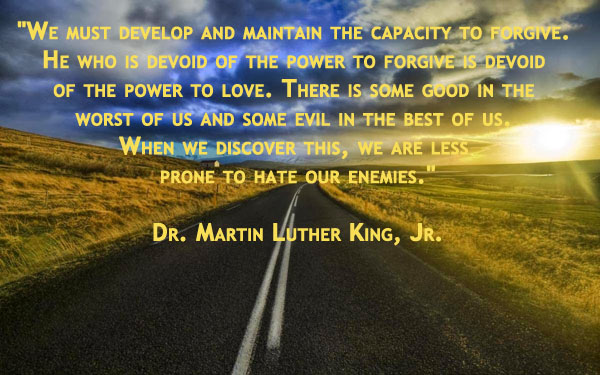
Of all the things that we humans are called upon to do, it is my opinion that real, genuine, authentic forgiveness is one of the most difficult. Humans, by nature, get a certain perverse enjoyment out of nursing grudges against others, holding on to wrongs done to them, and feeding what they believe is eternal and justifiable anger toward other people.
It doesn’t make any sense logically, objectively, or rationally because, in the end, unforgiveness causes a lot of self-inflicted pain that can sometimes last for the rest of a person’s life.
Because here’s the irony of being unforgiving.
No one suffers but the person who can’t or won’t forgive. The people who wronged the unforgiving go on with their lives, unaware of, perhaps, or, more likely, uncaring about the effect their behaviors. (more…)
There is an expression that “still waters run deep” that is often applied to people who tend to be mostly silent and low-key in their exterior lives that belies much complexity, thoughtfulness, and depth in their interior lives.
In other words, these people are masters at the art – and revel in the beauty of – silence. They enjoy the sound of silence. They crave more silence than not. And they are completely comfortable – in fact, they are most comfortable – in and with silence.
Before we discuss the art and beauty of silence, we must clear up some common misconceptions.
First, the art of silence doesn’t mean never talking (or writing), nor does it mean a lack of passion when talking (or writing). It’s not an either/or trait, unlike the way a lot of this-or-that, all-or-nothing generalists tend to portray the art of silence.
Second, the art of silence doesn’t indicate weakness, shyness, fear, or being intimidated. Too often the art of silence is portrayed as an inferior trait. Nothing could be further than the truth!
Third, the art of silence doesn’t mean not listening and not hearing. In fact, it means just the the opposite. Unlike talkative people who have great difficulty (and many times are completely tone-deaf) listening to and hearing anybody else because they’re so busy talking themselves, people who are masters at the art of silence hear and see everything that is said or done.
The difference is the art of silence, which includes self-control and self-discipline, knows when and/or if to respond to things that are said and done, which is why the art of silence is a quintessential leadership trait.
How do quintessential leaders use the art of silence? And why do quintessential leaders use the art of silence? Those are the two aspects of the art of silence that we will look at today.
One of the ways that quintessential leaders use the art of silence is to filter out distractions. Distractions come in many forms, but one of the most prevalent and hardest to avoid and/or ignore is incessant talking.
Some people who talk incessantly just need to talk all the time. And if they can find someone who will engage with them interactively, then they have even more to talk about.
Some of these people can’t abide any kind of silence, so in the absence of external noise, they talk to fill the void. Everything that comes into their minds comes out of their mouths.
There is no editing and there is no evaluation of timing, appropriateness, or audience. The words are simply there and they must be uttered immediately out loud.
Because there is no content control for people who need to talk, there is often inciting and offensive content in what they talk about as well.
The other kinds of people who talk incessantly are people who think out loud to process their ideas. These people are also looking for engagement because they want external feedback as they work through the process.
The same lack of content control, timing, and appropriateness may accompany this.
More likely, though, the biggest distraction in this kind of incessant talking is the drawn-out, rambling, unorganized, and sometimes incoherent process of formulating ideas out loud (people who are masters of the art of silence go through the same idea-formulating process, but they do it internally, not externally).
Quintessential leaders use the art of silence to stop the distraction of incessant talking by refusing to engage in the moment (incessant talkers need engagement, so if someone won’t engage, they’ll move and find others who will).
Quintessential leaders also use the art of silence in this situation because if their flow of productivity in working/thinking/life, which requires complete focus and attention, gets interrupted, they will lose a lot of time in the future to get back into that flow, if, in fact, they are able to. In other words, the total cost of not using the art of silence far outweighs any benefit of immediate engagement.
However, for some idea formulations (either in terms of importance, experience, and/or coaching), quintessential leaders are very willing to participate, but the timing and the scope must be negotiated and agreed upon in advance.
And there are two crucial reasons why.
The first reason is because quintessential leaders will have the time to come fully prepared for discussions like these. The second reason is so that quintessential leaders can carve out a piece of time to give the person and the process their undivided attention.
Another area where quintessential leaders use the art of silence is the area of dealing with challenging people. No matter what teams we lead in life, there will always be a challenging cast of characters among them.
Challenging people may be uninformed and biased-by-spinning loudmouths. They may be instigators. They may be argumentative. They may be talebearers (includes gossiping). They may be extremely needy. They may be drama queens or kings. They may be attention-seekers. They may be manipulators.
In whatever form challenging people appear (and I’ve listed some of the major areas above), quintessential leaders must be adept in using the art of silence in the right way at precisely the right times to effectively neutralize and/or eliminate the area of challenge.
There are two things that all challenging people are looking for in terms of satisfaction with these kinds of behaviors. One is total engagement. The other is total agreement (or a really good knock-down-drag-out argument).
Quintessential leaders give them neither with the art of silence.
Silence has several positive results.
First, quintessential leaders are modeling the right behavior – in effect, coaching them in “this-is-what-it-looks-like” – for their teams to learn as they encounter challenging people along the way.
Second, the art of silence immediately shuts down the challenging person. It also removes them and their influence from the team, because if there is no satisfaction in one place, challenging people will quickly go looking somewhere else for it, since that’s the driving need behind these behaviors.
A third way that quintessential leaders use the art of silence is to create enough space between them and everything and everyone else to create a place in their lives where they can retreat to as often and as long as they need to. This place is a place of assured peace, safety, comfort, and….wait for it…silence where quintessential leaders go to recharge and regroup.
Quintessential leaders don’t disconnect from life when they go to this place. They are fully engaged in everything that is important in life in necessary, productive, and practical ways.
However, they are completely distanced from all the unnecessary, all the impractical, all the frivolous, and all the jingly-jangly-clanging noise that comes at us from every direction and makes up our modern existences.
This is a personal and internal requirement for quintessential leaders, because this place must exist for quintessential leaders to be quintessential leaders. How often and how long the stays are will vary from situation to situation and individual to individual. But they must occur regularly.
If they don’t, then quintessential leaders become unquintessential leaders because they will lose sight of the big-picture, the vision, the focus, and the effective use of the art – and beauty of – silence.
And they will end up simply being another discordant note in the ever-increasingly-screeching and ear-splitting symphony of noise that has become the never-ending soundtrack of our lives.
Are we effectively using the the art of silence or have we forgotten and are on our way to becoming an insignificant off-key note that is lost in a maze of unpalatable noise?
Contrary to popular opinion, vision and focus are not the same thing. They are related, but vision and focus are distinct from each other in many ways. To be a quintessential leader, we must possess both vision and focus and know when and how to execute them consistently and well.
Frankly, many people in leadership positions today do not have either vision or focus. The majority of the exceptions to this have one, but not the other. That sliver-thin few, then, that possess both vision and focus are the ones we want to focus on in this post and, as we strive to be quintessential leaders ourselves, that we want to emulate.
What is vision and what role does it play in quintessential leadership? Vision is a big-picture and well-defined view of a distinct and yet-to-be-realized goal. Our mission statements, organizationally and individually, must capture vision.
This is the first step of quintessential leadership. Vision must be clear and concrete in its expression and it must create a framework within which we operate. In other words, if anything about us – thinking, being, doing, saying – goes outside that framework, then we have lost our vision.
Vision answers essential questions in broad terms, distinguishing the uniqueness of why we and our organizations exist and what we alone bring to the table to achieve a stated objective.
(If we cannot find anything unique in our existence – and by unique, I don’t mean philosophical differences, power plays, personality differences, etc. – then we won’t have a very compelling vision.
It will be difficult, if not impossible, if our stated vision looks almost identical to all the other organizations in our field, to distinguish why we should be the organization of choice. Not only that, but where there is no unique vision and there are lots of very similar competitors, the end result is confusion and attrition. In other words, everyone in the field loses in the end.)
Vision answers these questions:
Why do we exist?
What are our objectives?
What is the framework in which we will meet those objectives?
How is our framework both unique and better able to meet those objectives?
What does success, in terms of the objective, look like?
One of the biggest problems I see with vision statements in general is the wrong objective. Getting money, getting more customers, doing this, doing that are all short-term objectives and they are selfish objectives, and they are the wrong objectives.
Vision’s objective is long-term and consists of not what we get, but what we give. Because reaching long-term objectives requires giving a substantial investment of ourselves and our resources to the effort to give something better than what exists now to others beyond the organizational boundaries.
In other words, vision requires a selflessness that very few people in leadership positions now have. But quintessential leaders do and you see it in everything they are, they say, and they do.
Vision is the first and necessary part of being a quintessential leader. The second and equally-important part of being a quintessential leader is focus.
Focus is keeping your eye on the goal and moving toward it without deviation. It sounds simple, but this is, in many ways, the harder part to actually accomplish.
We live in a distraction-filled world that makes getting focus, keeping focus, and maintaining focus toward long-term goals the most difficult accomplishment to actually achieve for all of us.
Much of this is because our attention spans have been shortened to almost non-existence both subtly and overtly.
The overt ways have come to our doorsteps as a result of the technological revolution.
A constant and steady stream of new and cool gadgets litter and clog up our neurological landscape and they all seek to claim our attention and our desire at the same time.
24/7 virtual connectivity through email, cell phones, and social media are all increasingly fragmenting our time and attention while demanding our continual obsequiousness.
The subtle ways our attention spans have been practically destroyed can be attributed to the media and the workplace.
Media’s contributions have been shorter commercials with more products advertised, 24/7 multiple-channel access to talking heads, and, from digital providers, multiple-screen programming that can be simultaneously (sports channels lead in this area). With the addition of streaming services, our neurological landscapes have just become completely overcrowded and overwhelmed.
The workplace has contributed to this with its championing of multitasking – the more things you can do at one time, the more brilliant, the more talented, the more wonderful you are – and multitaskers, creating in the process, including most of the people in leadership positions, a superficial semblance of productivity that upon closer examination shows no depth, no forward progress, and no focus.
So how do quintessential leaders keep their focus when it’s clear all the odds are against them?
They never allow the vision, the mission statement, and the goal out of their sight. They, like salmon, swim upstream against the tide of distractions, exercising extreme self-discipline and extreme determination all the time to get to that goal.
Quintessential leaders are big-picture and long-term people and that’s how they live and breathe. As a result, they’re able to move right through the distractions without getting caught up in them for the most part.
Occasionally, though, even quintessential leaders will get taken in temporarily by a distraction that may seem important or significant. But the difference is that quintessential leaders recognize that it’s a distraction.
So what do quintessential leaders do? They always evaluate the distraction in terms of their vision, their mission statement and their focus. If the distraction is within that big-picture framework and needs to be addressed or resolved on the spot, quintessential leaders take care of it immediately and starting moving forward again.
Quintessential leaders, then, are never moving and doing just for the sake of moving and doing. If moving and doing does not have a purpose within the vision, the mission statement, and the goal, it’s irrelevant and eliminated.
Quintessential leaders are very proficient at this because they’ve either been doing it all their lives – some of us are naturally wired this way – or they’ve learned how to do it in the process of becoming quintessential leaders.
It’s not always easy, it’s not always fun, and it’s most definitely not always popular.
But quintessential always eventually reach their goals, in the end, no matter how long, how bumpy, how rough, how intense, and how grueling the journey between the initial vision and the completed objective is.
So let’s look at ourselves in relationship to our vision and our focus.
Unquintessential leaders (people who have no vision and/or no focus) tend to complain about having too many things to do at once, not being able to finish anything, finding it hard to focus on what they’re supposed to be doing, having no breathing room or free time to recharge.
Unquintessential leaders also complain about not being organized and being perpetually confused about what they’re supposed to be doing, and, often, in the end, they quit, either literally or symbolically (just going through the motions as a pretender).
Quintessential leaders (people who have both vision – with the right objective – and focus), on the other hand, rarely complain about the effort and the toll it takes from and on them – and it does because all effort takes a toll, but the difference is whether it ultimately means anything or not – and the only thing they will complain about, at times, is having to expend even more effort to keep all the distractions and noise out so that they stay focused on the objective.
There is no disorganization, no lack of clarity, and no confusion. And they don’t quit, no matter what gets thrown in their way along the route from vision to goal.
So, my fellow quintessential leaders, how are we doing?
The majority of articles and blogs about leadership talk about a single aspect – as if it exists and operates in a vacuum – of leadership. It is the public face of leadership: businesses, religious organizations, political organizations, social organizations, schools, and non-profit organizations.
Except for this blog and these books, I have not found any other resource on leadership that discusses it in terms of the whole of spectrum of our lives: it’s who we are, what we are, how we are everywhere in life.
That’s what makes this blog and these books unique. Most people don’t think a blog or books about leadership apply to them: to their lives, to who they are, what they are, and how they are.
They are wrong.
Because they’ve bought into the mainstream idea of what leadership is in a public sense, and since they’re not in one of those positions, then any discussion of leadership doesn’t apply to them.
(And most of the mainstream ideas of leadership are actually “management” instead of “leadership,” which fails time and time again because there are very few people strong enough and courageous enough to get outside of the MBA-fueled tiny, uninnovative, rigid, and constrictive box that confines them to failure).
The reality is that quintessential leadership applies to everyone who lives and breathes. No matter where we are in life or what we are doing, we all lead at least one team, if not several.
Everything we do, we say, and we are is setting an example for the others in our lives, and that, my friends, is leadership. How we do that determines whether we are quintessential leaders or unquintessential leaders.
Becoming a quintessential leader is the road not taken. It is the hard way, the difficult way, the way that demands that we look at leadership in terms of every and all aspects of our lives, not just a single part.
It requires rigorous self-examination without excuses, justifications, or blaming others. It requires constant, continuous, and momentous change from the inside out.
It requires a complete metamorphosis and transformation at the very foundational core of who and what we are, our intents, our attitudes, our motives, how we think, what we think, how we speak, what we speak, how we act, what we choose to do or not do, and how we set that example for others.
It requires fearless commitment and unwavering fortitude.
There is no room for the pretenders, the wannabes, the half-hearted, the sometimes-maybe, for the lackadaisical, and for the here-but-not-there.
We are either all in or all out.
One of the tests – of veracity, of genuineness, of authenticity – for whether we are quintessential leaders or not is how we consistently handle the good, the bad, and the ugly in life.
All of life.
From our most private internal lives to our most public external lives.
It is important to remember that this is the ideal, the goal that quintessential leaders strive for and to. None of us will execute this perfectly all the time, but there must be aggregate and continual evidence in our lives that this is who and what we are committed to – no matter how many failures, setbacks, and falls along the way we make and encounter -becoming.
Quintessential leadership is hardest to see when life is good. Humanity, in general, tends to be at its best when everything’s going well and life presents no challenges, no upsets, no hairpin turns in the road. We all, at least on the surface, can seem to be charitable, thoughtful, caring, concerned, kind, generous, gentle, merciful, and magnanimous.
It is in the good times, though, that the inner character of quintessential leaders separates them from everyone else.
One component of that character is humility.
Quintessential leaders never elevate themselves above others, nor do they constantly talk about how much they’ve accomplished, achieved, acquired (and, by extension, how much wealth they have by enumerating the amount of money those acquisitions cost), and how awesome and great they are.
Instead, quintessential leaders continue to live life modestly and quietly. They realize that the good times are part of the cycle of life and will not last.
Quintessential leaders also understand that the good times are a gift they did not earn, do not deserve, and are not entitled to, so in an attitude of service and thankfulness for them, quintessential leaders use the blessings of good times to help and assist others, often anonymously, and always silently and without any fanfare.
Another three-pronged component of the quintessential leader’s character that you’ll see in the good times in life is understanding and sensitivity combined with empathy.
Quintessential leaders are always cognizant that although they may be experiencing good times in their lives at that moment, many of the people with whom their lives intersect – and for whom they are examples and, therefore, leaders – may not be.
Quintessential leaders are excellent and accurate observers of life by nature. Because they listen more than they speak and watch more than they engage, they miss virtually nothing about what people say (or don’t say), do (or don’t do), and are (or are not), although they seldom, if ever, say anything about it.
They learn to understand and to relate to others in a tangible and meaningful way that includes the rare quality of being able to empathize by putting themselves into the situations that others are experiencing.
As a result, quintessential leaders are acutely sensitive to the circumstances of other people and how their behavior, words, and actions could affect them, not because they are inherently wrong, but because of what other people may be experiencing (for example, if someone is going through a relationship loss, quintessential leaders would not be talking on and on in bubbly, bouyant, and bouncy conversations with this person about all the great things in their wonderful and fantastic relationships).
Anything other than this kind of understanding, empathy, and sensitivity – deep awareness of others and genuinely and authentically relating to them – would be out of character for quintessential leaders during the good times of life.
Why?
Because quintessential leaders always have the big picture in the front of their minds. Good times come and go. Anything that’s happened to someone else could or may happen to us. How would we want to be treated when we are walking in those shoes?
It is always an others-perspective, not a me-perspective, that defines who, what, and how quintessential leaders are. In the good times in life. And in the bad and ugly times.
It is in the bad times and the ugly times in life that quintessential leaders become more apparent, because the bad times and the ugly times in life are the times that try our souls, our hearts, our minds and our character to their outermost limits.
The bad times and the ugly times present ample opportunities to be unquintessential leaders, to set and be bad examples for the people with whom our lives intersect.
The bad times and the ugly times in life can give rise to unfair criticisms, harsh and inaccurate evaluations and condemnations, rejections, resentments, mockery, stinging and hurtful putdowns (usually guised as “jokes” or followed by smiley faces), spitefulness, jealousies, pettiness, and defensiveness – all of which are not intrinsic character traits of quintessential leaders.
The reality is that we all have to deal with these kinds of attitudes, motives, words, and actions during the bad times and the ugly times in life, whether we are quintessential leaders or not.
They are hard-wired into our human nature and it is in the worst of times that we either fight and subdue them or we embrace and use them.
Unquintessential leaders embrace and use them.
Quintessential leaders fight and subdue them.
In other words, quintessential leaders exercise self-control (and, at times, this is the most exhausting work in the world, because it literally takes every ounce of energy and effort we have) and choose what is right instead of what seems easy, justified, and, at least temporarily, very self-satisfying.
These are very often epic behind-the-scenes battles that end in victories or capitulations, character developments or character destructions, good or bad choices, and wise or unwise decisions.
The outcome of what goes on in the private and inner workings of our hearts, souls, and minds is only apparent in what we do (or don’t do) and say (or don’t say) out in the open.
And it’s in the outward manifestation, in bad times and ugly times, that we can truly distinguish between quintessential leaders and unquintessential leaders.
Again, in bad times and ugly times in life, we all experience failure in being quintessential leaders.
There is not a human being who has ever lived, who lives, or who will live – except for the Son of God – who has, does, or will get it right 100% of the time. It’s impossible in our current configuration.
However, the hallmark difference between quintessential leaders and unquintessential leaders is that quintessential leaders are actively living – consciously and deliberately thinking, practicing, being in every part of their lives all the time – with the goal always directly in front of them.
It is a way of life – an integrated part of who, what, and how they consciencely (that’s not a misspelling – because the state of our consciences is directly related to quintessential leadership) and consciously are and are becoming.
In other words, quintessential leaders are well aware when they fail. Nobody else needs to point their failures out to them. The consciences of quintessential leaders are so finely-tuned and sensitive to what they should and want to be – the ideal – that their consciences are immediately stricken when they fall short in any way.
Quintessential leaders are devastated when they fail because they know that not only have they missed the mark of quintessential leadership, but they have failed the people whose lives intersect with theirs by setting a wrong and bad example.
Quintessential leaders, again, stand out in this area from unquintessential leaders.
Quintessential leaders first admit they failed, to themselves and to their teams. They then apologize and ask for forgiveness.
Quintessential leaders will next immediately undertake an exhaustive post-mortem on what happened and why it happened. In the process, quintessential leaders identify tangible and definitive steps to correct the failure, from the inside out, and actively start taking those steps.
Quintessential leaders often do one more thing: they use their failures and the process of identifying the causes and the corrective actions as teachable moments for their teams.
Unquintessential leaders can’t do this because they don’t even recognize a failure (and if someone pointed it out to them, they’d deny it and get defensive and start attacking the poor, unfortunate soul who dared to say anything), so their bad examples are all their teams get.
And their teams perpetuate those bad examples to their teams, and so it goes until we find ourselves in the world in its present tense surrounded by an overwhelming majority of unquintessential leaders.
At the heart of gratitude lies genuine and authentic appreciation. We live in an entitled society. As a result, there is a pervasive mindset of believing and expecting that when we receive good (words, actions, gifts), we deserve it – it’s our right just because we exist – and we owe nothing in return.
We, as a society, don’t know how to be thankful and how to express and show genuine and authentic appreciation to and for everyone and everything that intersects with our lives.
Instead, we have devolved into a culture of mutual admiration societies, where we acknowledge only, in an insincere and superficial manner, the people and the things that make us feel good, smart, funny, important, and interesting.
This is not genuine and authentic appreciation.
Instead, it is a revolving door of platitudes dependent on each participant continuing to walk in the endless and small circle of flattery and fawning that strokes our egos and our pride.
It is empty. It is meaningless. And when someone in the circle gets bored because they need a new retinue of genuflectors, they will leave and it will end.
This is also a characteristic of unquintessential leadership, which is entrenched in our society as well.
When is the last time someone in a leadership position said “thank you” to you for something or anything just because?
Does the only meaningless gesture of appreciation you get from an unquintessential leader happen when they need or want something from you or you can be useful to them? What happens when they don’t need or want something or you’re not useful in the moment?
Are you appreciated?
The answer is “no.” If you can’t do something for them or be something to them, you are invisible, useless, and worthless. Tough words. Real words. True words.
So how do quintessential leaders differ? How will you know?
First and foremost, quintessential leaders are genuine and authentic as people: who, what, and how they are. They are also humble and grateful for the gifts they’ve been given. They know they aren’t entitled to them. They know they don’t deserve them. And they know they are not owed anything.
Because of their character, their understanding of themselves in the big picture, and their ability to recognize that everything and everyone in their lives is ultimately a blessing – whether to teach a lesson, to advise for or against a path of life, to sharpen discernment, or to develop and grow the characteristics and character traits that build trust and make them trustworthy – quintessential leaders are continually expressing and showing genuine and authentic appreciation to everyone and for everything in their lives.
One difference that highlights their genuineness and the authenticity is that, most of the time, quintessential leaders show and express their appreciation in the background in an one-on-one interaction.
The other difference is that quintessential leaders show and express their genuine and authentic appreciation across the board for all the people and things in their lives.
And much of that appreciation, especially when there are difficult people and difficult things in a quintessential leader’s life that are put there as opportunities to choose the right way, to teach eternal lessons, to make the heart, soul, and mind more merciful because of the mercy received, ends up being for God’s ears only.
What does genuine and authentic appreciation look like?
It means being respectful and kind when you are treated rudely and contemptuously. It means not answering when you are threatened or challenged or deliberately goaded. It means being silent when you are having insults, condemnations, unfounded accusations, and unrepeatable names and labels showered on you.
It means being polite and expressing thanks to someone who you know, at the very least, doesn’t like you, and, at the very most, hates you. It means being gracious to everyone regardless of how they treat you. It means consciously, and sometimes with great effort, silencing the fickleness of emotions and answering instead the consistency of a highly-developed and sensitive conscience.
It means consistently choosing to do the right thing and the moral thing, even in those moments where the temptation is strongest and most urgent for anger, revenge, and ingratitude.
In other words, in the end, expressing and showing genuine and authentic appreciation is a product of striving to master self-control.
As always, I’ve expressed the ideal here. Even those of us who are consciously striving to be quintessential leaders fail to meet the ideal all the time.
But what distinguishes quintessential leaders from everyone else is that the ideal is always at the front of our lives and it is what we live by, strive for, and attain to.
Unless you’re God, Jesus Christ, or a fictional character (whose record, unlike the first two, is not perfect) in a Star Wars movie, the answer is “no.”
If you answered anything but “no,” then this post is for you.
Even if you answered “no,” this post is for you.
Because just saying “no” without understanding why doesn’t make you any more knowledgeable, any wiser, or any more of a quintessential leader than anyone who answered “yes” or “maybe.”
To discuss this topic cogently and thoroughly, we need to first look at the big picture and understand that there are different categories of questions we’re asked. These include factual questions, informational questions, moral questions, ethical questions, and life questions.
Moral questions and ethical questions should never be, for a quintessential leader, questions that we don’t have an immediate answer for and an explanation for our answers.
Consistent, unwavering, and unimpeachable moral and ethical character is a defining trait of quintessential leaders. It is literally a part of who and what we are and it is one of the traits that makes us trustworthy.
However, there are some factual questions and informational questions that we may not know the answers to, but we know we can find the answers.
When we are asked these kinds of questions, our responses are “Let me find the answers and get back to you.” Our responsibility then is to do what we say we’re going to do promptly.
But the questions that will be the ones we will not know or have all the answers for are life questions. And how and if we answer those questions accurately and compassionately will determine if we’re quintessential leaders or not.
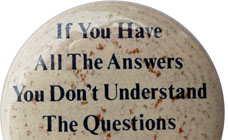
There is a leadership myth that people who are in positions of leadership are required to have all the answers and know everything or they are not leaders.
Many people in leadership positions tend to fall into the traps of this myth. And the results are devastating because more hurt and damage is done by trying to live up to the myth than simply saying “I don’t know, but…”
Because the reality is that when it comes to life questions, none of us have or know all the answers. Ever. There are many things in life that are beyond our human understanding, knowledge, and comprehension.
To pretend that we have all the answers or to believe that we can find all the answers is, at its root, dishonest.
Sometimes it’s unintentional dishonesty. We are trying to do what we think we’re supposed to be doing – the myth. There are several ways this unintentional dishonesty happens.
One way is that we simply don’t understand the nature of the question and we believe we’re answering it when in fact we’re answering another question altogether.
Another way is that we haven’t been where the person asking the question has been or is. In other words, we haven’t experienced firsthand either exactly or to the degree of what that person has or is experiencing, so we have no frame of reference from which to answer their question. But we try to answer it anyway.
And then sometimes it’s intentional dishonesty because of pride, arrogance, and the need to maintain control. We know we don’t know, but we don’t care.
So we make things up, we lie without blinking, and we fool enough of the people enough of the time to gain a lot of people who believe us until our fantasies and our lies fall apart, as all fantasies and lies do in time, and in the wake of them is a bigger swath of destruction and damage than any hurricane, earthquake, volcanic eruption, or tsunami could even begin to touch because we’ve destroyed lives from the inside out.
Destruction and damage to stuff is difficult to deal with and, while some losses are permanent and unrecoverable, a viable measure of recovery is still possible.
Destruction and damage to the soul and to the psyche, on the other hand is excruciating, and often times, the possibility of any kind of meaningful recovery is slim to none.
The reality of life is that some things in life simply don’t have answers – at least that are available to us peeps on the planet.
With many life questions, it’s impossible to make a nice, neat list and say, “If you do a, b, c, this will answer x life question.” Life and the unique situations that each of us experience – which generates the questions – as we go through life are not that simple.
If any of us thinks it is, then we simply don’t get it.
So when we are trying to live up to the “leader-knows-all” myth, we not only hurt ourselves and do more damage by “answering” life questions, but we hurt and do a lot of damage to those we’re “answering.”
What, then, do quintessential leaders do?
This came up recently in a discussion about an “answered” life question that I didn’t – and wouldn’t – ask, but that I have been and am experiencing 24/7 for a long time. And I’ll share with you what I shared in the discussion.
The “answer” was well-intentioned but it had some noticeable flaws and, in the end, was the answer to another question.
I had a physical reaction – my chest tightened up and I really had to work hard for a few minutes to get a grip and calm myself down – at the very beginning of the “answer,” because I knew it wasn’t the answer to the question.
There were disconcerting statements made that literally caused anxiety in me because I knew what was being said – and I’m not even sure the person answering the question realized they said what they said – showed a lack of knowledge, experience, and intimate understanding, even though the person answering the question is very compassionate, caring, and empathetic.
On a personal note, in some ways, at least for me, that’s much, much harder to deal with than someone you know doesn’t care.
And, yet, there would be no way to explain to this person or any other person who has not walked intimately and long-term in the shoes of this – or any other, for that matter – life question that the answers, if there are any, are not always so cut and dry, “this” or “that,” and that, in the big scheme of things, there are a lot of aspects that there are no answers for.
But as I listened to the “answer,” it became apparent that the life question being answered was not the one that had been asked. I have done and am doing all the things contained in that answer and none of them has answered my life question (which is the same life question the person was attempting to answer).
Quintessential leaders, first and foremost, recognize their limitations. And when it comes to life questions, we are all limited. We don’t have or know all the answers to life questions and we won’t as long as we breathe for a living.
And that’s okay. It doesn’t mean we’re less of a leader. It doesn’t mean we’ve failed. It doesn’t mean that we’ve let other people down. It means that we’re human.
I was asked during the discussion how I would have answered this life question. Since it’s a predominant life question for me right now, I gave the answer I’ve come to accept, but I added what someone who hasn’t walked in the shoes of this life question isn’t really able to in a meaningful way.
My answer? “I don’t know the answer, but I’m asking the same question myself because I’m going through the same thing. I completely understand exactly what you’re asking, why you’re asking it, and what a crushing, 24/7 weight it is on your mind and your life. I can’t solve it for you. I can’t fix it for you. But I can walk, step for step, with you and beside you through it. You are not completely alone.”
My fellow quintessential leaders, “I don’t know” in the matter of life questions is the next best thing to silence if we don’t know or have the answers. It is the product of wisdom. It is also the product of humility.
An abundance of words about something we haven’t experienced firsthand, know little or nothing about in a meaningful way, or simply don’t understand is the worst thing we can do.
Life questions are tough for everyone. Except for the people being intentionally dishonest in answering them, the motivation to find answers is not malicious (in fact, it’s the opposite because we really want to help), but when the answers are hollow or wrong or to a different question altogether, we do more harm than good.








 The Quintessential Leader