 After the terrorist attack in Paris on November 13, 2015, Facebook immediately came out with an app that let its users superimpose the French flag over their profile pictures to ostensibly show solidarity with France and Paris. (more…)
Posts Tagged ‘quintessential leader’
What Quintessential Leadership Looks Like: Following Through on Commitments
Posted: November 6, 2015 in Examples and Analyses of Quintessential LeadershipTags: action, cultivating teams, effort, example, follow through on commitments, integrity, quintessential leader
 It seems that it’s much easier for us to give easy and voluminous lip service to committing to do something than it is for us to actually take the actions and efforts to follow through on commitments we’ve made.
Part of the reason is that we don’t take our verbal commitments very seriously. They’re easy to say and take so little time and they temporarily pacify whomever we are talking to. But the reality is that there is no real intent to follow through behind them.
Another part of the reason is that we tend to over-commit, even though we can’t possibly follow through on everything we commit to, because we want to please people or we don’t want to disappoint them.
And still another part of the reason is that our tendency to commit to doing things that we end up not following through on is to make ourselves look good in the eyes of others as being generous benefactors.
No matter what the reasons are why we don’t follow through on the many commitments we make every day, the fact that we don’t follow through puts us on the path of unquintessential leadership.
Why?
- Important things don’t get done when we don’t follow through on our commitments.
- People – perhaps a lot of people – suffer, sometimes greatly and needlessly, because we don’t follow through on our commitments.
- We model a poor example for all our life teams – which they will emulate, perpetuating the path of unquintessential leadership into the future – when we don’t follow through on our commitments.
 Because quintessential leaders strive to follow through on their commitments, it’s important to go behind the scenes to examine how they do it (what this looks like) in a world where the majority of people, including those in leadership positions, fail to follow through on their commitments.
Quintessential leaders follow through on their commitments by:
- Thinking carefully about what they commit themselves to do;
- Ensuring that they have all the resources they need to fulfill their commitments;
- Being selective about what they commit to (because their integrity and their examples to their life teams are always in focus, they are careful to preserve both all the time);
- Refusing to over-commit;
- Refusing to commit to things they don’t have the time, the ability, the authority, and the resources to fulfill;
- Ensuring active, prompt, and complete fulfillment of the commitments they actually make (this means being involved, following up, and staying active in the process until the commitment they’ve made is completed).
Quintessential leaders value quality over quantity. They also value substantive action over superfluous talk.
That is why quintessential leaders carefully choose – and have no problem saying “No” to things and people – what they commit themselves to and follow through with.
Quintessential leaders are also people who do the right things for the right reasons, striving for anonymity and being completely under the radar.
Unlike the many people who say they’ll do something so that they’ll look good to other people, yet they fail to follow through at all, quintessential leaders always ensure that their left hands don’t know what their right hands are doing.
As we look at our own leadership lives – wherever we are in life, we lead at least one team and our lives are living examples to everyone around us to either reject or emulate – we must ask ourselves about our commitments and our follow through.
- Do we make commitments and then fail to follow through?
- Do we give lip service to commitments, with no intent of doing anything?
- Do we over-commit?
- Do we make commitments just to look good to other people?
- What example are we setting personally with the commitments we make and our follow through on those commitments?
How are we doing?
Quintessential Leaders Never Stop Learning and Educating Themselves
Posted: October 30, 2015 in Examples and Analyses of Quintessential LeadershipTags: change, discernment, education, growth, knowledge, learning, quintessential leader, substantive reading, understanding
 The day a human being – other than teenagers, who don’t know any better – decides they know it all and there is nothing else to learn or no reason to continue educating themselves is the day they die from the inside out.
When people in leadership positions do this, they become foolish, ignorant, and irrelevant, fit for nothing more than to go live as a hermit in a cave somewhere.
Because when people in leadership positions stop learning and stop educating themselves, they become useless.
We live in a world where ego breeds ignorance in people in leadership positions. Increasingly, this triumph of ego over knowledge (I’ve discussed this before) is applauded, embraced, and endorsed.
When this egotism and ignorance is in people in leadership positions, two things happen.
 For the majority of people impacted by them, an increase in gullibility (engendered by each of these people’s failure to continue to learn and educate themselves, preferring instead to let media and technology appeal to their baser – and ignorant – natures and give them neatly-packaged, but erroneous, talking points they can parrot) leads the majority just to accept whatever they hear as being true. Ignorance, then, perpetuates itself throughout society.
For the minority of people who are continuing to learn and educate themselves, these people in leadership positions lose their respect and their trust. And they lose this minority of people who either internally, first, and physically, eventually, walk away from them for good.
I’ll give a real-life example of this kind of ignorance because I hear and have heard statements about this over and over.
Not long ago, a person in a leadership position was talking to a group of people, which I was among. The person told the group that President George W. Bush didn’t know anything about the threat of attacks on 9/11/01 just like President Franklin D. Roosevelt didn’t know anything about the threat of attack on Pearl Harbor.
I sat there in disbelief because because both statements were totally false and if this person who is in a leadership position had continued learning and educating themselves, they would have never made those statements.
History has revealed that both presidents were well aware that the respective attacks were not only probable, but imminent. They chose to ignore that information because the attacks would give them the go-ahead to do what they would not be able to do any other way.
 In President Roosevelt’s case, the only way the United States could get into World War II officially (it had already been unofficially involved since the late 1930’s) with the support of the American people was if America was attacked. Therefore, the attack on Pearl Harbor was his (and his advisors’) ticket into the global conflict.
In President Bush’s case, one of his objectives was to finish the job in Iraq – killing Saddam Hussein – that had been unfinished when the Gulf War (August 1990 – February 1991) ended.
 He couldn’t just go attack, so he had to find a way to be in the Middle East. Al Qaeda’s uptick in activity and increased direct threats to the United States gave President Bush (and his advisors) the promise of an open door to complete his ultimate objective. When the attack came, the door opened.
Perhaps it’s hard to believe that a country would let its own people die in order the meet other objectives.
However, anyone who is continuing to learn and continuing their education – which includes history – will know that’s been the story of humanity.
Ignorance of the truth of our story as a species leads to more ignorance about our story in all its organizational contexts and ignorance about our story as individuals. The net effect is that we have no clue about the big picture and we believe lies and perpetuate them.
Because quintessential leaders keep the big picture in mind all the time, they know they don’t know everything about everything, and they know that ignorance breeds lies (quintessential leaders value and ensure, to the best of their abilities, truth in everything), quintessential leaders never stop learning and they never stop educating themselves.
How?
As anybody whose been through both the K-12 and higher educational systems in the United States knows very little learning and education happens in the process.
Much of what is taught are the propagated lies and sheer memorization of them (there are exceptions to this and I was fortunate enough to have a handful of educators along the way who were exceptions, just as I was fortunate enough to have parents who put a high premium on lifelong learning and education).
We come out of these systems with necessary pieces of paper, but, in most cases, very little real education and knowledge.
And that is when quintessential leaders embark on their lifelong quest for learning and education.
Quintessential leaders read widely. They read the classics (quality fiction), but mostly they read non-fiction on a wide variety of topics of substance.
Quintessential leaders know how to test and prove or disprove what they read. The more a person reads (and I’m talking about spending quiet and focused hours, not skimming something on  the internet and saying you read it) the better they become at discernment and at being able to determine what is true and what is not.
Quintessential leaders know how to think about and apply what they read because what they’ve learned stays with them and becomes a part of their collective reserve of information and their behavior.
Because quintessential leaders are well-read, they are very attuned to verbal inconsistencies and outright verbal ignorance.
Without that learning and educational process continuing, quintessential leaders would be susceptible to believing everything they hear (or read), because discernment, understanding, and knowledge is absent.
As always, we must, as quintessential leaders, look at our own lives to see whether we are on a journey of lifelong learning and education.
Therefore, we need to ask ourselves some questions:
- Do we read?
- If we’re not reading, why not?
- If we read, do we read widely and substantively, or do we read “easy reads” and “fluff?”
- If we read, can we compare what we’re reading with other things we’ve heard or read and know which is true or whether some or none is true?
- If we read, does it change our lives because we learn something we didn’t know or we gain a different understanding of something we thought we knew?
If we are not committed to and actively pursuing a lifelong commitment to learning and educating ourselves, then we are not quintessential leaders.
How are we doing?
Are We Quintessential Leader Pretenders?
Posted: October 7, 2015 in Quintessential LeadershipTags: honesty, imitable authenticity, integrity, quintessential leader, synchronized words and actions, team building
 The lack of a synchronized life of imitable authenticity among humans – and people in leadership positions – in what they say, who they are, and how they conduct every part of their lives is bemoaned almost constantly.
The reality is that what we do observe is an abundance of synchronized lives of not-to-be-imitated authenticity, more so now than ever before.
We now live in a society where being fundamentally selfish, self-centered, and driven by power and greed – something often hidden or obscured from public view in times past – has become not only visible, but accepted, expected, and applauded.
While some people in leadership positions posture with a public face of integrity, honesty, selflessness, transparency, and altruism with their words when their actions are the exact opposite (these are the ones who cause the bemoaning), most people in leadership positions now don’t try to hide how nefarious they are as people and in their leadership positions.
Bullying, cheating, one-upping, fighting, lying, treating people abominably, being perpetually profane and denigrating, and overall defective character among people in leadership positions is now considered admirable and the mark of strong leadership.
Are we who say we are striving to be quintessential leaders different? We should be. Increasingly, though, it seems that although we say we are different, in fact everything else about us says that we are less different that we purport to be.
 In other words, we are hypocrites, saying one thing about ourselves while the rest of our lives says the exact opposite. It seems that we have gotten comfortable lying to ourselves – and others – about ourselves.
When we live (and believe) a lie – saying one thing and doing and being something completely different – we are not quintessential leaders, but instead we are destroyers.
Most importantly, we destroy trust. With trust, we destroy credibility. When we lose trust and credibility, we destroy our teams. In every part of our lives.
Oh yes, the people around us may do – or pretend to do – what we tell them to, but it is not out of trust and respect.
For a few – and it’s a small few – of our teams, the reason is fear.
For most of our teams, though, it is a stopgap measure until – and they are scrambling to find the fastest exit – they can get as far away from us as possible.
If we’re losing our teams in droves, as quintessential leaders (this implies we care and we don’t want to lose them – no effort means we were lying about being quintessential leaders to begin with) we need to ask ourselves the following questions.
Do we want to inspire fear in our teams? Do we want to threaten and coerce our teams into doing whatever we want or else? Do we want our communication to be profane, denigrating, disrespectful, and dismissive?
Are we willing to cheat – the end justifies the means – anywhere and everywhere in our lives to get what we want and/or to get ahead? Are we willing to throw other people under the bus to make ourselves look good? Are we willing to be dishonest (lying, stealing, faking) to either avoid consequences or to get more for ourselves?
Do we care about our teams or are they just expendable commodities that we use, abuse, and then throw away when we can’t use and abuse them anymore? Are we sycophants with people we see as useful or important and tyrants with everyone else?
Who are we really? Do we know? Do we care? Does it matter?
The people we are best at fooling are ourselves. Most of us, even those of us who are striving to be quintessential leaders, are not aware of the depth of our self-deception about who and what we really are on the inside.
 Today, I challenge each of us to take stock of ourselves, of our lives, and of the disconnects we make between what we say we are and what we actually are.
We all have disconnects in our lives. Quintessential leaders acknowledge that, become aware of theirs, and undertake the process of doing something about it.
That’s imitable authenticity and that is a repeatable step (we can’t do it once and believe we’re done – it must be a daily part of our lives) that will lead to a synchronized life that sets a positive, realistic, and credible example to all the teams in our lives.
Anything less is unacceptable for quintessential leaders.
How are we doing?
The Unquintessential Leadership Aspects of Emotional Marketing
Posted: August 31, 2015 in General Things about Quintessential Leadership, Practical Quintessential Leadership, Qualities of a Quintessential LeaderTags: crassness, crudeness, deceptive, dishonest, elitism, emotional marketing, fear, fear-mongering, gimmicks, insensitity, intimidation, manipulation, plays on emotions, quintessential leader, sensationalism, superiority
 We live in an incredibly noisy world.
The world is so noisy, in fact, that most people have resorted to the most base tactics – and those involve emotional reactions and responses – to be seen and heard.
These tactics, which are more common than not and are all around us, even though we may not even be aware of them, include gimmicks, sensationalism, and manipulation.
But are gimmicks, sensationalism, and manipulation okay to use? Should quintessential leaders use them?
That’s the topic we’ll discuss in this post.
Lets look at some examples of what gimmicks, sensationalism, and manipulation look like first.
As you go through your day today, I challenge you to look at all that you read and see and be aware of whether they are gimmicks, sensationalism, and manipulation or not.
If you’re paying attention, I believe you will have an eye-opening day.
The front page of the August 27, 2015 New York Daily News, pictured below is an example of sensationalism.

The ad below for the ASPCA (American Society for the Prevention of Cruelty to Animals) featuring Sarah McLachlan’s 1997 hit song “Angel” is an example of manipulation.
These quotes and titles from a random sampling of the internet in the last week are gimmicky, sensational, and manipulative.
“…with ABC company’s finest immune boosting products as well as various soothing and calming treasures to help beat the stress…”
“How to Wreck Your Future”
“This Kind of Olive Oil Can Kill Cancer Cells in One Hour”
“Lose 20 Pounds in 21 Days”
What do all of these have in common?
First, they appeal directly to emotions and are designed to provoke an intense emotional response. Disgust. Sadness. Elitism. Fear. Hope. Happiness.
The second thing that they have in common is that they are dishonest, deceptive, manipulative and unproven.
The third thing they have in common is that they play on the gullible susceptibility of humans by promising, in most cases, something they can’t deliver.
But this is the way the majority of society has adopted to entice people to open the doors of their message or product because “smart” marketing says if someone opens the door the odds of them coming in and staying are very high.
This is the bait and the hook. And once emotions are involved, it doesn’t matter whether it’s true, right, logical, factual, or proven. Because emotional decisions don’t depend on anything real (how things are), but instead on sensation (how things feel).
Back in the day, this would have been called yellow journalism. Now it’s called emotional marketing.
There are many things wrong with these techniques. Here are a few of them.
 First, when a person or an organization is appealing to emotion, they are appealing to the irrational side of humans. Decisions made strictly on an emotional basis, with no consideration of logic and facts, are always, at the least, regrettable decisions and, at the worst, bad decisions.
And these kinds of decisions can – and often do – have disastrous consequences in peoples’ lives.
Second, a person or organization using emotional marketing is being dishonest and deceptive. Not only are they promising the moon, which no human can deliver, but they are intentionally misleading and manipulating other people to buy whatever they’re promoting or selling.
If a person or an organization draws people in under false pretenses and in an untrustworthy manner, then the logic follows that whatever they are promoting or selling can’t be trusted in terms of efficacy, quality, or longevity.
Third, people or organizations using emotional marketing are revealing both a lack of care and concern for others and a lack of personal integrity and character.
Because emotions are subjective and easily manipulated by gimmicks and sensationalism, using this type of marketing to reel customers in is a reflection of both a win-at-all-costs and the-end-justifies-the-means mindset, which is at the core of unquintessential leadership.
Unfortunately, most people are unaware of the emotional marketing that is thrown at them continually. And because society, in general, has abandoned logic, reason, and critical thinking in all its decision-making, it’s a safe bet to say that most people don’t really care if they are being manipulated and deceived by emotional marketing.
But we all should be aware and we should care. Consider the following statements from a generic emotional marketing campaign:

Notice that the first statement can’t be substantiated and has no objective data (ingredients that are different or better than specific competitors or the results of customer taste tests), but it promises healthier and tastier than any other tea that exists in the world.
The second statement also can’t be substantiated and is again lacking objective data to quantify it (e.g., 100 people who drank XYZ brand of tea in Yuma, Arizona on a 118-degree day in August said it was refreshing).
The third statement appeals to how a person looks (less calories equals less weight) and how a person feels (better than ever before).
The question of “how do you know?” is never addressed because of our lack of awareness and lack of care about being manipulated into buying something because it appeals to us on an emotional level.
 When we get accustomed to accepting things without proof, to using our emotions to guide our decisions and choices in life, to abandoning logic, critical thinking, and reason – which emotional marketing makes easier and, eventually, the default way we live life – we are at great risk for being more susceptible to deception, dishonesty, and manipulation every where in our lives.
Quintessential leaders don’t use emotional marketing. They don’t use gimmicks, sensationalism, and manipulation. They use facts, logic, and critical thinking. They prove what they say and do before they say and do it. And they expect everyone – their teams, their audiences, and their customers – to do the same. Nothing less than this method is acceptable.
The reality is that nothing less than this method should be acceptable for any of us, but even more so for those of us who are striving to be quintessential leaders.
The mirror test, as always, will tell us whether we have fallen into the trap of emotional marketing as quintessential leaders.
Do we consistently appeal to emotional responses by gimmicks, sensationalism, and manipulation to motivate our teams, to build our customer bases, and as a way of life?
Have we abandoned facts, logic, and critical thinking in our decision-making? Do we prove everything for ourselves or do we just accept whatever we see, we read, or we are told without any substantiation?
Have we moved more toward emotional marketing and away from factual, logical, and provable information in our lives, both as leaders and as consumers?
Do we even know the answers to any of these questions?
If we find that we don’t know the answers, then now is the time to examine our lives and figure out what we are doing and why.
If we find answers that show that we have embraced emotional marketing both as leaders and as consumers, then today is the day to begin to change that with a return to facts, logic, critical thinking, and truth, which will lead to us rebuilding our integrity and becoming trustworthy.
Does this matter to you?
If not, then you cannot claim to be a quintessential leader. In fact, you can’t claim to be any kind of leader. Instead, you are a duped follower of a dishonest, deceptive, manipulative, and untrustworthy system that has infiltrated every part of modern society.
If that’s okay with you and you can live with it and yourself, then this post won’t matter to you and you’ll dismiss it along with any other things in your life – including those occasional pangs of conscience that knock on your brain but you brush away and ignore – that demand a higher standard, a different standard, a standard that sets the right example for others.
But if it’s not okay with you, then join me in daring to be different and daring to do the right thing all the time and daring to become a quintessential leader in every aspect of our lives.
How are we doing?
What Quintessential Leadership Looks Like: Taking AND Staying on the High Road
Posted: July 30, 2015 in Qualities of a Quintessential Leader, Quintessential LeadershipTags: Donald Trump, low road, Mike Huckabee, quintessential leader, self control, self-monitoring, staying on the high road, taking the high road, Tom Brady
 Taking the high road is an idiom that describes a person who is consistently making the conscious choice to travel exclusively on the highest moral and ethical ground, regardless of what anyone else and everybody else is doing.
Taking the high road also characterizes a person who unwaveringly chooses to endeavor to do the right thing all the time, no matter what the circumstances.
Taking the high road is a choice. It is a choice that every human being on this planet decides to do or not do in every single situation we face. Taking the high road is a choice that quintessential leaders are committed to making continuously in every area of their lives for their entire lives.
Although we all fall short in consistently taking the high road at times, quintessential leaders distinguish themselves from everyone else by their determination, their tenacity, and their dedication to always taking the high road.
More than that, though, quintessential leaders work – and this is, I believe, the hardest work each of us has the choice to do in our lives, because it is the work of continual monitoring of and continual application of self-control in our attitudes, our motives, our thoughts, our words, and actions – diligently and tirelessly to also stay on the high road.
Before we look at what taking AND staying on the high road looks like in quintessential leaders, let’s see what the opposite looks like (unquintessential leaders).
Stop right now and think about everything you’ve heard, seen, read, thought, said, and done today up to this point. Everything. Do all of these things, added and averaged, tend toward taking AND staying on the high road?
If we’re unflinchingly honest – and that, my friends, is part of taking AND staying on the high road and unflinching honesty is scarce to non-existent in everyone and everywhere today – the answer will be “no.”
We humans tend to to like the low road because it appeals to the basest parts of our nature and it doesn’t make any demands on us.
We can be as dishonest, greedy, vitriolic, accusatory, condemning, condescending, mean, blaming, disrespectful, profane, and all-around-nasty as we want to be because that’s, unfortunately, the easiest way for us to be.
Sadly, it makes us feel smug and victorious to lie and get away with it, steal and get away with it, accuse others, condemn others, to put everybody in their place, to say whatever is on our mind however we want to say it (“and if they don’t like, well they can just get over it, because it’s our right!”) and never apologize for anything we say or do.
It’s all around us. Everybody’s doing it. And when we take the low road and stay on it, we fit in with everyone. We are popular. We get the kudos. We get the laughs. We get the “attaboys.” We get the praise and the glory.
And these things, which have kicked our natural tendancy as humans to be narcissistic, selfish, and self-absorbed into high gear with the ubiquitous intrusion of technology into our 24/7 lives, are incredibly powerful motivators to continue to choose to take and stay on the low road.
I’m a keen observer of people and human nature. There’s very, very little that I miss.
Why?
Because instead of talking, I listen. To every word. To every context. To every nuance.
Instead of engaging in frenzied action to constantly be the center of attention, I carefully watch actions and behavior and I process and I analyze.
Just this week, I can think of three public figures who have clearly taken and decided to stay on the low road. The interesting thing that I have observed in the process is that we all, with the exception of the rare quintessential leader here and there, identify with and side with these people because we’ve decided to take and stay on the low road ourselves.
 The first public figure is Tom Brady, quarterback for the New England Patriots. The quarterback of a football team is in a leadership position (but that seldom means they are quintessential leaders).
Brady was involved in deflating footballs for the Super Bowl game in January 2015. His team won the game.
Whether the deflation of the footballs actually had anything to do with the outcome of the game is irrelevant. The obvious cheating to put the game in the Patriots – and Brady’s – favor, however, is totally relevant.
The NFL found Brady complicit in the attempt to throw the game and suspended him for four games in the 2015-2016 season.
Now Brady is claiming to be the victim and is blaming everyone else for the deflated footballs. He’s saying he cooperated with the investigation – in spite of the fact that he destroyed the cellphone he used in that game – and the NFL is not being fair.
And a lot of the public agrees with him. Despite the cheating, the dishonesty, and the finger-pointing, most of the public believes that this is not a big deal and that it’s certainly not a punishable offense, and that Brady is getting a raw deal being suspended from playing four games.
The majority of us have chosen to take the low road and stay on it.
 A second public example of someone taking the low road and staying on it is Donald Trump, one of the 2016 Republican presidential candidates.
Trump, who epitomizes narcissism, is intentionally and brutally offensive, using sarcasm, finger-pointing, condemning, and outright lying in both his actions and his words.
There is no filter on his mouth: everything he says is exactly what he thinks and believes and he doesn’t care who or what is on the receiving end of it.
And he doesn’t see anything wrong with his behavior, so he never backs away, never backs down, and never, ever apologizes for anything. Pride and arrogance are often an integral part of taking and staying on the low road.
And, yet, incongruously Trump has vaulted to the top of the list of most political polls, both on the national and state level.
John Heilemann, a co-managing editor for Bloomberg Politics, did a focus group meeting with Trump supporters in New Hampshire this week to find out why they supported him. I saw a short excerpt this morning, and one of the prevailing reasons is “because he’s one of us.”
That’s an incredible admission that these people probably weren’t even aware they were making. But what they said was, in essence, we’ve chosen to take and stay on the low road and we like Trump because he’s made the same choice we have.
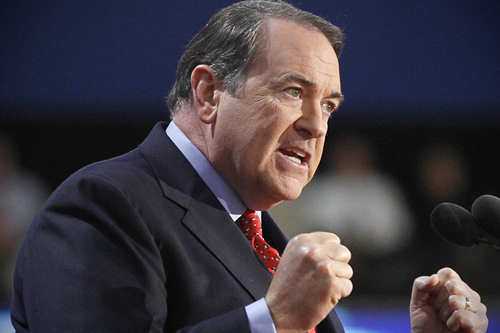 A final public example is ordained Baptist minister and former Arkansas governer Mike Huckabee, another of the 2016 Republican presidential candidates.
It appears that Gov. Huckabee is so desperate to make the final cut of participants in the first Republican debate on August 6, 2015 that he is willing to follow Donald Trump’s example in choosing to take and stay on the low road.
Earlier this week, he declared that the pending nuclear deal between the United States and Iran is equivalent to the actions of the Germans’ genocide of the Jews in the Holocaust: ““This president’s foreign policy is the most feckless in American history. It is so naive that he would trust the Iranians. By doing so, he will take the Israelis and march them to the door of the oven.”
While there are legitimate concerns with this pending agreement that should be addressed, Gov. Huckabee’s headline-grabbing hyperbolic and incendiary language represents the low road. The high road would have been to actually talk about the real issues regarding this agreement and how he would rectify those.
What is even more damning for Gov. Huckabee, however, is that in 2008 he proposed the exact same path of this agreement according to the Des Moines Register: “Huckabee wrote in Foreign Affairs that ‘all options’ must be put on the table in dealing with Iran to avoid a military confrontation with them. He said at the time that the real winners in such a war would be the Sunni extremists who attacked America on 9-11. Iran is a Shiite Muslim nation.
Huckabee called then for the establishment of a sanctions regime against Iran coupled with direct negotiations with that country.”
Despite a strong negative backlash to his inflammatory and contradictory statement, Gov. Huckabee has continued on the low road by refusing to backtrack on the harshness of his rhetoric and to acknowledge the inconsistency with his position seven years ago.
Now that we’ve seen what choosing to take and stay on the low road looks like, what does choosing to take AND stay on the high road look like? Since we are striving to be quintessential leaders in every area of our lives, it’s not only important to know what we should not do, but also what we should do.
Quintessential leaders choose to take AND stay on the high road by:
- Always thinking before we speak, making sure our words are not sarcastic, condemning, mean, accusatory, disrespectful, condescending, bombastic, insensitive, and hurtful. A lot of times that process means simply being quiet until we have the time and perspective to deal with our thoughts and our words properly.
- Always considering how our words and actions will affect other people. The simple test we run everything against is “will what I want to say or do hurt, harm, or help other people?” Notice that quintessential leaders are outward-focused (they are never “it’s all about me“), which is a high-road characteristic. If it will hurt or harm other people (dishonesty, greed, stealing, crushing someone with less strength just because we can, etc.), then we don’t do or say it. If it will help others, then we ensure that we do or say it in a way that is respectful, kind, gentle, generous, and completely without strings attached.
- Always refusing to choose to stoop to the low-road level that others may choose to take by refusing to respond at all by arguing, retaliating, attacking, badmouthing, either to their faces or behind their backs, and seeing if we can go even lower than they are going.
The high road is at times a difficult choice for all of us to make because it seems we’re naturally wired for the low road. But quintessential leaders are those rare people who choose to fight and struggle and wrestle with themselves (and this goes on almost constantly at an internal level) to take AND stay on the high road.
It is a lifelong war that we all lose battles in from time to time. But winning this war should be the goal that every quintessential leader has. And the only way we can win it is to do it.
We each need to look deep inside our own lives to see whether we have chosen to try to take AND stay on the high road everywhere, every time, all the time in our lives.
Or have we chosen to take and stay on the low road for all the wrong reasons?
How are we doing?
 The Quintessential Leader