Posts Tagged ‘pride’

Quintessential leaders never have to – nor in fact, would – promote their efforts, a piece of a larger picture and larger plan. They are interested in outcomes and their contributions, as leaders, are devoted to successful outcomes for their teams, business units, organizations, and society at large. That is where their focus, their attention, and their efforts are directed.

So, when you hear people continually promote themselves as leaders, constantly touting their sole accomplishments, pointing everything back to themselves, you are seeing someone who is not only not a quintessential leader, but who is not even in a leadership position, except in his or her own mind. Everything the person is about is self-aggrandizement

Although self-aggrandizers are abundant throughout society, they seem to be even most prolific in business, sports, donald trump self-aggrandizementand religion. Donald Trump in business comes to mind. Muhammad Ali in his heyday in boxing comes to mind. The world of religious organizations is so full of these types of muhammad ali cassius clay self-aggrandizementpeople that it is difficult to pinpoint a single example. And the so-called religious types are the easiest to recognize and unmask because they all claim to be some sort of “only” representative of God and yet none of them agrees with each other or God.

Self-aggrandizers have an exaggerated and unsubstantiated view of their accomplishments and their contributions. They are legends in their own minds. They are completely self-absorbed and everything they say and do is from a “the world revolves around me” perspective. The prominent words their vocabularies are Imy, and me.

Self-aggrandizers believe they are superior to the rest of the human race. They also believe that they are unfairly treated and under-recognized by everyone else, primarily because, in their delusional , self-important opinions, everyone else is too ignorant and too blind to see how great and awesome they really are.

So, instead of spending time actually accomplishing the results that quintessential leaders are known for, the self-aggrandizers spend all their time promoting themselves. We’ve all worked with people who are self-aggrandizers and they are a detriment and an obstacle to productivity and success because they are consumed with nothing but being seen and heard and constant attention-seeking. These people suck up all the energy of whatever environment they are in and frequently stall or stop any progress if they’re allowed to continue unchecked.

The roots of self-aggrandizement are strong delusion, an overinflated ego (pride, vanity, arrogance), and insecurity. When a person has to spend all his or her time telling everyone how special, great, wonderful, awesome, superior he or she is – when in reality, if a person really is any or some or all of those things, it is readily apparent to everyone as a pattern of behavior and as just who that person is all the time and usually the person doesn’t even see those qualities in themselves, but it is other people who point them out – that person is first trying to convince him or herself those things are true – insecurity – and second trying to convince everyone else they are true as well.

The strong delusion is a contextual issue. Everything said to or about the self-aggrandizer gets assimilated through the “I, my, me” filter that dominates his or her thinking, and comes out, at best, twisted completely out of or spun completely away from its original context, or, at worst, completely invented (a lie). Regardless of which way the self-aggrandizer comes to his or her conclusions, he or she is always right and everyone else is always wrong.

An overinflated ego will argue, fight, contest, and keep conflict going. The ironic thing is that most people will tire of the endless arguing, fighting, contesting, and conflict after a while because they realize, at some point, that there’s no reasoning with a self-aggrandizer and the continuation of the discussion is a waste of time, but because the self-aggrandizng person gets the last word, so to speak, this boosts his or her ego even more and further convinces him or her that he or she is right. It’s a vicious circle, not based on evidence or fact, but simply based on the self-aggrandizer’s ability to out talk and outlast everyone else.

Insecurity is the knock of reality on a self-aggrandizer’s door. But since self-aggrandizers live in a world of strong delusions and super-sized egos, they will never allow this reality to get any further than the door. They lock insecurity out with even more self-aggrandizement.

So, if you see or hear someone who is always making presumptuous and momentous claims about him or herself, their positions, their accomplishments and who and what they are, you should recognize that that person is a self-aggrandizer. He or she is not any kind of leader and not a quintessential leader.

We as quintessential leaders need to recognize self-aggrandizement and remove it from among our teams and remove ourselves as far from it as possible. It is one of the most toxic and destructive forces that we will face in life. Giving it any attention will only encourage it and make it worse. We don’t need that. Our teams, our business units, our organizations don’t need that.

Anakin Skywalker Before He Became Darth VaderRecently, I sat down and watched, for the second time, back-to-back, the last two movies of the Star Wars prequel trilogy – Episode II: Attack of the Clones and Episode III: Revenge of the Sith. I had not seen either movie in several years, but wanted to review them after a recent Star Wars marathon on Spike TV during the Thanksgiving weekend when I saw most of all the three Star Wars movies in the original trilogy.

As I watched these two movies, I was amazed to see a lot of quintessential leadership – the presence or lack of presence – issues emerge. I decided to do an analysis of how Anakin Skywalker became Darth Vader, because in looking at the transformation, we can learn some important lessons about quintessential leadership – what it is and what it isn’t and how the presence or absence of the components of trust and trustworthiness, which I’ve discussed in detail in this blog, determine whether even the most competent, gifted, and capable people are also quintessential leaders.

Luke SkywalkerOne of the first things I noticed this time is how much Anakin and Luke Skywalker were alike in temperament and thinking. Both men were extremely gifted, but both also overestimated their gifts and their abilities and it created a recklessness and pride in them that clouded their ability to think clearly, to be humble, and to exercise self-control.

Both Anakin and Luke Skywalker were inconsistent in performance. At times, they both did the right thing, and at other times, they both did the wrong thing. Emotionally, they were both out of control, and they both lived their lives based on their feelings, which is why they both had an inconsistent level of performance. In short, they were unreliable and unpredictable, which are traits of unquintessential leaders.

Additionally, both Anakin and Luke Skywalker shared the trait of impatience. This came in part from pride and their overestimation of themselves, but it also came from a lack of contentment with where they were and what they were doing and the ability to see each step as part of a big-picture process. They both wanted, for example, to be Jedi knights – and both pretended to be before they were – before they had met all the qualifications through training and experience to actually be a Jedi knight.

This is a common character flaw that we find in unquintessential leaders. They want to positions, the titles, but they are either unwilling or unable to patiently do the work and take the time to be qualified to have those positions and titles. When they find a way – as Anakin did – to take a shortcut to where they believe they should be and want to be, the results are always disastrous.

Luke, in spite of sharing many of the unquintessential character traits of his father, turned out to, when push came to shove, avoid the same path his father had chosen. But it occurred to me that even though he did the right thing in the end, he still had the character flaw that he shared with Anakin of questioning the fairness of things as it related to him and he never completely learned to control his emotions, so Luke, as a force for good, long-term, remains questionable in my mind. Doing one right thing one time doesn’t make a person’s character. Right character is developed through a lifetime of making the right choices every time, all the time.

Granted, none of us does this perfectly, but a quintessential leader has this at the front of his or her intent and purpose at all times. That’s the quality of integrity.

So let’s look briefly at the unquintessential leader traits that Anakin Skywalker had that led him to choose to become Darth Vader. Notice that I purposefully used the word choose, because that is a crucial element in this discussion: the totality of all the choices in life that each of us makes is an integral component of whether we are quintessential leaders or unquintessential leaders at our core. Granted, there are gifts, abilities, talents that contribute to this equation, but even there, we have the choice to develop them or ignore them, use them or not use them, and to decide how we’re going to use them, so choice is always involved at the fundamental level.

In Episode II: Attack of the Clones, we see Anakin Skywalker as a young adult and in an apprenticeship with Obi-Wan Kenobi to become a Jedi knight. One of the things that stands out about Anakin’s character, even here, is how forcefully he is led by his emotions. He’s a no-holds-barred kind of person when it comes to how he feels. His pursuit of love is untamed and relentless. His fears rule his days and nights. His anger is fierce and hot. His resentments about the things he believes aren’t fair seethe steadily just under the surface, occasionally spewing out in volcanic outbursts.

Yoda LeadershipInterestingly, both Yoda and Obi-Wan Kenobi – as they would years later with his son – are constantly warning Anakin about self-control in all areas of his life (choices), but especially with regard to his emotions. Anakin doesn’t realize that being led by his emotions is the destabilizing force in his life. 

Emotional thinking crowds out objective thinking and the ability to observe things are they are instead of things from – as Obi-Wan ironically tells Luke to explain not revealing Darth Vader as Luke’s father – from a “certain point of view.” Emotional thinking leads to inconsistency, which is an unquintessential leader trait.

The roots of Anakin’s discontent, which is fueled by his rampant and conflicting, at times, emotions are evident in this episode.

He doesn’t see, for example, Lord Palpatine clearly, and believes he is one of the good guys, while Lord Palpatine is slowly and deliberately using Anakin’s emotional thinking and lack of objectivity to surreptitously manipulate Anakin. 

Anakin believes that things the Jedi are or aren’t doing for him, with him, and to him are not fair and are holding him back. This belief is fully cemented in Episode III: Revenge of the Sith, and it becomes the underpinning of all the choices he makes from there on out. 

As a result of Anakin’s lack of self-control, not only with his emotions, but in the rest of his life, where we see the same vacillation between extremes that his emotions have start appearing, we see three other unquintessential traits appear: a lack of integrity, a lack of honesty, and a lack of authenticity.

Anakin becomes dishonest with everyone, including himself, in these two episodes. Anakin isn’t even truthful with his wife, even though his fear – uncontrolled emotion – of her dying in childbirth leads him to choose to become Darth Vadar, because Lord Palpatine offers Anakin the power to prevent her death. This dishonesty also points to Anakin’s self-absorption, self-centeredness, and selfishness.

No longer is he focused on the big picture of why he is there and what the mission of the Jedi is. It no longer is important to Anakin by the end, only what he wants and what he feels and what he needs. In a sense, even his wife and twin children go off Anakin’s radar because his choices will dramatically and negatively affect them.

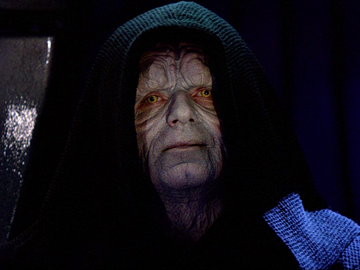
Lord Palpatine aka The EmporerNear the end of Anakin’s road to choosing to become Darth Vadar, he straddles the line between being a Jedi apprentice and being Lord Palpatine’s apprentice. He is thoroughly inauthentic, double-minded, and we watch as he walks the tightrope of trying to be someone that he has already abandoned being in his mind and in his emotions. The Jedi sense that something’s wrong, as does Anakin’s wife, but Anakin has gotten so good at pretending to be something he’s not that no one realizes what is really wrong until it’s too late.

Anakin’s issue with integrity was always there, but he made choices in both episodes which eroded and destroyed his integrity completely. A simple – and yet not simple when we examine it – example is his marriage to Padmé Amidala. The Jedi code forbade close attachments because of the emotions those attachments engendered and which the Jedi realized could dilute a Jedi’s obligation to his primary duty and could make him a vulnerable target for the dark side of the force.

But Anakin made a choice to deliberately break the Jedi code and marry Padmé in secret, and then further chose to hide their marriage and lie about their marriage, and encouraged Padmé to do the same. I think this is the defining event that destroyed any integrity that Anakin had left.

So, by the end of the third episode, we have seen all the choices along the way that Anakin Skywalker made that led him to choose to become Darth Vader. He had tremendous gifts, great abilities, and a lot of potential. But he lacked the traits of a quintessential leader, so, in the end, all that Anakin possessed naturally didn’t matter. We see the the same lack of quintessential leadership traits in the machine-driven-Darth Vader in the first Star Wars trilogy: his outside has changed, he’s got more power, but the inside – what he lacked or destroyed by choice to begin with – remained remarkably the same.

The question I leave with you is what are all the choices that are we making today? Are they choices that will enhance our quintessential leadership potential and realization, or are they choices that are eroding our quintessential leadership potential and are cumulatively making us unquintessential leaders?

Every choice matters. Let’s make every choice count toward quintessential leadership.