Update: 12/16/14:
42 deaths from car accidents in General Motors models have now been linked to the faulty ignition switch problem.
Update 11/11/14:
 Emails uncovered by the Wall Street Journal show that General Motors ordered a half million redesigned ignition switches from Delphi two months before the auto manufacturer issued a recall on some – but not all – vehicles with the defective ignition switch installed.
As of October 30, 2014, the number of deaths acknowledged by GM to be directly linked to the faulty ignition switch has risen from 13 to 30.
However, General Motors continues to maintain that the people in leadership positions – the executive team – in the company had no idea about the ignition switch problem, the order to Delphi for replacement ignition switches that cost GM approximately $3 million, or the need for a general recall.

General Motors’ 2nd quarter profits, posted yesterday (July 24, 2014), dropped 85% from their 2nd quarter 2013 profits. Frankly, it’s incredulous to me, given the financial hit the U.S. automaker has taken in massive recalls due to years of knowingly using substandard and faulty equipment, which is directly tied to 13 known fatalities, that General Motors (GM) is making any profit at all.
To those GM customers who’ve been impacted by the lack of quintessential leadership that has been in place at the auto manufacturer for decades – and, in my opinion, still could be with the current GM CEO Mary Barra, who began her career with GM since 1980 with a degree in electrical engineering, and in leadership positions within the company since earning her MBA in 1988 – that GM has any profits at all is likely a bitter pill to swallow.
 I will not recount the entire unquintessential leadership history of GM here. That would be a book to write and with writing a new book already currently in the works, I don’t have time to commit to another. However, I will highlight several areas where unquintessential leadership existed/exists and will include links that provide more detailed information about them.
The paramount unquintessential leadership trait of GM is they routinely put corporate profits above the safety of their customers.
Starting in 2003, GM engineers redesigned and ordered modified ignition switches – with a torque setting that was below GM’s minimum requirements – from its supplier, Delphi. The cost of an ignition switch? 57 cents.
From 2004 to 2013, thirteen fatalities occurred involving GM cars that had the modified ignition switches installed. All but one of the accidents were single-vehicle crashes where the drivers lost control and crashed head-on into something, in most cases a tree. In none of the crashes did the airbags deploy.
Additionally, beginning around the same time period as the first accident, GM car owners began reporting that their midsize and compact-size vehicles were randomly and intermittently shutting off while they were driving them.
In the 2004 crash involving a Saturn Ion that killed Gene Erickson, GM told federal investigators, who couldn’t understand why the car suddenly swerved into a tree and the airbags didn’t deploy, that the company didn’t have any answers as to why either.
However, just a month before GM talked with federal regulators about the accident, a GM engineer had concluded that the Ion had probably lost power, which would have prevented the airbags from deploying.
Investigations into fatal car accidents where mechanical failure is the most plausible explanation involve the National Highway Traffic Safety Administration contacting the automobile manufacturer to see if (a) they have any similar reports; (b) if their engineers have determined a cause, using the car’s “black box” data; and, (3) whether it is an isolated problem or one that could require a general recall.
GM showed its unquintessential leadership trait of self-centeredness when decided to lie and obfuscate in the Erickson case because of money. Fines for an inexpensive part not meeting the company’s minimum standard, a possible lawsuit by Mr. Erickson’s family, and a large recall would have cut into GM’s profits. The shareholders wouldn’t be happy. People might lose their jobs.
Two other unquintessential leadership traits at GM are deception and dishonesty.
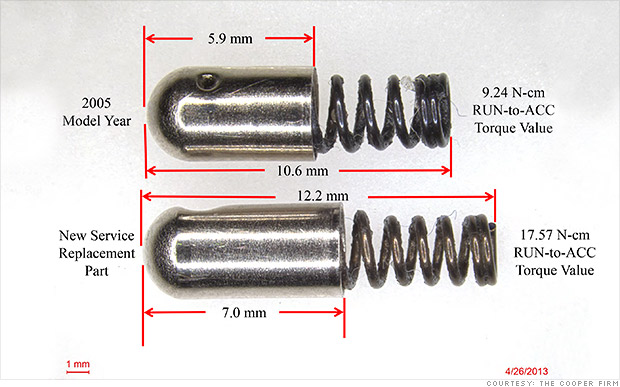 In 2009, despite years of knowledge about the faulty ignition switch and substantial evidence of conscious coverups by GM employees at every level in the company, GM engineers finally began to internally and quietly increase the torque on the faulty ignition switches.
(And, despite what GM executives have testified to under oath, these engineers had the consent and knowledge of every person in a leadership position in every department – including the legal department, whose head denied any knowledge of the problem until this year – at GM.
To suggest otherwise is dishonest, which is why it remains to be seen if Ms. Barra will become a quintessential leader or will continue in the unquintessential leadership tradition that has, so far, defined GM’s leadership.)
However, when GM’s engineers made the change to the ignition switch, instead of creating a new part number for the ignition switch with the higher torque, which is standard operating procedure when any change is associated with a part or item to distinguish it from similar parts and items, they used the same part number assigned to the faulty ignition switch. This was clearly an act of deception and dishonesty.
(A simple example of distinguishing similar items by part number is how the part numbers of different wattage light bulbs might read: 40-watt bulb (40WBLB); 60-watt bulb (60WBLB); 100-watt bulb (100WBLB); and, 50-100-150-watt bulb (50100150WBLB).)
The 2.6 billion recall of GM cars now underway is directly related to this deception and dishonesty. Because the two ignition switches didn’t have unique part numbers, there is no way of telling whether GM car owners have the defective switch or the corrected switch. Therefore, GM is having to replace all ignition switches in all GM cars with that part number.
Ms. Barra has a lot left to prove that she is not the latest GM CEO to be an unquintessential leader. When a CEO, who has insurmountable evidence to the contrary, states about a month ago that “I don’t really think there was a cover-up”, followed by a lot of justifications and excuses, it is clear that Ms. Barra has absorbed a lot of the GM unquintessential leadership in the 34 years she has been employed there and, even if it’s possible, it will take a lot of time and effort to change what to her is a normal definition of leadership.
As always, it’s easy to look at a big corporation like General Motors and objectively see the unquintessential leadership within that company and shake our heads and perhaps even pat ourselves on the backs because “we’re not like that!”
But are we? Maybe not in all areas. Maybe not on the same scale in terms of causing peoples deaths and tanking corporate profits.
But here’s what we need to remember. Even one instance of unquintessential leadership that we don’t learn from and change immediately or just one unquintessential leadership trait that we are unable or unwilling to change, no matter how few people it affects, no matter the scale of the effects, puts us in the same boat as the unquintessential leadership at GM.
There are no degrees of right or wrong, good or bad, quintessential leadership or unquintessential leadership. It either is or isn’t. We either are or aren’t.
Therefore, my fellow quintessential leaders, we should take a close and thoughful look at why the people in leadership positions at GM are unquintessential leaders and examine ourselves in the light of the unquintessential leadership traits we’ve outlined today.
How are we doing?


 The Quintessential Leader