Posts Tagged ‘integrity’

Authenticity is Who and What Quintessential Leaders AreA discernible trait of quintessential leaders is that we are continually striving for authenticity in every part of who, what, and how we are. It is an easily-identifiable part of our character which is borne out by our behavior.

One of the easiest aspects of behavior that shows us what both unquintessential leadership and quintessential leadership looks like is in our verbal and written communication with others.

Whether we are authentic or unauthentic is plain to see by what words we say and write and how we say and write them. 

The words we choose and the method we use to convey those words provide vital insights into whether we are striving for authenticity or whether we are, at the heart, core, and soul of who we are, either struggling with inauthenticity or we are truly committed to being inauthentic as a matter of course.

I make the distinction between struggling with inauthenticity and being committed to it because it’s important for all of us to understand that quintessential leaders will struggle at times with inauthenticity, while unquintessential leaders don’t struggle at all with it because being inauthentic is a committed way of being for them.

So what makes the difference between struggling with inauthenticity and being committed to it?

Awareness is the difference.

Quintessential leaders who are being inauthentic are not aware of being inauthentic, but as soon as they become aware of the inauthenticity, they commit to changing it immediately.

Unquintessential leaders, on the other hand, are fully aware of being inauthentic and are determined to remain inauthentic.

How do I know this? Because I’ve struggled with inauthenticity at times and not even realized it. However, once it hit me between the eyes, opening my eyes to an area of inauthenticity, I immediately made and fulfilled the commitment to change it.

Not being aware of inauthenticity is a part of the growth cycle for humans and the mature development of quintessential leaders (if all of us were already perfect, we’d have absolutely nothing to do and no place to go and life would be interminably boring and meaningless). 

However, it is often the case – to our shame and discredit – that as we who are striving to be quintessential leaders are unaware of our own areas of inauthenticity, we are eager to and constantly pointing, in public venues and in condemning language, out the areas of inauthenticity in other growing-into-quintessential-leaders who are unaware of their own areas of inauthenticity. 

This is unquintessential leadership behavior. Quintessential leaders examine themselves and they focus on changing what they need to change. They do not constantly exalt themselves as paragons of virtue and continually look around at everyone else and proclaim, for the whole world to see, their faults and shortcomings.

Instead, they work diligently to be an example, in every area of their lives, of what quintessential leadership looks like. They know that action – their own work on themselves – can be a powerful motivator and teacher for everyone with whom their lives intersect.

They also know that constant and public criticism and condemnation is not only a powerful demotivator, but a lousy example for anyone to follow and emulate (unfortunately, human nature tends toward this kind of behavior, so there are always plenty of admirers and supporters in criticism and condemnation of other people).

So before we look at what authenticity in communication looks like, let’s first look at what it doesn’t look like.

Vladimar Nabokov wrote, “Words without experience are meaningless.” I would clarify this to say that any words spoken or written without experience or empathy (literally the ability and choice to walk in the shoes of someone else’s experience and understand that experience from their perspective) and compassion are meaningless.

Inauthenticity in communication says and writes words that are empty and hollow because the person communicating them either has never experienced what they are communicating about or they lack empathy and compassion, choosing to assume they know something they don’t or choosing to pass judgment without facts, without understanding, and without knowledge.

This is unquintessential leadership because pride and arrogance are behind the communication as well as a total lack of kindness and gentleness. In other words, the communicator believes, even though they don’t have clue nor do they care what they’re talking about, that they are entitled to say or write the words as well as being harsh and condemning in the process.

Inauthenticity in communication is also evident in the common behavior of simply parroting cliches, “conventional wisdom,” and idioms because it seems like the right thing to say or write.

There is no thought or depth that goes into these utterances. In fact, this is the cheap and easy way out: we throw a well-worn phrase that sounds good and we’ve heard all our lives at someone else, check it off our list (while patting ourselves on the back for our generosity and benevolence toward the poor souls we communicated with), erase it permanently, and go blissfully on with our unimpacted lives without missing a beat.

Parroting as a method of communication is unquintessential leadership for a couple of reasons.

The first is motivation. We’re communicating something we’ve always heard – but most of the time have not had to put to the test of veracity through experience – because it makes us feel better, not because it will make the person we’re communicating with feel better.

The second reason parroting is unquintessential leadership is because we are not taking the person we’re communicating with into account at all. We don’t seek insight and understanding by taking the time to really listen to them – we may hear them, but there’s a world of difference between just hearing and really listening – nor do we take the time to think about the kind of communication we would want from someone if we were in the same or similar circumstances. 

By simply parroting something we’ve heard but have no evidence or proof of its value and/or truth, we effectively complete dismiss the person we’re communicating with and we tell them we don’t care about them and they are not important enough to us for us to waste our time with them.

So now that we know what it doesn’t look like, let’s discuss what authenticity in communication – quintessential leadership – does look like.

Unfortunately, as Nabokov stated, experience is often how we gain the ability to be authentic in our communication with other people. However, whether we have authenticity in our communication with others still comes down to us making the choice to be authentic.

Choosing authenticity in our communication with other people requires an investment from us. In them. In time. In effort. In carefulness.

In a society where unquintessential leadership abounds, as well as entitlement and “it’s all about me,” the selflessness required for this kind of investment has all but disappeared.
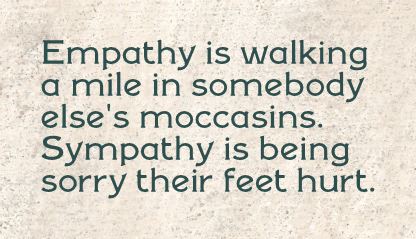
The difference between empathy and sympathyBut quintessential leaders know that they don’t have to have experienced something to be authentic in their communication with other people. And because of their commitment to developing unimpeachable character, two of the highly-developed traits they have are empathy and compassion for other people.

Empathy, like most of the other traits that make quintessential leaders trustworthy, is very rare and getting rarer. Most people believe that sympathy and empathy are the same thing and they are not.

Sympathy takes no long-term investment in another person: it tends to be a hands-off, “one-and-done” event.

Empathy, on the other hand, is a hands-on, long-term, hand-in-hand walk through the journey of – and with – another person. It is seeing through their eyes, understanding through their thoughts and emotions, and listening with interaction to know what is really behind their communication (often the words that are said or written have something else entirely behind them).

Compassion is always a by-product of and a companion of empathy. It is understanding, encouraging, invested, gentle, kind, and patient. It can be – and should be – the result of our own struggles, setbacks, and hard times in life. 

But because compassion and empathy are so interrelated, many people choose a lack of compassion because they offer only sympathy as a one-time-shot to other people.

These same people also, ironically, do everything in their power to evoke compassion toward themselves, including constant manipulation, self-exaltation, and telling everyone how they are not like all those other poor slobs in the world who don’t deserve anyone’s compassion.

This is the Scarlett O’Hara (Gone With the Wind) syndrome, because like Margaret Mitchell’s infamous anti-heroine, in the end, everything is all about them and they refuse to share the stage of life with anyone else.

Another area that demonstrates the authenticity of quintessential leaders in communication with other people is that quintessential leaders do not parrot cliches, “conventional wisdom,” or idioms. Instead, quintessential leaders consider carefully the impact of their words and how they use them.

Because quintessential leaders are invested in other people, they understand and are sensitive to the needs that exist.

Words have power and weightThey are also profoundly aware of the power of words, the impact of words, and the effect of words. 

They are not cavalier with words, simply letting whatever comes immediately to mind come out in their speech and writing. They always spend a considerable amount of time looking for ways to deeply and encouragingly communicate and avoiding hurt and offense. 

They know and understand that even words that may advocate a course correction should build up and not tear down. That can’t be done with parroting something someone else has said or something they’ve heard all their lives. It can only be done with original thought combined with empathy and compassion.

This is just one aspect of behavior that makes quintessential leaders rare in society today.

But each of us is striving to become a quintessential leader, so this must be a behavior we develop, grow, and exhibit everywhere in our lives and model for all the teams we lead in our lives. 

I say this often, but it cannot be repeated too much. If you breathe for a living, you lead at least one team in your life. Quintessential leadership is not confined to organizations, and can, therefore, be dismissed by everyone else. 

Somebody in your life is looking to you and depending on you to model leadership for them. It might be your children. It might be your students. It might be your family members. It might be your spouse. It might be your coworkers. It might be your friends. It might be the sports team you coach. It might be the volunteer groups you are involved with. It might be anybody.

So, as always, we must look in our own mirrors and conduct a thorough, extensive, comprehensive, and fearlessly honest evaluation of what our communication with other people looks like.

Are we inauthentic anywhere or everywhere in our communication with other people? 

If we are, is it because we lack awareness of our inauthenticity in our communication with other people?

Or is it because we’ve deliberately committed to a path of inauthenticity in our communication with other people?

If we find authenticity in our communication with other people, are we committed to preserving that and developing it to the point where it is literally a part of who and what we are all the time?

I can only answer these questions for myself. Each of you can answer them only for yourselves. Do we have the character and the courage to look, to see, to answer, and to change where and if we need to?

How are we doing?

Airplanes are like organizationsThe connections between planes, pilots, flying and quintessential leadership have been percolating in my mind for several years. 

Each time there is a new air disaster, these connections come back to the front of my thinking and expand as I find deeper meaning and more interrelated threads between these on-the-surface seemingly dissimilar things.

They are very similar, as this post will demonstrate, because the same core mechanisms exist among them.

Let’s start at the basic connections. Planes are like organizations. Pilots are the leaders who are responsible for the planes. How pilots fly (lead) planes depends on whether the project (the flight) is successful or unsuccessful. (Passengers are customers who pay for and expect success every time.)

The health of a plane is a factor in successful outcomes. Like organizations, if a plane is poorly or sloppily maintained, has outdated equipment and/or software, and has major structural or mechanical problems that compromise its integrity, that will limit and hinder the ability of the pilot to lead the plane to a successful outcome: a safe landing and delivery of passengers to their destination.

The leadership ability of the pilot is also a factor in successful outcomes. This encompasses several areas, including experience, skills, health (vision and heart come to mind), lifestyle (getting enough sleep, alcohol and/or drug consumption, and allergies that are treated with medication), and attitude toward the job and the customers (selfless or self-centered).

How the pilot flies the plane is a third crucial factor in successful outcomes. And, while not the only factor, this factor can often mean the difference between successfully averting disaster or disastrously averting success when problems with the plane or another pilot arise. 

Why?

Pilots have choices as to how they fly a plane. They can choose to manually fly the plane, relying on their critical thinking, their skills, and their experience, or they can choose to fly the plane on autopilot, which is automation – often out-of-date and based on a limited (because humans write it) scope of scenarios under ideal conditions – software installed on all commercial planes. 

Pilots Are LeadersResearch has shown that when pilots depend on automation software primarily to fly their planes, they lose critical thinking skills. They also lose touch with the plane’s structure and instrumentation and how to use those to their greatest advantage – successful outcome – in emergency situations. Reaction time to crises is also considerably slower when pilots depend exclusively on autopilot to fly.

Too many inexperienced pilots depend solely on autopilot, which can lead to a disastrous outcome.

One of the more recent examples of this was the February 12, 2009 crash of Continental Connection Flight 3407 in Buffalo, NY, which killed 50 people (this included a man in the house the plane crashed into).

The pilots of Flight 3407 assumed that because they were flying on autopilot, they didn’t need to pay attention or monitor anything. Ice began to accumulate on the wings, making the plane heavier and dragging it down under the burgeoning weight, resulting in deceleration. The pilots didn’t notice.

Finally the plane began to stall as it descended. The pilot, inexperienced, confused, and panicked, pulled the stick shaker, which had alerted him to the impending stall of the engines, toward him instead of away from him. 19 seconds later the plane had crashed and 50 people were dead.

On the other end of this spectrum is the example of an experienced and highly-skilled pilot – ironically, almost a month before the crash in Buffalo, NY – who was flying USAirways Flight 1549 out of LaGuardia Airport in New York City. 

Captain Chelsey Sullenberger had just taken off from the runway when a flock of birds flew into the plane’s engines, stalling them both. Unable to maneuver back to LaGuardia or maneuver over to Teterboro Airport in New Jersey, Captain Sullenberger was forced to land the plane in the Hudson River.

Because he was flying the plane manually, he was able to use his expertise and ability to think clearly in a time of crisis to accomplish a soft landing into the river, referred to as the Miracle on the Hudson, which kept the plane intact on impact and ensured the survival of all the passengers and crew.

For us as quintessential leaders, our experience, skills, attitudes, and how we choose to lead – on autopilot or manually – can also be the deciding factor in ultimate success (even if the only thing that amounts to is minimizing the impact of what is going to be a disaster no matter how we slice it) or ultimate failure.

As humans, autopilot is our default mode of operation. We are the sum of our biology, experiences, knowledge, attitudes, and skills. Some areas of our life depend on autopilot. Breathing is one of those. Imagine having to think about and manually having to force breath in and out of our lungs. We’d get nothing else accomplished in our lives but this because breath, more or less, is life.

So autopilot for some things is an absolute necessity. However, where we run into trouble with autopilot in our lives is in the areas of experience, knowledge, skills, and attitudes. Much depends on when we acquired them, how we acquired them, and how we apply them from that point on.

Most of our autopilot programming, if you will, is acquired early on in our lives. Because we don’t have full knowledge of everything and we don’t have the maturity or resources to (a) realize that, and (b) do something to correct it, we end up with a lot of faulty and outdated programming in our autopilot that we often employ the rest of our lives, resulting in the same old failures – some disastrous and some not – over and over again throughout our lives.

At some point, we would hope, maturity – and getting tired of the same old, same old – would direct us to start flying our lives manually so that we can figure out how to successfully navigate through, around, and beyond the things that our autopilot keeps crashing us in the middle of. (Sorry, Grammar Nazis, that preposition has to be at the end of that sentence. :-))

Quintessential leaders recognize that our autopilot is faulty and outdated. We understand that the only way to lead is manually.

Why?

Because leading manually ensures that we are:

  1. Fully engaged all the time
  2. Maximizing our current level of aggregate experience, expert skills, full knowledge, and optimized attitudes
  3. successful outcome quintessential leaderCritically thinking about obstacles, problems, options, and solutions
  4. Able to respond in real time without panic or chaos
  5. Able to ensure successful outcomes even in disastrous situations
  6. Updating – or, in some cases, rewriting from scratch – our autopilot with new and corrected code to use in future similar situations

So, my fellow quintessential leaders, now is the time for us to look in our own lives to discern the current state of our planes (organizations, families, congregations, schools, etc.), our piloting (leadership) experience, skills and attitudes, and whether we as pilots choose to fly (lead) on autopilot or manually.

What do we see? What needs to change? What do we need to change?

Are we willing to commit to what we can change and what we need to change, no matter how difficult it will be, how much resistance – from ourselves and others – we might encounter, and how much time and effort it will take?

If we’re striving to be quintessential leaders, the answer is unequivocally “Yes.” 

But here is the heart of the matter. What is your answer?

Coach Dean Smith UNC quintessential leaderCoach Dean Smith, who led the University of North Carolina basketball program for 36 years, died on February 7, 2015 after a long battle with dementia. Throughout his coaching career and his life after coaching, Coach Smith embodied many of the characteristics of quintessential leadership.

He was not a perfect man, but none of us can claim perfection either. There were times when he wasn’t a quintessential leader, just as there are times we are not quintessential leaders.

But when Coach Smith’s life as a whole, both on the basketball court and off, is considered (and that’s the only way to consider anyone’s life, including our own, because no one – including each of us – gets it right every single time), it’s clear that his goal was to be a quintessential leader. And the results of his commitment to that goal are evident to this day.

I grew up in North Carolina. But me being an UNC basketball fan was not a given. My dad got his undergraduate degree from Wake Forest and he taught physical therapy at Duke University and did a year of pre-veterinary schools studies at North Carolina State University. My mom studied medical technology at Duke University, which is where she and my dad met and made their lifelong commitment to each other. (more…)

As quintessential leaders, we need to be aware of how constant connection to digital technology negatively affects us as leaders and the people on the teams we lead.

If we don’t understand what this looks like and how it manifests itself and we don’t find a way to ensure that we have a balance between real life and digital life, then we will not be able to be quintessential leaders. It’s that simple.

Going Gentle Into That Good Night's avatarGoing Gentle Into That Good Night

internet going gentle into that good night neurological changesThis is the first of a multipart series of reviews that I will write on The End of Absence: Reclaiming What We’ve Lost in a World of Constant Connection written by Michael Harris in 2014.

I have written on the main point of Harris’ book in “Dementia of the Preoccupied: How Multitasking and Being Attached to Technology 24/7 is Creating A Dementia Effect on Society” and “The Quintessential Leader Perspective On the Art – and Beauty – of Silence,” which everybody should take some time now to read.

The End of Absence: Reclaiming What We've Lost in a World of Constant Connection by Michael HarrisI would also highly recommend that everyone read The End of Absence: Reclaiming What We’ve Lost in a World of Constant Connection. At about 200 pages, it is completely doable for the shorter attention spans (one of the side effects, as I’ve noted and Harris notes, of a life immersed in digital technology).

Michael Harris and I…

View original post 3,183 more words

the quintessential leader building trust and being trust worthy book

In the first post of this series, the excerpt from chapter 1 included a list of all the components we must develop and have to build trust and be trustworthy.

The second post in this series, which included an excerpt from chapter 2 of Building Trust and Being Trustworthy, looked at the component of honesty in building trust and being trustworthy.

This post will include an excerpt from chapter 3 of Building Trust and Being Trustworthy

Another component of building trust and being trustworthy that we must have is integrity.

Most people don’t realize that integrity and honesty are two distinct but complementary components of building trust and being trustworthy. This chapter defines and shows what integrity does and doesn’t look like.

Building trust and being trustworthy is an integrated trait of quintessential leaders.

It is also an integrated trait that all of us – because each and every one of us leads at least one team, small or large, of people in our lives – need to develop and have as part of the core of who we are and what we are. In essence, this trait is at the center of exemplary character and conduct, and none of us should settle for anything less than this in ourselves and others.

Unfortunately, most of us settle for less. A lot less. In ourselves. In others. 

The majority of people in leadership positions today are not trust builders and they are not trustworthy. Many of us, frankly, are also not trust builders and trustworthy.

We live in a world that with no moral code as its foundation that expects trust to be non-existent or broken. Look around. It’s everywhere, including, in many cases, very close to you.

And society has become so accustomed to this that it glorifies it instead of condemning it.

Politicians who lie routinely, who line their pockets with money and perks while making decisions that hurt and destroy the people they are supposed to represent, who cheat on their wives because they can.

Arts and sports celebrities who have no regard for faithfulness to their spouses, who live hedonistic lifestyles that destroy their families, the people around them, and, eventually their lives.

Religious leaders who cheat on their wives, who cheat on their taxes, and who scam their congregations both in how they deceitfully handle the word of God and in coercive and corrupt financial matters, acquiring wealth and power in the process.

Business leaders who destroy millions of lives by deceit, fraud, and illegal actions that result in their employees and customers losing everything while they escape any kind of punitive action and instead reap obscene profits and end their tenures – only to go to another financially lucrative position – with golden parachutes that are equally obscene.

And we, as individual leaders for our teams, who cheat on our taxes, who are routinely dishonest with the children (our own and others) and other people entrusted to us, who routinely steal things from our workplaces (you most likely didn’t pay for that pen you’re using at work, so it doesn’t belong to you), who routinely break traffic laws, who will walk out of stores with something we were not charged for and never think twice about it, who will take extra money that we’re not owed in financial transactions without blinking an eye, who cheat on our spouses, who marry until “divorce do us part,” and who, as a course of habit, break confidences of family and friends, gossip about family and friends behind their backs, and destroy reputations in the process.

Maybe we haven’t thought about building trust and being trustworthy at this kind of nitty gritty level.

But until we do – and we develop and have this trait as the core of who and what we are – we will not build trust and we will not be trustworthy. And we will not be quintessential leaders.

Trust and trustworthiness is probably the single most important trait we can possess. And it is also the most fragile.

It can take a long time to build and be, but it can be broken irreparably in a single second.

Therefore, this is a lifetime work on and in ourselves that we must commit to making an integral part of our character by continually developing it, maintaining it, and growing it. 

This goal should be our goal.

But it requires courage. It requires diligence. It requires vigilance. It requires continual self-examination. It requires continual change. It requires the ability to, much of the time, stand alone to maintain.

It is not for the faint-hearted. It is not for the vacillators. It is not for the crowd-pleasers. It is not for the pretenders. It is not for the wannabes. It is not for the weak.

But if you’re reading this, I know that you’re not any of those kinds of people. Those kinds of people won’t even read this because it requires time, effort, change, and commitment, and too many of us are, sadly, either just too lazy or we just don’t care. 

Building Trust and Being Trustworthy takes an in-depth look at the “this is what it looks like in practice” aspect of each of the components we need to develop and have to build trust and be trustworthy. The second chapter discusses the component of honesty in building trust and being trustworthy.

olive-horizontal-line

Excerpt from”Chapter 3: The Integrity Component of Trust and Trustworthiness”

We have already looked in-depth at the honesty component of trust and trustworthiness, and now we will look a corresponding and complementary component: integrity. They are not the same, although both must be present in quintessential leaders. To separate them more logically in thinking, honesty is how a person is (conduct), while integrity is who and what a person is (values and standards).

Generally, one doesn’t exist without the other because they depend on each other. If you observe someone who’s habitually dishonest with him or herself and others in any and/or every part of his or her life, you will find upon further observation, that person also lacks integrity. On the other hand, if you see someone who’s habitually honest with him or herself in any and/or every part of his or her life, upon further observation of that person, you will learn that he or she possesses integrity.

The word integrity comes from the root word integral, which means, among other things, entirecomplete, or whole. And that is a strong part of what integrity actually is. It is undivided and unwavering with regard to moral principles, to right and wrong, to right values and standards.

There  is no deviation, regardless of circumstances or costs. It is a systemic quality that affects everything in life. If it’s not a part of a person, life is perpetually chaotic, a free-for-all, and completely unpredictable in terms of directions and outcomes. If it is part of a person, there’s an unchangeable and dependable framework that can be trusted and counted on no matter what’s going on inside the frame.

So, what does integrity look like in action? It first has an intrinsic set of immutable values and standards and adheres to those values and standards, no matter what. Second, it is a conscious and deliberate choice of service – selflessness – over self-interest.

Integrity, by default, is encapsulated by Spock’s famous statement before sacrificing his life to save the rest of the Enterprise crew in The Wrath of Khan: “The needs of the many outweigh the needs of the one.” A quintessential leader will have the integrity to do what’s best for everyone, not just what’s best for him or herself. There is never a component of self-interest as a guiding principle in decision-making.

Integrity is also demonstrated by good stewardship. A quintessential leader will use resources correctly and judiciously and will acquire and allocate them fairly and skillfully, maximizing the benefit to all, based on needs, not wants.

Additionally, a quintessential leader will guard and protect those resources, ensuring that they are not diluted or wasted (this includes people – a good team can be undone by just one person that is not contributing or is actively creating divisions and disruptions).”

yoda star wars leadershipUnless you’re God, Jesus Christ, or a fictional character (whose record, unlike the first two, is not perfect) in a Star Wars movie, the answer is “no.”

If you answered anything but “no,” then this post is for you.

Even if you answered “no,” this post is for you.

Because just saying “no” without understanding why doesn’t make you any more knowledgeable, any wiser, or any more of a quintessential leader than anyone who answered “yes” or “maybe.”

To discuss this topic cogently and thoroughly, we need to first look at the big picture and understand that there are different categories of questions we’re asked. These include factual questions, informational questions, moral questions, ethical questions, and life questions.

Moral questions and ethical questions should never be, for a quintessential leader, questions that we don’t have an immediate answer for and an explanation for our answers.

Consistent, unwavering, and unimpeachable moral and ethical character is a defining trait of quintessential leaders. It is literally a part of who and what we are and it is one of the traits that makes us trustworthy.

However, there are some factual questions and informational questions that we may not know the answers to, but we know we can find the answers.

When we are asked these kinds of questions, our responses are “Let me find the answers and get back to you.” Our responsibility then is to do what we say we’re going to do promptly.

life questions quintessential leaderBut the questions that will be the ones we will not know or have all the answers for are life questions. And how and if we answer those questions accurately and compassionately will determine if we’re quintessential leaders or not.

There is a leadership myth that people who are in positions of leadership are required to have all the answers and know everything or they are not leaders.

Many people in leadership positions tend to fall into the traps of this myth. And the results are devastating because more hurt and damage is done by trying to live up to the myth than simply saying “I don’t know, but…”

Because the reality is that when it comes to life questions, none of us have or know all the answers. Ever. There are many things in life that are beyond our human understanding, knowledge, and comprehension.

To pretend that we have all the answers or to believe that we can find all the answers is, at its root, dishonest.

Sometimes it’s unintentional dishonesty. We are trying to do what we think we’re supposed to be doing – the myth. There are several ways this unintentional dishonesty happens.

One way is that we simply don’t understand the nature of the question and we believe we’re answering it when in fact we’re answering another question altogether.

Another way is that we haven’t been where the person asking the question has been or is. In other words, we haven’t experienced firsthand either exactly or to the degree of what that person has or is experiencing, so we have no frame of reference from which to answer their question. But we try to answer it anyway.

And then sometimes it’s intentional dishonesty because of pride, arrogance, and the need to maintain control. We know we don’t know, but we don’t care.

So we make things up, we lie without blinking, and we fool enough of the people enough of the time to gain a lot of people who believe us until our fantasies and our lies fall apart, as all fantasies and lies do in time, and in the wake of them is a bigger swath of destruction and damage than any hurricane, earthquake, volcanic eruption, or tsunami could even begin to touch because we’ve destroyed lives from the inside out.

Destruction and damage to stuff is difficult to deal with and, while some losses are permanent and unrecoverable, a viable measure of recovery is still possible.

no one has all the answers quintessential leaderDestruction and damage to the soul and to the psyche, on the other hand is excruciating, and often times, the possibility of any kind of meaningful recovery is slim to none.

The reality of life is that some things in life simply don’t have answers – at least that are available to us peeps on the planet.

With many life questions, it’s impossible to make a nice, neat list and say, “If you do a, b, c, this will answer x life question.” Life and the unique situations that each of us experience – which generates the questions – as we go through life are not that simple.

If any of us thinks it is, then we simply don’t get it.

So when we are trying to live up to the “leader-knows-all” myth, we not only hurt ourselves and do more damage by “answering” life questions, but we hurt and do a lot of damage to those we’re “answering.”

What, then, do quintessential leaders do? 

This came up recently in a discussion about an “answered” life question that I didn’t – and wouldn’t – ask, but that I have been and am experiencing 24/7 for a long time. And I’ll share with you what I shared in the discussion.

The “answer” was well-intentioned but it had some noticeable flaws and, in the end, was the answer to another question.

I had a physical reaction – my chest tightened up and I really had to work hard for a few minutes to get a grip and calm myself down – at the very beginning of the “answer,” because I knew it wasn’t the answer to the question.

There were disconcerting statements made that literally caused anxiety in me because I knew what was being said – and I’m not even sure the person answering the question realized they said what they said – showed a lack of knowledge, experience, and intimate understanding, even though the person answering the question is very compassionate, caring, and empathetic.

On a personal note, in some ways, at least for me, that’s much, much harder to deal with than someone you know doesn’t care.

And, yet, there would be no way to explain to this person or any other person who has not walked intimately and long-term in the shoes of this – or any other, for that matter – life question that the answers, if there are any, are not always so cut and dry, “this” or “that,” and that, in the big scheme of things, there are a lot of aspects that there are no answers for. 

But as I listened to the “answer,” it became apparent that the life question being answered was not the one that had been asked. I have done and am doing all the things contained in that answer and none of them has answered my life question (which is the same life question the person was attempting to answer).

Quintessential leaders, first and foremost, recognize their limitations. And when it comes to life questions, we are all limited. We don’t have or know all the answers to life questions and we won’t as long as we breathe for a living.

And that’s okay. It doesn’t mean we’re less of a leader. It doesn’t mean we’ve failed. It doesn’t mean that we’ve let other people down. It means that we’re human.

I was asked during the discussion how I would have answered this life question. Since it’s a predominant life question for me right now, I gave the answer I’ve come to accept, but I added what someone who hasn’t walked in the shoes of this life question isn’t really able to in a meaningful way.

My answer? “I don’t know the answer, but I’m asking the same question myself because I’m going through the same thing. I completely understand exactly what you’re asking, why you’re asking it, and what a crushing, 24/7 weight it is on your mind and your life. I can’t solve it for you. I can’t fix it for you. But I can walk, step for step, with you and beside you through it. You are not completely alone.”

My fellow quintessential leaders, “I don’t know” in the matter of life questions is the next best thing to silence if we don’t know or have the answers. It is the product of wisdom. It is also the product of humility.

An abundance of words about something we haven’t experienced firsthand, know little or nothing about in a meaningful way, or simply don’t understand is the worst thing we can do.

Life questions are tough for everyone. Except for the people being intentionally dishonest in answering them, the motivation to find answers is not malicious (in fact, it’s the opposite because we really want to help), but when the answers are hollow or wrong or to a different question altogether, we do more harm than good. 

How are we doing?