Update: 12/16/14:

42 deaths from car accidents in General Motors models have now been linked to the faulty ignition switch problem. 

Update 11/11/14:

unquintessential leadership gm delphi ignition switch deathEmails uncovered by the Wall Street Journal show that General Motors ordered a half million redesigned ignition switches from Delphi two months before the auto manufacturer issued a recall on some – but not all – vehicles with the defective ignition switch installed.

As of October 30, 2014, the number of deaths acknowledged by GM to be directly linked to the faulty ignition switch has risen from 13 to 30.

However, General Motors continues to maintain that the people in leadership positions – the executive team – in the company had no idea about the ignition switch problem, the order to Delphi for replacement ignition switches that cost GM approximately $3 million, or the need for a general recall.

yellow-dividing-line

General Motors’ 2nd quarter profits, posted yesterday (July 24, 2014), dropped 85% from their 2nd quarter 2013 profits. Frankly, it’s incredulous to me, given the financial hit the U.S. automaker has taken in massive recalls due to years of knowingly using substandard and faulty equipment, which is directly tied to 13 known fatalities, that General Motors (GM) is making any profit at all. 

To those GM customers who’ve been impacted by the lack of quintessential leadership that has been in place at the auto manufacturer for decades – and, in my opinion, still could be with the current GM CEO Mary Barra, who began her career with GM since 1980 with a degree in electrical engineering, and in leadership positions within the company since earning her MBA in 1988 – that GM has any profits at all is likely a bitter pill to swallow.

faulty ignition switch unquintessential leader general motorsI will not recount the entire unquintessential leadership history of GM here. That would be a book to write and with writing a new book already currently in the works, I don’t have time to commit to another. However, I will highlight several areas where unquintessential leadership existed/exists and will include links that provide more detailed information about them.

The paramount unquintessential leadership trait of GM is they routinely put corporate profits above the safety of their customers

Starting in 2003, GM engineers redesigned and ordered modified ignition switches – with a torque setting that was below GM’s minimum requirements – from its supplier, Delphi. The cost of an ignition switch? 57 cents.

From 2004 to 2013, thirteen fatalities occurred involving GM cars that had the modified ignition switches installed. All but one of the accidents were single-vehicle crashes where the drivers lost control and crashed head-on into something, in most cases a tree. In none of the crashes did the airbags deploy.

Additionally, beginning around the same time period as the first accident, GM car owners began reporting that their midsize and compact-size vehicles were randomly and intermittently shutting off while they were driving them. 

In the 2004 crash involving a Saturn Ion that killed Gene Erickson, GM told federal investigators, who couldn’t understand why the car suddenly swerved into a tree and the airbags didn’t deploy, that the company didn’t have any answers as to why either.

However, just a month before GM talked with federal regulators about the accident, a GM engineer had concluded that the Ion had probably lost power, which would have prevented the airbags from deploying.

Investigations into fatal car accidents where mechanical failure is the most plausible explanation involve the National Highway Traffic Safety Administration contacting the automobile manufacturer to see if (a) they have any similar reports; (b) if their engineers have determined a cause, using the car’s “black box” data; and, (3) whether it is an isolated problem or one that could require a general recall.

GM showed its unquintessential leadership trait of self-centeredness when decided to lie and obfuscate in the Erickson case because of money. Fines for an inexpensive part not meeting the company’s minimum standard, a possible lawsuit by Mr. Erickson’s family, and a large recall would have cut into GM’s profits. The shareholders wouldn’t be happy. People might lose their jobs. 

Therefore, GM’s response to federal inquiries into the subsequent 12 fatalities involving GM cars where mechanical failure was suspected was the same: silence.

Two other unquintessential leadership traits at GM are deception and dishonesty.
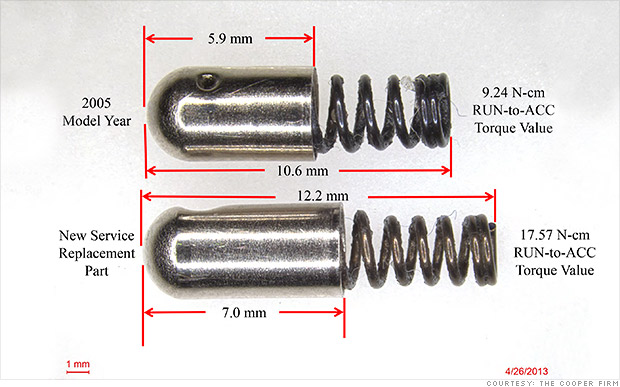
faulty ignition switch unquintessential leader gm general motorsIn 2009, despite years of knowledge about the faulty ignition switch and substantial evidence of conscious coverups by GM employees at every level in the company, GM engineers finally began to internally and quietly increase the torque on the faulty ignition switches.  

(And, despite what GM executives have testified to under oath, these engineers had the consent and knowledge of every person in a leadership position in every department – including the legal department, whose head denied any knowledge of the problem until this year – at GM.

To suggest otherwise is dishonest, which is why it remains to be seen if Ms. Barra will become a quintessential leader or will continue in the unquintessential leadership tradition that has, so far, defined GM’s leadership.)

However, when GM’s engineers made the change to the ignition switch, instead of creating a new part number for the ignition switch with the higher torque, which is standard operating procedure when any change is associated with a part or item to distinguish it from similar parts and items, they used the same part number assigned to the faulty ignition switch. This was clearly an act of deception and dishonesty.

(A simple example of distinguishing similar items by part number is how the part numbers of different wattage light bulbs might read: 40-watt bulb (40WBLB); 60-watt bulb (60WBLB); 100-watt bulb (100WBLB); and, 50-100-150-watt bulb (50100150WBLB).) 

The 2.6 billion recall of GM cars now underway is directly related to this deception and dishonesty. Because the two ignition switches didn’t have unique part numbers, there is no way of telling whether GM car owners have the defective switch or the corrected switch. Therefore, GM is having to replace all ignition switches in all GM cars with that part number.

Ms. Barra has a lot left to prove that she is not the latest GM CEO to be an unquintessential leader. When a CEO, who has insurmountable evidence to the contrary, states about a month ago that “I don’t really think there was a cover-up”, followed  by a lot of justifications and excuses, it is clear that Ms. Barra has absorbed a lot of the GM unquintessential leadership in the 34 years she has been employed there and, even if it’s possible, it will take a lot of time and effort to change what to her is a normal definition of leadership.

As always, it’s easy to look at a big corporation like General Motors and objectively see the unquintessential leadership within that company and shake our heads and perhaps even pat ourselves on the backs because “we’re not like that!”

But are we? Maybe not in all areas. Maybe not on the same scale in terms of causing peoples deaths and tanking corporate profits.

But here’s what we need to remember. Even one instance of unquintessential leadership that we don’t learn from and change immediately or just one unquintessential leadership trait that we are unable or unwilling to change, no matter how few people it affects, no matter the scale of the effects, puts us in the same boat as the unquintessential leadership at GM.

There are no degrees of right or wrong, good or bad, quintessential leadership or unquintessential leadership. It either is or isn’t. We either are or aren’t. 

Therefore, my fellow quintessential leaders, we should take a close and thoughful look at why the people in leadership positions at GM are unquintessential leaders and examine ourselves in the light of the unquintessential leadership traits we’ve outlined today.

How are we doing?

Too often people, whether they are in leadership positions or not, refuse to be accountable and take responsibility for their lives, their actions, and their words. We live in a society that encourages and enables blaming everyone and everything else for issues, problems, and mistakes in our lives. This behavior (trait) is called the blame game. Its presence can be seen pervasively everywhere – globally, organizationally, and personally – we look around us.

When people in leadership positions (and this is increasingly the rule rather than the exception) resort to the blame game, the results can be devastating, destructive, and even fatal (I am working on an upcoming post about the past and present unquintessential leadership at General Motors that includes the blame game as one component). malaysian airlines MH17 attack Ukraine unquintessential leadership

The blame game involves a complex web of lies those who employ it tell themselves. While we won’t discuss all the lies involved, we will discuss the two that seem to weigh the most heavily in the blame game.

The first lie is that we are passive victims of our circumstances and we have no power over changing them. As we discussed in “Quintessential Leadership Practically Applied: If Things Aren’t Working, Then Change Them,” none of us are passive observers and participants in our lives.

Each of us has the ability and the responsibility to take action when issues, problems, and mistakes occur. That is the accountability trait of building trust and being trustworthy.

The second lie is that our actions (or words) are the result of others’ actions (words (i.e., “if they didn’t do/say that, I wouldn’t be doing/saying this”). This is the ultimate cop-out. Our actions and words should never be based on what others do and say or don’t do and say. They should instead be based on our core: character, integrity, and principles that are absolute, moral, and right, no matter what.

To see a current example of the unquintessential leader trait of the blame game, we need to look no further than Russian President Vladimir Putin’s response to the surface-to-air missile attack yesterday (July 17, 2014) on Malaysian Airlines Flight MH17 over Ukraine that resulted in the death of all 295 passengers and crew members on the plane:

Russian President Vladimir Putin“Undoubtedly, the government in whose air space this happened bears responsibility for this terrible tragedy” and “this tragedy would not have happened if there were peace in this land, or in any case, if [Kiev] had not renewed hostilities in south-eastern Ukraine.”

Essentially, President Putin is blaming the Ukrainians who want to maintain their independence from Russian for the attack and deaths of MH17’s passengers and crew.

But the reason there is no peace in Ukraine is because of Russia’s invasion of Ukraine earlier this year, aided by pro-Russian Ukrainians, forcing independent Ukrainians to protect their land and their independence.

In other words, there would be peace (as relative as the term “peace” is on a planet that is strongly disposed to war at the slightest provocation) in Ukraine if the Russians had not broken the peace.

Additionally, data and research into the missile attack has revealed that the missile was provided by the Russians to the pro-Russian Ukranians who launched the attack. While the attack was happening, the pro-Russian Ukranians were in contact with the Russian military (there have been several other downed flights in that air space this past week, but none of the other planes were civilian) and had their approval.

So instead of President Putin manning up (the blame game is a coward’s game) and taking responsibility for the attack (in terms of war, it was a mistake, because they had no way of knowing whether they were attacking a military plane or a civilian plane), he shows his unquintessential leadership by putting all the blame on the Ukrainians who were forced into fighting for their independence by President Putin’s and the Russian military’s action against Ukraine earliest this year.

So, the question for us, fellow quintessential leaders, is are we consistently accountable and take responsibility for the issues, problems, and mistakes in our lives (and that sometimes we alone cause and make), or do we, if not all the time, from time to time, exhibit the unquintessential leader trait of playing the blame game?

How are we doing?

Unquintessential leadership is everywhere. Very few people in leadership positions even know, much less understand what quintessential leadership is. 

When we trace back and see how and when these unquintessential leaders were placed in leadership positions, we often find that the people who selected them were also unquintessential leaders and taught and mirrored the unquintessential leadership traits these people now exhibit. We also find that in most cases politics, personality, and a very limited criteria for selection – often superficial or technical – was applied.

The results of unquintessential leadership are reflected in the teams they are supposed to be leading. These results are devastating: to the teams and to the organizations these teams exist in. And yet the unquintessential leaders are oblivious to their responsibility for the carnage they – to a person, among unquintessential leaders, if there is a problem, it’s always the fault of others (“they turned on me,” “they were unmanageable,” “they were not team players,” etc.) leave in their wakes.

Unquintessential leadership, like quintessential leadership, has cause-and-effect results.

exaggerated sense of self-importance narcissism leadershipOne thing that is common and an overarching characteristic of unquintessential leaders is their own exaggerated sense of self-importance. This manifests itself in both subtle ways and obvious ways, but it’s always at the core of what unquintessential leaders do. Or don’t do.

An exaggerated sense of one’s own important is one of the most dangerous character traits a human being can have. It produces pride, arrogance, disdain, control, and the denigration of everyone and everything around it. It produces disaster and is one of the biggest enemies to what successful team-building looks like (cohesion, productivity, satisfaction, progress, growth, and profitability).

Let’s look at some of the specific characteristics that unquintessential leaders exhibit because of their exaggerated senses of their own importance and what the effects of those are, not only on their teams, but on their organizations – and beyond (if an organization is malfunctioning from within, then it is completely impotent and ineffective outside itself).

Unquintessential leaders are micromanagers. Not even the smallest detail can be attended to or decision can be made without their approval. The irony is that unquintessential leaders excel at minutiae, but they are either incapable or unwilling – or both – of handling the big picture and making big and/or tough decisions.

The effect on their teams is that their teams disengage completely and quit, either symbolically or literally. Oh the people may show up, but they are not there. Why bother? Human beings were given reason, creativity, initiative, and a need to produce, to grow, to reach their greatest potentials. When all of that is stifled or eradicated by micromanagement – which is really a lack of trust – a shell exists, but everything else dies. 

Team members who don’t yet have other options to go to will stay, but they are not there. Team members who have other options leave as soon as they’re able to pursue the new options.

Organizations with high attrition rates always have serious micromanagement problems, which, in turn, means they have a lot of unquintessential leaders in place.

quintessential leaders have a compassUnquintessential leaders try to control, through intimidation, threats, manipulation, coercion, and, sometimes, brute force, their teams. They insert themselves into every aspect of their team members’ lives, both inside and outside the organizational context, and try to wield power over each and every outcome.

The primary effect of this on their teams is resistance. No human being has absolute control over another human being. When this kind of control is exerted among human beings, resistance is the natural result. Interestingly, the net effect of this is the same as that of micromanagement: the team quits, internally and/or externally.

What defies logic for me is that often unquintessential leaders recognize that their teams have quit. When they do, unquintessential leaders then micromanage and try to control even more. It’s absolutely absurd. But I’ve seen it happen over and over.

Unquintessential leaders are inconsistent and unreliable. There is absolutely nothing about them that their teams can count on except that they will be inconsistent and unreliable.

The next effect of this is that their teams have no trust in the unquintessential leaders and the unquintessential leaders have proven themselves untrustworthy.

What eventually happens is that their teams end up bypassing them completely and going to others outside the team construct who’ve proven themselves to be quintessential leaders. Unquintessential leaders get angry about this, but their exaggerated senses of self-importance blind them to the fact that their actions have necessitated that their teams go elsewhere for what they need and require.

Unquintessential leaders are never available for their teams when they need them. They’re either too busy, physically absent, or simply unwilling to put the needs of their teams above their own needs and desires. You can never find them when you really need them.

The effect on their teams is disillusionment, anger, and resentment. The disillusionment, anger, and resentment starts building underneath the surface of their teams, but as this particular characteristic is repeated, that anger and resentment is palpable and evident throughout the team. It becomes something you can discern on a very tangible level in words, in body language, in attitudes. It’s an incredibly destructive force.

These are some of the more obvious results of unquintessential leadership (Qualities of Quintessential Leaders offers a stark and refreshing contrast of some of the results of quintessential leadership).

quintessential leaders changeToday’s question for you and me is simple. Am I an unquintessential leader or am I a quintessential leader?

As always, this is a look-in-the-mirror question for you and for me that requires close examination, brutal honesty, and if you and I are not quintessential leaders, immediate steps to change.

I am brave enough to look in that mirror and do the work of looking and changing. Will you join me?


Building Trust and Being Trustworthy is available on Amazon in both paperback and Kindle versions.

Recent scientific research has revealed that the brain has a special cell – called a “grid cell” – that functions as a global positioning system (GPS), enabling us to continually know where we are in relationship to all the routes we take while physically moving about and storing those as memories that we retrieve when we traverse a route we have already traveled before.

I am not sure I have this neurological GPS grid cell. From my earliest memories, I have been prone to getting lost, not just my first time going some place, but often every time, especially if it’s a place I travel to infrequently. My lack in this area is so pronounced that – and this is rare, but it’s happened enough to give me pause – in the dark, especially, I get turned around in my own house and walk into the wrong room. 

In addition, I’m directionally-challenged. North, south, east, and west are beyond my scope of understanding in real life (I can tell you where they are on a map). If I have to point in a direction, I usually point in the wrong direction. I have to remind myself of my elementary school science that the sun rises in the east and it sets in the west so that twice a day I know where east and west are.

This directional challenge is even worse when I get directions from someone who uses north, south, east, and west as descriptors to explain how to get from point A to point B.

You know just how directionally-challenged you are when you actually prefer a perplexing propensity (probably not unique to northeast Tennessee, but I haven’t run into as much anywhere else in the country as I have here) to use non-existent landmarks and vague measurements with no road names as driving directions that might be less likely to get you lost.

Even when the directions sound like this: “you go down there (pointing in the direction you need to go), and you go past where that big ol’ tobaccer barn useta be, and then you kinda curve around a little, and then you go to the red light, and then you go right, and it’s just a little ways after that.”

So when I bought my first GPS for the car, I was elated.

It was actually very comforting and soothing for me because I tend to panic when I get lost and the fear of the uncertainty of knowing what to do next – if I stay where I am, I’m still lost, but if I move from where I am, then I may get even more lost – has been a permanent fixture of my life since the day I got my driver’s license.

Never again would I have to worry about getting lost again while driving. Because even if I had no clue where I was and where I needed to go, it did and would get me there reliably. I could trust it to navigate me correctly, no matter what.

Quintessential leaders have a similar GPS that doesn’t come pre-programmed, doesn’t depend on satellites hovering above earth’s atmosphere, and doesn’t have to worry about outages because of sunspots or solar flares.

This GPS is developed over time, the product of having an absolute moral foundation of right and wrong, adhering consistently to that absolute moral foundation of right and wrong, and having that adherence become an integral part of who we are and what we do, no matter what.

character gps system quintessential leaderThe quintessential leader’s GPS is character.

Character tells us what our position is no matter what circumstances we find ourselves in, no matter who we’re with, no matter what other factors, familiar or unfamiliar, are involved. It ensures that we accurately and consistently navigate life, no matter where life takes us or what life throws at us.

But there’s always a caveat with global positioning systems that we as quintessential leaders need to be aware of, recognize, and resist.

The first time I turned my GPS on in my car, I was driving from my house to an interstate on a route that I could drive with my eyes closed. Almost as soon as I’d pulled out of my driveway, the GPS started telling me to go to a different road and take a different route to the interstate. I vividly remember arguing out loud – and with vigor – with the GPS.

“I’m not going that way. I always go this way. I know you think I ought to do something different, but I’m not going to. Enough already!”

The more I resisted going the way the GPS was telling me to go, the more it talked to me telling me I was not going the way it wanted me to go. And the more loudly I responded to it, trying to drown out the voice, trying to get it to be quiet, trying to convince it that I was right and it was wrong, it seemed the louder and more insistent it got.

Similarly, we have to be aware that we can do the same thing with our character GPS. It will always lead us and guide us the right way, but we have to be aware that we can chose to ignore it or override it or even turn it off. It won’t force us to do the right thing. That’s a choice we have to make. Every time.

Going or doing something the way we always have gone or done it may not be wrong. However, it may also not be the best way. What our character GPS does is make us actively stop and be consciously aware and thinking about that more carefully as that internal voice guides our attitudes, our motives, our thoughts, our words, and our actions.

How often do we argue with our character GPS? How often do we rationalize doing something different than what it is telling us to do? How often do we make excuses for not following the directions it’s giving us? How often do we completely ignore it? How often do we just turn it off?

I know we all do at times. I know because I am guilty of having done this and doing this at times. Unfortunately, it seems that is part of being human and the struggle that humans encounter continually. Sometimes we struggle well and succeed. Other times we struggle poorly and we fail.

However, as quintessential leaders, our character global positioning systems should be already very well-developed, with updates being applied as they become available, so that, even though the struggles never go away entirely, we experience them less often and when we do experience them, we succeed much more than we fail.

In conjunction with this on-going development of our character global positioning systems, we will find that we are less apt to argue with, to rationalize around, to make excuses about, to ignore, or to completely turn them off.

Instead, we listen, we pay attention and we follow the route without deviation, without detours, and without exceptions. Every time. All the time.

Developing a character GPS takes commitment. It takes time. It takes a lot of effort. It also, often, means going completely counter to prevailing systems, ideas, methods, social norms, business norms, and life norms.

It’s important to remember that just because everybody else is doing something doesn’t mean everybody else is right.

For quintessential leaders, one of the first things we discover is that, in many cases, everybody else has settled for low standards or no standards. That’s hardly something we’d consider a worthy gauge against which to measure ourselves.

Quintessential leaders must dare to be and to do not only differently than the status quo, but also to replace it with the traits that make up our character global positioning systems: honesty, integrity, consistency, fairness, setting a higher standard, righting wrongs, accountability, sincerity, and setting boundaries.

How are we doing?

The mission statement and motto of The Quintessential Leader is simple, but it encompasses the totality of quintessential leadership: “Lead people. Manage things.”

While we’d all like to be quintessential leaders and work with quintessential leaders, the reality is that a lot of people in leadership positions are not quintessential leaders.

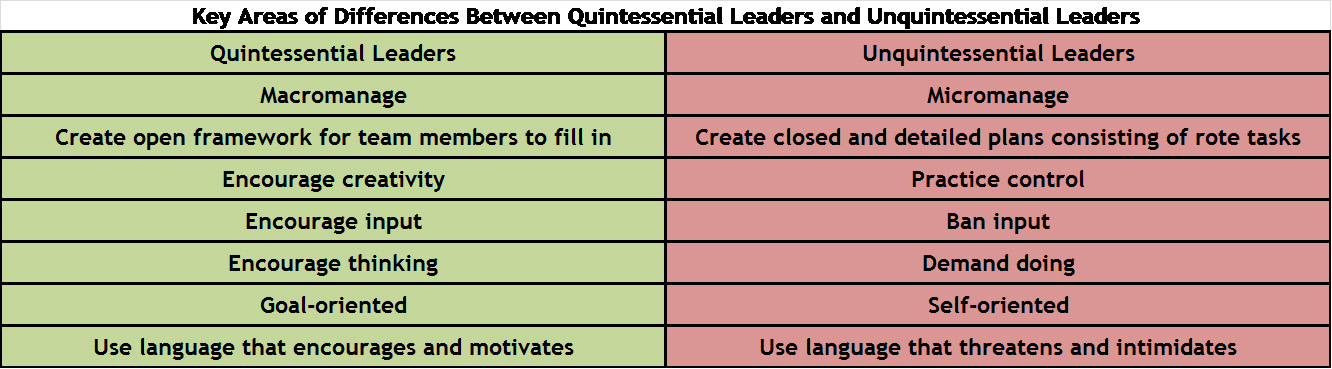
There are key differences that highlight whether someone in a leadership position is a quintessential leader or not. Today’s post will summarize those differences.

Key differences between quintessential and unquintessential leaders

The first difference is that quintessential leaders lead (macromanage) their teams and unquintessential leaders manage (micromanage) teams. 

Let’s talk about micromanagement and why people are micromanagers. The first issue is that micromanagers don’t trust their teams; in fact, it turns out the only people they trust are themselves.

However, what’s ironic about this is that they apparently only trust even themselves up to a point, because if a person really had confidence in their abilities as leaders, they would have confidence that they built and developed a team they could trust.

The second issue with micromanagers is that they are in people’s faces constantly about every little detail and, by doing that, they smother the flow of productivity and they extinguish any initiative or desire to maximize effort on the part of their teams.

The third issue with micromanagers is their constant need to remind their teams that they are “in charge.” This is what dictators and despots do as well.

This, as you can imagine, doesn’t always set well with grown people who are constantly being treated like young children (before all you parents jump on me, I know this has to be done with tiny kids because they’ll run you over in a heartbeat if they don’t know you’re in charge, but you don’t say it all the time and eventually, you don’t have to say it at all).

So how are macromanagers (quintessential leaders) different?

Macromanagers trust their teams. They also respect their teams. Quintessential leaders build teams carefully and well, and they have confidence in the people they’ve chosen: that they will do the right thing and the best thing in all circumstances.

Macromanagers also look at the big picture and that’s where they keep their focus and invest their energy. They know that staying on top of the big stuff will ensure that their teams can progress and be successful. Instead of hindering productivity and squelching initiative, macromanagers fuel the development of their team members by allowing them to own the process.

Macromanagers never say have to say they are in charge. Their teams know macromanagers lead, guide, and direct them – and, if need be, will jump in and work right beside them or save them if they’re in over their heads – but their teams also know that, first and foremost, macromanagers are part of the team.

There’s no “us” and “them” or “you all” and “me.” Instead, there is only “we.”

Another key difference between people who are quintessential leaders and those who are not is in how they approach projects and goals.

Unquintessential leaders always present goals and projects as closed, detailed plans that are set in stone with nothing left for the team members to do except execute rote tasks. This is that mind-numbing work that all of us hate – it’s necessary at times, but no one enjoys it – and it kills enthusiasm and initiative.

It also prevents growth, change, and innovation, ensuring that things continue to be done the same way because that’s the way it’s always been done. This is a death knell to any organization. It may take a while, but the organization will eventually die because it stagnates and becomes obsolete.

framework for goals and projectsQuintessential leaders, on the other hand, always present goals and projects as a framework (much like builders do when they frame a house). This frame has established parameters, major milestones, and what the end result should look like completed, but everything else is in the hands of the team to conceptualize and complete.

Why? Although there are many reasons, I’ll give a couple here.

One reason is to develop the talents and abilities of the team, giving them a safe environment in which to try new ideas – and there will be failures, but each time there is a failure, there is also a learning opportunity – and bring some originality to the table.

The other reason is that quintessential leaders intentionally build their teams with people who are smarter than they are and who know more than they know. They know these people can find better, faster, more efficient, more effective, and more profitable ways to complete goals and projects. And, seriously, what’s the point of having all that intelligence, knowledge, and talent if you’re not going to use it?

A third key difference between quintessential leaders and unquintessential leaders is how they approach their teams.

Unquintessential leaders alway practice control of their teams. They dictate everything to their teams and they don’t allow any deviation from what they dictate. Team members who dare to deviate are resoundingly condemned and usually punished and humiliated publicly as a warning to the rest of the team that unless they stay in line, they will suffer the same fate. 

creativity quintessential leaderQuintessential leaders, on the other hand, encourage creativity. They recognize that each person on the team is unique and brings something unique – that’s why they are on the team! – to the team and to processes. Quintessential leaders also realize that creativity leads to innovation and innovation can lead to positive changes.

Another key difference between quintessential leaders and unquintessential leaders is how they view input from their teams.

Unquintessential leaders, as we’ve seen, know everything already, are in charge, and dictate everything, so it’s no surprise they don’t want any input from their teams. But they go a step further by banning their teams from giving them any input.

The message this sends is that unquintessential leaders don’t even need their teams, but they got stuck with them anyway, so they’re making the best of it by keeping them invisible and quiet.

Quintessential leaders, on the other hand, constantly encourage input from their teams. They know that they don’t have all the answers and they know they’re surrounded by a group of trustworthy and smart and creative people who can work together with them to come up with the right and best answers. 

A fifth key difference between people in leadership positions who are quintessential leaders and those who are not has to do with how they view the minds of their teams.

Unquintessential leaders don’t care what their teams think. They see thinking as dangerous. The way this is manifested is by demanding that their teams do whatever the unquintessential leaders say to do without questioning or thinking about it. And, just so we’re clear, this is what people like Adolph Hitler, Joseph Stalin, Idi Amin, and Robert Mugabe did and do too.

The problem with not knowing what others are thinking is that you really don’t know them at all, so the relationship is, at best, superficial, and, at worst, hostile.

And unspoken hostility is awful to deal with, because although it doesn’t come out in words, there are all these uncomfortable things that you sense and you don’t know why or what they mean and that you touch the edges of without knowing what it is that’s beyond those edges.

Quintessential leaders, in contrast, strongly encourage thinking among their teams. They understand the value of eschewing blind acceptance of anything without proof and conviction.

thinking teams quintessential leaderAnd quintessential leaders also understand that thinking people can help in the process of eliminating bad ideas, wrong ideas, untenable ideas, and unworkable ideas.

Quintessential leaders recognize that none of us exists in a vacuum and, because we’re all prone to making mistakes and missing the obvious, having a thinking team on board can rectify those things before we get so far down the road, investment-wise, with them that it’s very costly and very hard to tear everything down and start over.

The next key difference between quintessential leaders and unquintessential leaders is in what they emphasize and focus on.

Unquintessential leaders always have themselves – how things affect them, how they are treated, how they are perceived, how important they are, and how respected they are – as their primary emphasis and focus. “It’s all about me” is the message they send out over and over again.

Quintessential leaders rarely even think about themselves except within the framework of the team, and their emphasis and focus is always on goals. That means an almost-parallel emphasis and focus is on their teams. Because the team as a unit accomplishes goals. So the welfare of quintessential leaders’ teams is always directly tied to the accomplishment of the teams’ goals. 

The last key difference between people who are quintessential leaders and those who are not is in how they communicate.

Unquintessential leaders overarchingly communicate using language that threatens and intimidates. Most of the time, it’s obvious and in your face, But there’s an interesting phenomenon that occurs sometimes: the threats and intimidation are couched as a sincere desire to help, but when seen as a whole, it becomes obvious what they actually are.

Communication is an area where quintessential leaders tend to be very good. They say what they mean and they mean what they say. However, quintessential leaders always use language that encourages and motivates, even when they’re correcting a problem or coaching a team member whose performance needs to improve. 

The thought I’ll leave you with today requires looking in the mirror at ourselves instead of through the window at everybody else.

Let’s take these key areas and see which side of the equation we fall on. We may be quintessential leaders in all but one of them. Or we may be quintessential leaders in half of them. Or we may be quintessential leaders in less than half of them.

Recognizing and acknowledging honestly where we are is the first step to change. None of us are perfect. None of us are not guilty, somewhere in the course of our lives, of being unquintessential leaders. That includes me.

But just because we were – or maybe still are in some areas – doesn’t mean that we have to stay there. There’s no time like today to start the process of change.

And it is a process. We didn’t get here overnight and we won’t change from where we are overnight.

But we commit to change and we start taking steps forward to put that into action.

There will be falls. There will be setbacks. There may even be a few disasters along the way.

But the key to successful change is to get back up each time and start moving forward again.

If we fall and don’t get up, or if we decide it’s just too hard and too much work and we quit, then we have failed in reaching our potential and our goal of being quintessential leaders. Let’s not fail!