Archive for the ‘Quintessential Leadership’ Category

This last post analyzing the quintessential leadership of Henry VIII will cover the last 11 years of Henry’s life. We will pick up here where we left off at the end of Quintessential Leadership Analysis of Henry VIII – Pt. 2 – 1525 – 1536.

After having Anne Boleyn executed in early 1536, Henry VIII married Jane Seymour. Jane was perhaps, if such a thing existed for Henry VIII, the love of his life. Jane Jane Seymour - Third Wife of Henry VIIIbrought all the qualities of quiet submission, calming influence, virtuous dignity, and careful circumspection that Anne Boleyn lacked to her marriage and to the throne. Her family, as Boleyn’s had been, became ensconced at the royal court once Jane became queen.

While Jane’s character seems to be beyond reproach, the same cannot be said of her two brothers, Edward and Thomas Seymour (who was executed by the Privy Council two years after Henry VIII’s death on charges of treason). The longevity of the Seymour brothers being installed at court shows how mercurial both they and Henry VIII were. Edward and Thomas were good at eliminating their competition, blaming others for mistakes, and twisting things to appeal to increasingly-mentally-unstable Henry VIII. They had no ethics, unlike Jane, who seems to have been quite ethical, much like Catherine of Aragon.

Jane was able to accomplish several important things during her brief tenure as queen. She worked hard to bring Mary I back to court regularly, which enabled Henry VIII and Mary to develop a stronger familial bond. Most importantly, she gave birth to a healthy, live male heir – the one thing that mattered most in the world to Henry VIII. However, the labor was difficult and prolonged, and Jane died on October 24, 1537, twelve days after giving birth to Edward VI.

There are two pieces of evidence that support that Jane Seymour held a special place in Henry VIII’s life. One was that Henry mourned her death for an extended period of time and did not remarry – although Thomas Cromwell was almost immediately searching for marriage prospects for Henry after Jane’s death – for three years. The second was that Henry was buried according to his wishes beside Jane after his death in 1547.

Thomas Cromwell pretty much ran the country during Henry’s period of mourning, and it was in this capacity that he both overreached his abilities and made old enemies greater enemies and made new enemies as well, including the Seymour brothers.

Cromwell was a true religious reformist and saw an opportunity to further the English reformation and strengthen the crown’s coffers by taking over and shutting down monasteries throughout England. A lot of these monasteries had financial and physical assets that made them wealthy, and Cromwell saw an opportunity to both push the religious reform and confiscate those assets for the crown. He assured Henry that there was little to no opposition to it.

Cromwell, aided by the Archbishop of Canterbury, Thomas Cranmer, began a systemic pillaging campaign against all the monasteries. There was organized opposition when the campaign got to the northern part of England, but it was quickly and harshly suppressed by mass executions sanctioned by Henry at Cromwell’s suggestion.

Thomas Cromwell’s undoing came as a result of the marriage he arranged between the German Anne of Cleves and Henry in January 1540. Cromwell touted the beauty of Anne to Henry, while hoping that an alliance with Lutheran Germany would truly bring reform to the English church, but he clearly misread the fact that Henry was thoroughly a Catholic in his dogma and, in true unquintessential leadership fashion,  was just using the church and reforms to achieve his own ends and serve his own interests.

The Anne that Henry met was not the Anne that Cromwell had described to him, and,Anne of Cleves - Fourth Wife of Henry VIII after failing to find a way to void the marriage contract, Henry relented to marry her. However, the marriage was never consummated and was annulled in July 1540.

Henry VIII was generous with Anne of Cleves (she fared the best in life of all his wives) after the annulment, and gave her estates and an income for the rest of her life. Anne and Henry also became good friends and Anne had very close relationships with both Mary and Elizabeth. Anne was instrumental in Henry’s decision to reinstate both daughters in the legitimate line of succession after Edward VI, and she lived to see Mary I crowned in 1553, after Edward’s death.

Henry blamed Cromwell for the marriage fiasco and the enemies that Cromwell had accrued at court saw their opportunity to get rid of him.

Here is an unquintessential leadership trait that Henry VIII possessed. He was always susceptible – perhaps because of his own declining mental health – to believing stories of treason, corruption, and general dishonor. Henry was persuaded by Cromwell’s opponents that Cromwell was a traitor and Henry sentenced him to execution. Cromwell was beheaded, in what by all accounts was a botched execution that required several strokes of the ax before his head was actually cut off, on July 8, 1540.

Cromwell was the most capable, albeit ruthless and unscrupulous, chief minister that Henry VIII had, and Henry later regretted Cromwell’s execution, accusing his ministers of bringing false charges to him about Cromwell to secure his execution.

This is an example of unquintessential leadership as well. Henry VIII consistently blamed other people when things went wrong. He never took responsibility as the ultimate authority in England for decisions that brought consequences he later regretted. We see this trait throughout his life and throughout his rulership of England.

After Cromwell’s death, Charles Brandon, the Duke of Suffolk, and Edward Seymour became Henry VIII’s chief advisers, with Seymour handling the duties of chief minister.

It was just after Henry’s annulment from Anne of Cleves that he married Catherine Howard, the niece of Thomas Howard, the Duke of Norfolk. Catherine was much Catherine Howard - Fifth Wife of Henry VIIIyounger than Henry VIII, which by itself made marriage difficult. But she was also flighty, indiscreet in all things  (including her arrogant and contemptuous attitude toward Henry’s children), and promiscuous before her marriage and had affairs during her marriage – most notably with Thomas Culpepper, Henry’s courtier. These were the nails, so to speak, in her coffin.

She was executed by beheading on grounds of adultery on February 23, 1542. Culpepper had already been executed on the same charges in December of 1541.

After Catherine Howard’s execution, Henry turned his attention toward foreign matters. He had become suspicious of the French and saw them as a contributing factor in Scotland’s frequent insurgencies into the northern part of England. Convinced that Francis was reneging on the Franco-English alliance, Henry decided to break the alliance and form a new alliance against France with Charles V and Spain.

In 1543, Henry also married again. His new wife was Catherine Parr. Catherine and Thomas Seymour had been planning to marry, which Henry was aware of, so Henry sent Thomas out of the country before Henry and Catherine were married. CatherineCatherine Parr - Sixth Wife of Henry VIII seems to have been much like Jane Seymour in her circumspection, and she welcomed and was extremely close to all of Henry’s children, taking the responsibility for ensuring the further education of Elizabeth I and Edward VI. She outlived Henry and died after childbirth in 1548 during her final marriage to Thomas Seymour (they married in secret about six months after Henry’s death).

In 1544, Henry and Charles decided to invade France. England supplied the navy and Spain supplied the ground troops. Henry intended to regain the land that the English had lost previously to France in Boulogne. Conquest proved difficult and Henry’s sieges were abruptly ended by Spain signing a peace treaty with France. Unable to sustain an all-out war, Henry and the English army returned home.

By this time, Henry VIII was in full decline mentally and physically. His Henry VIII near the end of his lifegluttony and lack of activity since a wound in a jousting match that never healed and limited his mobility caught up with him and by the time he died in 1547, he weighed about 400 pounds. He became a virtual recluse and his mental health deteriorated further. It now appears that he may have suffered from a rare genetic disease known as McLeod neuroacanthocytosis syndrome, which may explain some of the severe physical and most of the severe mental decline Henry experienced as he aged. Whatever genetic factors contributed to Henry VIII’s mental and physical problems, however, cannot be blamed for his intrinsic lack of good and right character.

The two things that consumed Henry, when he was well enough, the last two and a half years of his life were his son and religion. When he died on January 28, 1547, he left a son who would inherit the throne – although his reign would be cut short by an early death in July 1553, which would throw the English monarchy and England into utter chaos until Elizabeth I took the throne in January 1558 – and he left religious reforms – an English Bible, for instance – that paved the way for the English and their descendants to be able to read the Bible themselves and reject the erroneous idea that any human and any religious organization must be the intermediary between humans and their God, a fight still being fought today almost everywhere, although not always as overtly or as obviously as within the Catholic faith, in the world of religion.

On the whole, though, when we look at Henry VIII’s life and reign, regardless of what physiological factors may have played a role, we see an unquintessential leader.

He lacked the ability to build trust and be trustworthy.

He never accepted his responsibility for anything, but instead blamed others when things went wrong.

He was arrogant and full of pride and made some very bad decisions in attempts to prove his superiority to his peers, both at home and abroad.

He lacked any self-control in his private life and his public life.

He had faulty discernment of other people, and allowed himself to be manipulated by every kind of deception and dishonesty at every turn, especially when it suited his needs, served his purposes, or otherwise fulfilled the selfish nature that characterized this man. For Henry VIII, the end always justified the means.

He truly, in the end, only cared about how people and things were useful to him. If they weren’t useful, they ceased to exist (literally, by execution, and mentally in his memory).

As quintessential leaders, we need to observe and evaluate ourselves in light of the unquintessential leadership traits we see in Henry VIII. We need to be brutally honest and ask some hard questions as we look into our own mirrors of leadership.

Does the end justify the means for us? Are we willing to do or allow our teams to do anything, regardless of the ethics, the rightness, the morality, to achieve an outcome we want? If so, we’re being unquintessential leaders.

Do we practice or allow our teams to practice or allow ourselves to be influenced by any kind of deceit and dishonesty (presenting false information as true information, spinning information, angling information, omitting key or relevant information, or misinforming for any reason)? If so, we’re being unquintessential leaders.

Do we manipulate, allow our teams to manipulate, or allow ourselves to be manipulated to achieve an outcome we want? If so, we’re being unquintessential leaders.

Are our decisions made to serve ourselves or to serve others? Do we care about what we want more than we care about what anyone else wants or needs? Will we willingly and cavalierly sacrifice – or eliminate – anybody and everybody to satisfy our own wants and desires? If so, we’re being unquintessential leaders.

Are we always blaming everyone and everything else when things go wrong or don’t go the way we had intended or hoped, never taking any responsibility for our roles as leaders in making the decision? If so, we’re being unquintessential leaders.

Henry VIII should make all of us, as quintessential leaders, take a long, serious, and totally honest gut check to see if and where we are guilty of any of his unquintessential leadership traits and behaviors.

It takes courage, which it seems is hard to find in today’s society, to do a deep and honest moral inventory that actually looks at, actually admits, and immediately changes anything in our lives that reveals any unquintessential leadership traits and behaviors.

A lot of people in leadership positions today are cowards, much like Henry VIII was, who hid behind excuses, justifications, blame, and other people most of his life. Cowardice is the path of least resistance and a coward will find him or herself surrounded by plenty of company.

So I ask you, my fellow quintessential leaders, the same question I ask myself on a continual basis. Are you a coward or are you courageous?

A quick review of the week of March 15, 2013 finds further examples of unquintessential leadership already noted with two principles here previously.

The first is Carnival Cruise Lines. After the debacle the week of February 15, 2013 with the Triumph, this week brings stories about three of the cruise line company’s other ships having similar troubles. The Dream, Elation, and Legend cruise ships all experienced technical difficulties this week, and all have had to be either towed, stopped early, or are limping slowly back to port.

Once again, Carnival’s response is to offer insignificant refunds or discounts, instead of taking their whole fleet off the water for whatever time it takes to update the equipment and make the vessels seaworthy and trustworthy. This is unquintessential leadership because these are serious and potentially dangerous, if not fatal, problems andCarnival Cruise Legend Cruise Ship those in leadership positions are unwilling to acknowledge and fix them immediately, no matter what the cost in money or time is. Those in executive positions at Carnival Cruise Lines are unquintessential leaders because they don’t care about the safety of the passengers nor the reliability and trustworthiness of the company. Instead, all they care about is how much money they can make. This is greed and selfishness in action.

The second principle is freshman Senator Ted Cruz. Senator Cruz is a Harvard Law School graduate who should be totally knowledgeable about the difference between an opinion about the U.S. Constitution and what the U.S. Constitution actually says. If he’s not, then Harvard needs take a serious look at its law school curriculum and professors.

On Thursday, March 14, 2013, Senator Cruz, in what has become his customary rude and disrespectful manner toward more-seasoned legislators, argued during a Senate Judiciary committee meeting than a ban on assault weapons is unconstitutional. In a condescending “schooling” session directed at Senator Dianne Feinstein that, in essence, implied that she had no understanding of the 2nd Amendment, so she needed it explained to her, Senator Cruz said that banning assault weapons is to the 2nd Amendment what censoring books is to the 1st Amendment.

It is not, although that’s what the Tea Party and the NRA would like everyone to believe. The 2nd Amendment says: “A well regulated militia, being necessary to the security of a free state, the right of the people to keep and bear arms, shall not be infringed.”

The Supreme Court ruled definitively on the scope of what the 2nd Amendment covers in 2008’s District of Columbia V. Heller, with Justice Anthony Scalia’s majority opinion, which clearly says that 2nd amendment does not preclude banning assault weapons.

The reality is that at the time the amendment was added to the U.S. Constitution, no assault weapons existed, and the intent was to give all U.S. citizens the right to protect their homes, property, and families, and to feed themselves through hunting. It goes without saying that one doesn’t need assault weapons to do either of these things.

So Senator Cruz shows his unquintessential leadership again in several ways. First, he doesn’t even know the body of constitutional law involving the 2nd Amendment, which is unacceptable for a person in a leadership position who is a member of a committee that deals with matters involving constitutional law. Second, he is contradicting, without legitimate basis, the highest legal authority in the United States. And third, Senator Cruz consistently shows contempt and disrespect in his dealings and conversations with his colleagues, many of whom have served much longer – admittedly, probably too long in many cases – in the United States Senate than he has.

These are two news items that caught my attention regarding quintessential leadership – or the lack of it – this week. I urge all of us as quintessential leaders to observe the world around us – and that includes the news – and find mirrors that we can look into and see if we’re being the quintessential leaders we’re striving to be and say we are or there are areas where we are being unquintessential leaders and we need to change.

I’ve certainly seen some unquintessential leadership things in my mirrors this week and I have committed myself to changing them into quintessential leadership. We all have our weak spots and our blind spots and our unquintessential leadership thoughts, attitudes, and actions.

The difference between an unquintessential leader and a quintessential leader is that unquintessential leaders always look through windows, so they never see what they need to see about themselves, only what others need to do or change or be.

Quintessential leaders, on the other hand, look into mirrors and when they see the reflections of themselves, they see what needs to done, changed, or who they need to be, and they immediately commit to and start taking action to make that happen.

So my question to you, fellow quintessential leaders, is are you looking through a window or are you looking into a mirror?

In a follow-up to last week’s post on CPR and quintessential leadership regarding the action of a Brookdale Senior Living nurse refusing to do CPR on 87-year-old Lorraine Bayless, I saw this news article today where Brookdale Senior Living, which initially backed up the nurse’s refusal to do CPR as being consistent with company policy, has now reversed their position.

The statement says that the incident “resulted from a complete misunderstanding of our practice with regards to emergency medical care for our residents” and that the nurse had “misinterpreted the company’s guidelines.”

This further shows the unquintessential leadership in place at Brookdale Senior Living. First is the “reversal” of a policy that the company defended and stood by several days. Second is the subtle shifting of the blame to the nurse for the lack of medical attention. And the third is the minimalizing language Brookdale Senior Living uses in their reversal statement. To characterize this incident as “misunderstanding” or “misinterpretation” is to basically say it’s not a big deal, even though that misunderstanding and misinterpretation led to somebody’s death.

All of these show just how entrenched the unquintessential leadership is at Brookdale Senior Living. As I said before, it would be naive to believe this is the only senior living company where practices and policies like these are in place and unquintessential leadership is extant through the ranks within the corporation.

But it should serve as a warning and a caution to those of us entrusted with being quintessential leaders in helping our parents as they age to ensure that we’re providing the best and most care for them, as they did for us when we were babies, helpless, and completely dependent on them. These companies, despite their claims, really don’t have “our residents” as their priority. It is about money (greed) and the law (minimum legal liability).

These are driving forces that the unquintessential leadership in these companies come from, along with the lack of character, integrity, ethics, and moral responsibility that many of the individuals that are employed by these companies possess.

No doubt by now everyone has read and/or heard about Colleen, the nurse who Brookdale Senior Livingrefused to do CPR on an 87-year-old woman who collapsed in the dining room of Glenwood Gardens, a Brookdale Senior Living facility located in Bakersfield, CA. The elderly woman later died at a local hospital.

The partial transcript of the 911 call is almost unbelievable, especially in the nurse’sGlenwood Gardens - Brookdale Senior Living - Bakersfield, California refusal, with her boss concurring with her refusal, to let the dispatcher talk someone – anyone – else through doing CPR – saying it was against company policy – to aid the elderly woman, who was barely breathing.

After reading this story, I contacted a friend of mine who is the director of nursing at the Brookdale Senior Living facility where my mom lived until she came home to live with me until her death. I asked if this was really company policy. She confirmed that it was.

Even though my mom had a DNR, so this would not have applied to her, I told my nurse friend that I didn’t remember anyone telling us that during the admissions process, since that would be something that should be clearly stated at the outset for people considering a Brookdale Senior Living facility as a choice for themselves or a family member.

She said she had brought that up to the admissions person there who basically said that telling people wasn’t required because it was explicitly stated in the mountain of paperwork that was signed and given at the time of admission. I admitted I hadn’t read every word of mine because my sister and I asked all the important questions we needed answers to during the admissions process, but that I didn’t think that was a responsible answer, because that, for a lot of people, would be a deciding factor in determining living arrangements.

I then asked my nurse friend what she would have done. She said she didn’t care what the legal issues were because this was a moral and ethical issue and she would have broken the company policy and put her employment in jeopardy to do the CPR. She made an interesting statement about how she would not be able to live with her conscience if she could help someone and didn’t. She also reminded me that in nursing school, she took The Florence Nightingale Pledge, which is similar to the Hippocratic Oath that doctors take, which includes the intent of doing no harm to those in their care. 

So what does this have to do with quintessential leadership or the lack of quintessential leadership? Everything.

We’ll start with the nurse because it’s the easier of the two to clearly see a lack of quintessential leadership. As a nurse, she took the same pledge my friend did. The welfare of that 87-year-old lady – even if any efforts at CPR didn’t, in the end, save her life – should have been her only concern. The dispatcher gave her an opportunity to let somebody else do CPR and the nurse refused everything. She lost – or maybe never had – the vision of what being a nurse means. At the very least, her nursing license should be immediately and permanently voided in all 50 states.

Brookdale Senior Living is also being operated and run by unquintessential leadership. That this policy is in place at all, in assisted living facilities, is not only absurd, but reprehensible and irresponsible. But the company’s unquintessential leadership goes far beyond this one incident.

It is important to take a big-picture look at this company – and all others like it – to see what their priorities are (I know a lot about Brookdale Senior Living, which is why I am singling them out, but it would be naive to say they are the only senior community company that has these policies and operating models). While seniors and their families are encouraged to believe that these companies care about them and put “our residents first,” that is, in fact, not the truth. What these companies care about most is profit (the monthly charges, for the bare minimum of services, start around $5000 in the south, so it makes sense that it’s much higher in other parts of the country) and no legal liability. If the residents happen to fall in the mix pleasantly, that’s okay, but if they don’t, then the company comes first.

The lack of honesty and the greed and self-interests of the companies are all unquintessial leadership traits. So, buyer beware, which quintessential leaders don’t have to worry about, applies to anyone considering one of these facilities.

Brookdale Senior Living lacks quintessential leadership in many areas beyond this, based on my experience with them and subsequent first-hand knowledge that I have had of their activities. They have policies in place that don’t protect the residents, the interests of the residents, and the families of the residents. And the puzzling part of this is that some of these policies leave them wide open for lawsuits, if someone wanted to pursue them.

In my mom’s case, while she was living there – and this precipitated (among other things affecting her health that I had discussed and been promised over and over would be done and never were), after Mama emphatically told me she wanted to live with me and didn’t want to go back there, Mama coming home to live with me until her death in August of last year – she had a very bad fall in the middle of the night.

(I don’t know what happened in Mama’s brain during the month between her diagnosis with vascular dementia and the hospitalization in a geriatric psychiatric facility after a couple of the most bizarre weeks of her life and my twin sister’s and my lives, but the first thing I noticed on my first visit with her there was that she was suddenly turning around counter-clockwise. Because of that, she would lose her balance. That became her way of turning her body, and as the diseases – Lewy Body dementia was also present – worsened and her balance in general got worse, she was more prone to falling.)

The problem – and quintessential leadership failure – was that I didn’t hear about the fall until 8:30 the next morning when I called Mama to tell her I was on my way (I was there every day, often for hours at a time, just to keep an eye on things and make sure she was okay) and she told me she’d fallen and her ankle was hurting badly. I was livid as she told me that a CNA had come in and found her on the floor, asked her if she was okay, and when Mama said she was, lifted her up and put her back in bed.

The unquintessential leadership in this scenario abounds. The first is asking someone, who, by the way, had a serious hearing loss and did not have her hearing aids on, with dementias and Alzheimer’s Disease to accurately assess her condition. The second was not calling EMS to take her to the emergency room to check for broken bones (fortunately, she didn’t break anything, but she had a serious ankle sprain), then call me to tell me to go to the ER. The third was the CNA moving her without confirmation that nothing was broken.

I got calmed down enough to go in and talk with the director of nursing, because I had explicitly said early on that if anything happened to Mama, I wanted to know immediately, no matter what time of the day or night it was. It was in the record and it wasn’t done. I got a lot of excuses about why the CNA didn’t call – also unquintessential leadership – but finally the director of nursing agreed that she should have and told me she’d get mobile x-rays done just to make sure Mama was okay.

I ended up spending almost two weeks pretty much living there with Mama to ensure she was healing and safe (I understood that it was assisted living, so I couldn’t expect someone other than me to be there 24/7).

About a week after that, I went in early one morning – several people had been in and out of the room and Mama had gone to breakfast, so a lot of people had an opportunity to observe her – and I immediately noticed she was having a really hard time breathing. The fact that no one else saw it or said anything to me about it was unquintessential leadership. I got her to the doctor and the determination was either pneumonia or the beginnings of congestive heart failure.

The doctor treated it as pneumonia since the chest x-ray seemed to indicate that, but it was in fact congestive heart failure, which landed Mama in the hospital a week after that (she’d been staying with me that week and I grew more concerned as I saw her breathing getting more and more labored). It was after that hospitalization that Mama came to live with me for good.

I didn’t blame all of Mama’s issues with high blood pressure and congestive heart failure on the Brookdale Senior Living facility. It wasn’t all their fault. However, the lack of quintessential leadership at the facility definitely contributed to Mama’s condition.

Her doctor had ordered a very strict diet to try to deal with blood pressure and weight and I had talked to everyone there for about a year trying to ensure that the diet was followed.

Everybody from the top down gave me lip-service that they would follow the doctor’s orders, but no one followed up and no one ensured it was done. I saw time and again, with my own eyes, that it wasn’t being done. Each time I brought it to the attention of those in leadership positions there, I heard blame and then the same old promises, which were never kept.

That was unquintessential leadership on so many levels.

But the most unquintessential leadership story that I heard about this particular facility was recounted to me (and I will not recount the details here to protect the person, who is a good friend, who told me in excruciating details one of the most horrific stories I think I’ve ever heard in my life) months later and it is damning evidence that Brookdale Senior Living is under unquintessential leadership from the very top down.

This story involved a serious medical emergency with a resident – whom Mama and I both knew and who was vivacious, healthy, and said to me every time she saw me, “I just love your little mama” – brought on by a criminal act by another resident, that occurred on a Sunday morning. The registered nurse was asked to call 911, but instead of calling 911, the RN started trying to call the executive director and the director of nursing. Finally, because the RN wouldn’t call 911, one of the staff members did.

The resident with the serious medical emergency was transported to the hospital, where she died a week later. The staff member told 911 what had happened, but immediately the RN started disputing her story. The executive director finally came in and the cover-up of what actually happened began in earnest. The staff member was put on notice because she’d “broken the chain of command,” which she had not, but the RN, who was at the top of the chain of command, didn’t do what she should have done, which was to have called 911, and then called facility leadership to let them know what happened.

The family was lied to about what happened and the circumstances under which it happened. No action was taken against the resident who committed the criminal act, which jeopardized every other resident still there. And eventually the staff member who did the right thing was fired for insubordination.

You might wonder why and what all this has to do with us as quintessential leaders. The answer is “everything!” This is both a strong caution for those of us who are now the quintessential leaders who are entrusted with our aging parents’ care and for those of us who are striving to be quintessential leaders in every aspect of our lives.

This is what unquintessential leadership looks like in action, with specifics that have broad application throughout our professional, personal, and spiritual lives. As quintessential leaders, we have the responsibility to ensure we are not following in the footsteps of the examples given above. Please be sure to read an excellent companion blog article to this one entitled “Quintessential Selfishness.”

That requires us to have the commitment, the determination, and the courage to do the right thing all the time, no matter what the personal cost is to us. It requires us to have an immovable and unshakable moral and ethical foundation that is the basis of everything we are, we do, we say, and we think. It requires all the components of Building Trust and Being Trustworthy to be an active and living part of our very beings all the time.

It’s prudent to look in the mirror quite frequently and make sure we are the quintessential leaders we say we are and are striving to become better at. Too often, we can all get lazy or complacent and believe, as Paul Simon so eloquently wrote, “that we’re gliding down the highway when, in fact, we’re slip slidin’ away.” 

Today’s post has been on my mind quite some time, as I’ve spent a lot of time observing, processing, analyzing how prevalent groupthink has become and how the majority of people, it seems, have adapted that as the norm, and, in the process, just checked their brains at the door.

It’s important to remember that the brain is part of the body and it must be exercised just as the rest of the body is exercised to stay sharp, to stay aware, and to be discerning.

It doesn’t mean that every thought we have is right. But how do you know for yourself what right and wrong thinking is, if you’re not thinking at all? It doesn’t mean that every conclusion we draw from thinking is feasible, doable, or practical. But, again, how do you know for yourself whether conclusions – yours or others – are feasible, doable, or practical if you’re not in the habit of thinking in objective terms about costs and benefits, pros and cons, and outcomes?

We are becoming a society that is content to let others do our thinking for us. And there are a lot of individuals and organizations that want to do our thinking for us. It seems that most of us prefer to just go with the flow and agree to whatever all the things we’re attached to in our lives tell us are right, good, and true. And that’s a very, very dangerous place to be.

As quintessential leaders, we must be on constant guard against groupthink and what it conveys about trust and trustworthiness. My book, Building Trust and Being Trustworthy, is an in-depth discussion of the components that make up building trust and being trustworthy. Get your copy today!

There is not a human being on this planet who can afford not to know and understand this subject. Too many people don’t. That is, in part, why we are seeing the dominance of  groupthink – enforced and accepted – and we are seeing a steep and rapid degradation in moral and ethical standards everywhere we turn.

As a refresher for those who may not have read George Orwell’s 1984 – a book that I also believe should be required reading for everyone on the planet – let me briefly define the idea behind groupthink.

Groupthink, generally, refers to a collective of people all thinking the exact same thing, with no deviation. The underlying desire and professed aim is harmony and unity, so to avoid possible disruption of that, individuals are discouraged and sometimes threatened from objective analysis and truth and proof tests of the accepted thinking.

Loyalty to the group is emphasized over everything else, including truth, and any questioning of the group thinking is seen as disloyal. Therefore, all creativity, all objective analysis, and all truth and proof testing is squashed and, if it occurs, the individual is deemed dangerous and untrustworthy.

The problem with groupthink is that when bad ideas, old ideas that didn’t work the first time around, wrong ideas, unworkable ideas, not-very-smart ideas, and untrue ideas come in, since no dissension, no checks and balances, no questioning is allowed, they become part and parcel of the working body of information within the group.

And bad groupthink becomes badthink and the derailing of the entire group has begun.

Individuals in this environment, such as Orwell’s Winston Smith, know that their mental – and these are rarely, if ever verbalized, and when they are, they are verbalized very, very carefully (if you watch The Tudors, think of how Thomas More handled a groupthink he was not a part of – I would definitely take the same road he took until I was left no choice, as he was not, and then I’d lay it out as concisely and concretely as it has been written and rewritten in my thinking ) – reality checks, proving, testing for truths are very dangerous and that elimination – whether literally with their lives or symbolically by being cast out and banned from the group – is inevitable. There is no other outcome at some point. It’s an accepted fact.

Why is groupthink such a powerful card that some people in leadership positions want to play? Why do they play it? What does it say about trust and trustworthiness? What does it say about respect?

Groupthink is imposed because of fear. Fear of losing power, fear of losing stature, and fear of being proven wrong. It is imposed as a means of complete control. It says to those its imposed upon that they are not trusted and they are not trustworthy. It also says they have no value and, therefore, are not worthy of any respect.

However, you’ll never hear those reasons stated out loud. Instead, you’ll hear words like “loyalty,” “unity,” “collaboration,” and statements about “being on the same page.” There is always a certain amount of coercion and guilt that accompanies these words and statements that play on the emotions of a species – that’s us humans – who have a strong desire for connection and attachment to other humans. And the possible deprivation of that is why groupthink is so powerful for a lot of people and why society accepts it, in general, hook, line, and sinker.

There are way too many examples of groupthink and its repercussions in our society that is literally saturated with it now to discuss them all here.

Marissa Mayer - CEO - Yahoo!But the story about Marissa Mayer’s banning of telecommuting at Yahoo! this week encapsulates groupthink in such as way that it put the icing on the cake of my thinking about this subject for me. I’ll give a few examples of why.

One of the banes of groupthink is the reintroduction of archaic and unfeasible ideas from the past repackaged and remarketed as “new and fresh” thinking. It really shows outdated and stale or no thinking, and it shows the absence of quintessential leadership.

I’ve read widely on this decision by Mayers and have been thinking about it a lot with my own professional background in technology. It makes no sense for a lot of reasons.

Yahoo!’s business, as are all high-tech companies, is encompassed by mobile computing – having the technology to do whatever you need to whenever it needs to be done. Its benefit is specifically what she is banning in this memo.

The everybody-has-to-be-in-the-same-physical-location-or-nothing-will-get-done is not only an archaic idea, but it also has been proven untrue.

Telecommuting workers, on the whole – if you’re lazy telecommuting, you’ll be lazy at an office – are more productive and contribute a higher yield of results to companies because they’re not in an office, going to meetings all day, answering inane phone calls and emails all day, listening to their coworkers talk – and much of that talk is not about work – all day.

Meetings can still take place, face-to-face, with current and emerging technology, so nothing’s lost if someone needs that face time. To say otherwise is dishonest. I say that because I’ve heard this as the kingpin argument too many times and it’s simply untrue.

But the meetings tend to be focused and shorter and not the colossal wastes of time that most meetings in the office are when all the disorganized thinkers who also have a penchant and need to talk out every single random thought in their heads take over and kill productivity for hours at a time.

Telecommuting also represents a huge reduction in overhead for companies and for employees. For companies, it means less equipment, less office space, and less office consumables, which represents a significant cost savings and a better bottom line. Employees save money and time – that they can spend working – by not having to drive, often, long distances to an office. Employees are also eligible for tax benefits by having and maintaining a home office. It’s a win-win situation.

Mayer’s contention that Yahoo!’s employees will be more collaborative, more innovative and more productive by all being in the same physical location is badthink.

The reality is that if employees aren’t productive, collaborative when the need arises, and innovative as telecommuters, then they will not be productive, collaborative, or innovative anywhere else. That’s a skill set issue, not a location issue.

But what Mayer misses in this edict is the lack of quintessential leadership that has been in Yahoo! for years. If those in leadership positions don’t communicate vision, don’t develop and communicate strategies and goals, then all the employees basically end up doing their own thing, whether they are working from home or working at the office.

Instead of Mayer taking ownership for her responsibility as CEO – and admitting the lack of quintessential leadership in the past – she is essentially blaming Yahoo!’s problems on the employees. That is badthink and that is unquintessential leadership.

Another aspect of groupthink in the Yahoo! example comes from Mayer’s “one-size-fits-all” perspective. That is not only a foolish perspective, but it is an unquintessential leader perspective. Mayer is clearly an extrovert. She thinks like an extrovert. She acts like an extrovert. And she expects everyone in Yahoo! to think and act like an extrovert.

Mayer gets her energy from interaction with other people. She took only two weeks of maternity leave when her son was born last year and got back into the office, where she was surrounded by a lot of people. And that’s fine, because that’s what extroverts do.

However, with her faulty groupthink – which is believing all her employees will be energized by all the people around them 10-12 hours a day – she doesn’t realize that an inordinately high percentage of people in technology are introverts. Introverts get drained quickly of resources by a steady and continuous stream of people interaction and it reduces their productivity, innovation, and collaboration.

So here’s an example of the result of badthink. The introverts who are forced to come into the office now will not be roaming the halls, sharing lunches with their colleagues, or all the other random “here’s-a-spark” encounters that Mayer envisions happening when everyone’s onsite. Instead, the introverts will hole up in their cubes, earbuds and iPods engaged, and work alone. If they venture out for food, drink, and bathroom breaks, they will choose times when they are least likely to be hung up, and the food and drinks will come back to the cube with them.

And they’ll be somewhat less productive, somewhat less inclined to spend extra time working on projects, and very unhappy. What will most likely happen at Yahoo! because of this new rule is that they will lose some of their best employees, who will go to other high-tech firms who recognize the value of telecommuting.

Mayer will be left, then, with the same telecommuters who didn’t work when they were at home, but now they’re in the office not working, and she’ll also be left with a lot of disgruntled employees, who would normally be good workers, with morale issues because even if they haven’t telecommuted, they always knew it was an option if something unexpected came up, and now they’ve basically been told “come to the office or else.”

Groupthink is something that we as quintessential leaders must be aware of, must resist, and must ensure is not how we lead our teams. It’s a subtle enemy. It’s a dangerous enemy. It’s a destructive enemy. 

There have been a lot of examples of unquintessential leadership in this week’s news, and I will highlight the ones that have caught my attention – some you may be aware of and others you may not be – and give a brief summary of each of them with links so you can review the stories yourselves and glean the lessons from each of them that we, as quintessential leaders, must always be diligent to look for and learn from.

Lance ArmstrongThe first story is the news, which, frankly, is no surprise to me, that Lance Armstrong has refused to meet with the U.S. Anti-Doping Agency (USADA) and testify under oath about his use of illegal substances during his career as a professional cyclist. In light of this development – which was a necessary step in his path to be able compete athletically in any sport and any hopes of redemption from his fall from grace – it seems to bear out that all that he said in his interview with Oprah Winfrey last month was nothing more than lies accompanied by crocodile tears. Purely unquintessential leadership on every level with this man.

Another unquintessential leadership story that caught my Alex (A-Rod) Rodriguez - New York Yankeesinterest this week was about Alex Rodriguez, third baseman for my favorite baseball team, the New York Yankees. Joe Posnanski does a very good job of showing the unquintessential leadership traits that have led to his demise, not only as a baseball player, but as a role model for young kids playing the game of baseball. Mr. Posnanski lists several things that contributed to where A-Rod finds himself now, but from a quintessential leader point of view, three character traits – pride, cheating, and dishonesty – are at the core of what makes Alex Rodriguez an unquintessential leader.
Another unquintessential leadership news story from this week was the revelation that the FBI – anyone who knows the real history of the FBI from its inception and anything at all about the tactics of its first director, J. Edgar Hoover, should really not be surprised by this latest story – has a lot of employees using government-issued equipment to engage in sexting. Not only is this behavior immoral, but it’s also illegal under federal law, which the FBI is the enforcing agency of.

The next instance of unquintessential leadership to get a lot of press this week has global implications, as well as terrorist implications. Government systems and corporate systems were the target – from China and Pakistan to the U.S. and from the U.S. to Iran (that we know of). This high-profile story also introduced the general public to a new term – spear phishing – which is already well-known in the cyber security field. In general terms, the unquintessential leadership behavior is hacking or trying to hack computers and networks.

Hacking – one famous hacking group is Anonymous – involves several unquintessential leadership traits: the deliberate breaking into and breaching, if possible, of computers and networks; distributing malicious or harmful software to either steal information or destroy information or incapacitate the computer or network; and, a lot of pride and arrogance in taking credit for the breach.

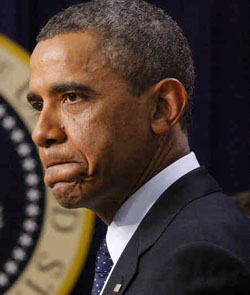
President Barack ObamaThe last unquintessential leadership news story I’ll cover for this week is the looming sequestration if President Obama and the US Congress don’t reach a budget agreement.

While both sides bear responsibility for the lack of an agreement, President Obama, as Commander-in-Chief, has shown an unquintessential leadership trait side of his introverted temperament – he’s an INTJ –  which I also am, so I understand what’s happened and why, but the unquintessential leadership aspect of his decision is a faulty cost-benefit analysis.

When INTJ’s have done everything in their power to try to resolve, negotiate, change, and conclude an impasse or breach, whether with an individual or a group of individuals, and nothing happens, as their energy levels get depleted and they get tired of hitting their heads against a brick wall, so to speak, they do a cost (how much am I putting into this?)-benefit (what is the best I can expect as a result?) analysis, and if the cost outweighs the benefit, they stop, close the door, and walk away for good.

Once that door is closed, it can’t be reopened, because the INTJ has moved on to things he or she can resolve, negotiate, change and conclude, and the last effort is no longer a part of their lives, literally. It’s over. Period.

That’s a part of the temperament and it drives all the other people in our lives crazy because it’s the only temperament that does this and none of the other temperaments understand it. Trust me, I’ve heard it enough to know it doesn’t make sense to anyone who’s not an INTJ.

That appears to be the point that President Obama has reached with the U.S. Congress.

The problem here with the lack of an agreement and the possible automatic sequester is that whatever the cost is to President Obama personally, it does not outweigh the benefits of continuing the resolution process, the negotiating, the change,  and successful conclusion needed to get past the breaches and impasses that exist. One of the traits of quintessential leadership is understanding that the needs of the many outweigh the needs of the one, and as the leader of the United States, President Obama needs to remember – and keep at it, now matter how it affects him personally, because this is the job that he has – the needs of the American people outweigh any personal needs that he has.

President Obama doesn’t get the luxury of being an ordinary INTJ where the stakes aren’t all that high if he walks away for good. At least not until 2017.