Posts Tagged ‘quintessential leader’

This is very important for us as quintessential leaders and for our teams, so be sure to read this last review on The End of Absence: Reclaiming What We’ve Lost in a World of Constant Connection by Michael Harris.

Going Gentle Into That Good Night's avatarGoing Gentle Into That Good Night

The Visual InternetThis is the last of a three-part series of reviews that I am writing on The End of Absence: Reclaiming What We’ve Lost in a World of Constant Connection written by Michael Harris in 2014.
The End of Absence: Reclaiming What We've Lost in a World of Constant Connection by Michael HarrisIn “Part 1 – ‘The End of Absence (Michael Harris) Book Review,” we looked at the definition of absence and how it relates to our quality of life.

We also discussed how constant connection to technology is eliminating absence from our lives, and in the process, rewiring our brains with dementia-like characteristics. It is a lifestyle dementia that we are consciously creating by choosing to live in a world of constant connection.

We also discussed how the disappearance of absence is also causing the disappearance of our ability to think, to to reason, to plan, to dream, to create, and to innovate. In short, we’re trading the depth of real life, with all its hills and…

View original post 2,924 more words

Why Personality Types Matter When Building TeamsImagine a world in which every other person alive is exactly like you in how they are: thinking, speaking, and doing. With your temperament, your strengths, and your weaknesses. With the same things that can make you irresistibly charming (let’s all, since this is fantasy, go ahead and pretend that we have at least one quality that people find charming about us) and obnoxiously annoying. Everywhere you turn, you see an exact clone of yourself.

Do this sound like a great dream or an awful nightmare?

For me, it’s an awful nightmare. (more…)

This is the 2nd part of the review of Michael Harris’ “The End of Absence: Reclaiming What We’ve Lost in a World of Constant Connection.”

As quintessential leaders, this not only affects us but the teams we lead. One of our roles as leaders is to model and coach our teams. If we’re constantly connected to technology, then that is the example we are setting for our teams.

And it’s devastatingly detrimental to us and to them.

Going Gentle Into That Good Night's avatarGoing Gentle Into That Good Night

information superhighway going gentle into that good nightThis is the second of a three-part series of reviews that I am writing on The End of Absence: Reclaiming What We’ve Lost in a World of Constant Connection written by Michael Harris in 2014.

The End of Absence: Reclaiming What We've Lost in a World of Constant Connection by Michael HarrisIn “Part 1 – ‘The End of Absence’ (Michael Harris) Book Review,” we looked at the definition of absence and how it relates to our quality of life.

We discussed how absence gives rise to critical thinking, problem-solving, short-term and long-term planning, concentrated focus, and creativity.

We also discussed the physical, emotional, and mental benefits of absence.

And, finally, we discussed how absence has been eroded by our constant connection to technology to the point that it is virtually extinct in our current society.

We discussed how this has dumbed down society as a whole and how susceptible that makes us to being controlled, manipulated, and deceived by technology.

And, finally, we looked at how much…

View original post 3,075 more words

As quintessential leaders, we need to be aware of how constant connection to digital technology negatively affects us as leaders and the people on the teams we lead.

If we don’t understand what this looks like and how it manifests itself and we don’t find a way to ensure that we have a balance between real life and digital life, then we will not be able to be quintessential leaders. It’s that simple.

Going Gentle Into That Good Night's avatarGoing Gentle Into That Good Night

internet going gentle into that good night neurological changesThis is the first of a multipart series of reviews that I will write on The End of Absence: Reclaiming What We’ve Lost in a World of Constant Connection written by Michael Harris in 2014.

I have written on the main point of Harris’ book in “Dementia of the Preoccupied: How Multitasking and Being Attached to Technology 24/7 is Creating A Dementia Effect on Society” and “The Quintessential Leader Perspective On the Art – and Beauty – of Silence,” which everybody should take some time now to read.

The End of Absence: Reclaiming What We've Lost in a World of Constant Connection by Michael HarrisI would also highly recommend that everyone read The End of Absence: Reclaiming What We’ve Lost in a World of Constant Connection. At about 200 pages, it is completely doable for the shorter attention spans (one of the side effects, as I’ve noted and Harris notes, of a life immersed in digital technology).

Michael Harris and I…

View original post 3,183 more words

forgiveness quintessential leader

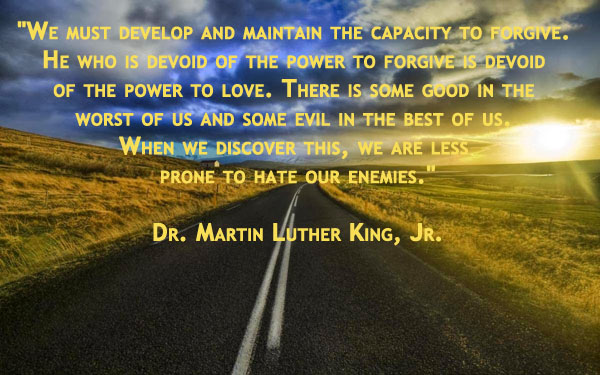
Of all the things that we humans are called upon to do, it is my opinion that real, genuine, authentic forgiveness is one of the most difficult. Humans, by nature, get a certain perverse enjoyment out of nursing grudges against others, holding on to wrongs done to them, and feeding what they believe is eternal and justifiable anger toward other people.

It doesn’t make any sense logically, objectively, or rationally because, in the end, unforgiveness causes a lot of self-inflicted pain that can sometimes last for the rest of a person’s life.

Because here’s the irony of being unforgiving.

No one suffers but the person who can’t or won’t forgive. The people who wronged the unforgiving go on with their lives, unaware of, perhaps, or, more likely, uncaring about the effect their behaviors. (more…)

martin luther king 1966

“Change does not roll in on the wheels of inevitability, but comes through continuous struggle.”
Dr. Martin Luther King, Jr.

The Greek word agōnízomai, from which the English word agonize comes, means to struggle intensely. Real change involves real agony. As Dr. King so astutely observed, change is not inevitable.

Inertia is our natural state. Inertia is comfortable. But inertia is also stagnant. Too often, we settle for inertia as our state of being because it’s easy and because that’s the way we (or someone before us) have always done things, have always thought about things, and have always been.

Inertia, as all of us who’ve studied physics know, requires a lot of force to overcome. But, for change, the force comes primarily from within us in the elements of desire, choice, and action combined. (more…)